[### Reel A0856 - Page 0547 ###]
DIVIDER
ORIGINAL COPY SUPPLEMENT TO MARCH HISTORY 1ST PATHFINDER SQ (M) PROV
Property of B Frank Watson, Capt AC, 391st Bomb Gp (M), APO 145.
[### Reel A0856 - Page 0584 ###]
SQUADRON WAR HISTORY FIRST PATHFINDER SQUADRON (M) PROVISIONAL OF THE NINTH AIR FORCE
SUPPLEMENT NUMBER ONE TO THE HISTORY FOR MARCH 1945
Submitted by:-
B FRANK WATSON,
Captain AC,
Squadron Historical Officer.
20 May 1945
[### Reel A0856 - Page 0588 ###]
INTRODUCTION
The History of the 1st Pathfinder Sq (M) Prov was first written by 1st Lt A A Riede AC who was a member of one of the three crews that were selected on 12 Jan 1944 from the 322d BG to study Pathfinder tactics. In the Squadron War Diary previously submitted he tells of the practice runs with the first plane, a B-26 (903), and writes about the events preliminary to the "activation" of the Provisional Squadron on 16 Feb 1944. The order gives the date of 15 Feb 44 He describes the trials of the young provisional squadron in struggling to exist as a combat unit without a Table of Organization. It was almost a case of "scrounge or die". The diary was continued by 1st Lt Francis V. Lindon AC who very full covered the daily life of the Squadron during February. Beginning with March there is a tendency to continue the diary as a combat mission diary without the very interesting history and comment found in the earlier issues. As time went on and others wrote the Diary, the emphasis on the crew and the target was continued. The account of the organization, supply and functioning of the various sections under the provisional set-up was omitted.
Each month of the Diary included a statement of the Loading List and a list of the names of the men receiving Decorations and Awards during the month. The Loading List was taken as of a certain date and it showed all crew members as a part of the crew with which they flew some missions. As individuals might be assigned to different crews on different missions, there was a certain variation in the list during the month. For instance, although the Loading List for the month of March, 1945 shows that Capt W L Smith was Bombardier and Sgt W B Rizzo was Eng Gunner on Capt F H Jones' crew, actually, the Bombardier was 2Lt W L Hoenshel and the Eng Gunner was S/Sgt W D DeCew at the time the plane was shot down over Germany on 2 March.
Notes. 1. Hq IX BC 13 Feb 44 GO 28 App Exh "A"
This Supplement to the March History is written with the thought that it may give an experience record that will be useful for future Historians or Researchers. The undersigned Historical Officer came to the 1st Pathfinder Sq (M) Prov on 19 Mar 1945. Before that date, the Squadron War Diary had sufficed as the Squadron History. It does not, however, contain some of the historical papers and material that should be contained in a history. This supplement to the March Diary will therefore in a small way possible at this late date and in the limited time available present the missing facts. It is necessarily incomplete as some of the persons interviewed were reluctant to give statements, and all statements and all typing were done by this officer, in addition to his regular duties as Assistant Intelligence Officer and Public Relations Officer between the date of our arrival in Holland on 28 April and the date he was released from DS with the 1st Pathfinder Sq on 19 May. Prior to that date he prepared an analysis of every Mission Interrogation Report for March covering more than 459 aircraft. From this study much information was gained to improve this history.
This Squadron has had a most important place in the war and its experience is important. It stood alone and was not a part of a Group. It had all organization problems of independent organizations without the customary equipment and personnel.
In spite of its proved usefulness, it was never raised out of the Provisional class. It learned from experience and improved as it went along. Its record has been praised officially many times, but this recognition did not extend to raising it out of its embryonic character. This meant that its members were denied the usual publicity given their brethren in other units, due to the classified nature of their operations. They were also unable to enjoy the frequent mention of their "unit" in spoken conversation in public. Their anonymity in news, in their letters home, and in conversation did not render less important, but rather, added glory to their faithful performance of a painstaking job. Now the DS is ended and that ended the Squadron. For the record the followings basic information is set forth:
UNIT: "FIRST PATHFINDER SQUADRON (MEDIUM) PROVISIONAL"
ACTIVATION, ETC: ACTIVATED BY HQ IX BC GO #28, 15 FEB 44, AS PROVISIONAL UNIT UNDER T/O&E 1-127 DATED 26 MAR 1945 INCLUDING COLUMN "RADIO V" AS GUIDES NOT TO BE EXCEEDED.
PRINCIPAL SOURCES OF PERSONNEL: MEDIUM BOMB GROUPS OF THE NINTH BOMBER COMMAND INCLUDING 386TH, 387TH, 322ND and 391ST. AUTH: HQ IX BC SO #44, PARS 15, 16, 17 AND 18, DATED 14 FEB 1944. Note #3.
ASSIGNMENTS: TO AAF STATION 485 AT GREAT SALING, ESSEX, ENGLAND. AUTH: HQ IX BC GO #28, 13 Feb 1944. Note #2.
MOVEMENTS: 27 SEP 1944 TO FIELD A-61 AT BEAUVAIS, FRANCE. AUTH: HQ 9AF (REAR) APO 696, ALERT ORDER #65, PAR 1, 22 AUG 1944.
MOVED 7 JAN 1945 TO FIELD A-72 AT MONCHY-LA-GACHE, FRANCE. AUTH: HQ IX BD (M) SECRET LETTERS DATED 20 AND 31 DEC 1944, RE: MOVEMENT OF TROOPS. FILE 370.5.
Notes.
2. Hq IX BC GO #28, 13 Feb 44. App Exh A.
3. Hq IX BC SO #44, 14 Feb 44. App Exh B.
While this Supplement is for/the March History, nevertheless, due to the fact that the Squadron had broken up before the History could be submitted, frequent mention will be made of events that occurred in April and May but must be known to get a proper perspective. The essential facts for March required by par 4b of Memo 20-3 are as follows: 1. Organization negative 2. Strength 31 Mar 45: 204 O, 543 EM 3. Movements negative 4. Losses: On the mission flown on the afternoon of 2 March to the Giessen Ordnance Depot with the 394th BG, the crew of Capt P H Jones' plane was engaged by enemy fighter planes and the Marauder was shot down. When an engine caught on fire, the crew baled out and has since been missing in action. They were:
Pilot Capt P H Jones
Co-pilot 2 Lt R L Richmond
Navigator 1 Lt J M LeBoeuf
Bombardier 2 Lt W L Hoenshel
Eng Gun er S/Sgt W D DeCew
Rad Gunner T/Sgt H M Isenberg
Tail Gunner S/Sgt R H Folsom
After V-E Day Capt Jones and Lt Richmond returned to the Squadron for a visit on their way home from a prison camp. Their complete report of their enlightening, but cruel experience as told to an Intelligence Officer is contained in the Appendix (4).
On the morning of 21 Mar 1945, on the mission to the Coesfeld Communications Center with the 387th BG, 1st Lt R W Miller's plane was struck by flak near Barchem (R-121932). The Navigator 1st Lt D Dale was injured and the Radio Gunner T/Sgt R J Fitzgerald was killed. The plane salvoed its bombs and returned to base.
Notes #4. Transcript of interrogation of Capt P H Jones and Lt R L Richmond, returned Prisoners of war. App Exh C.
5. The March Awards to and Decorations for the Officers and men of this Squadron are listed in the Squadron War Diary for March previously submitted.
BLIND BOMBING BY PATHFINDER
On days unsuitable for visual bombing due to the dense cloud cover, the Pathfinder airplanes were designed to Blaze the trail along a given route at the head of the medium bomber formations. Frequently, solid cloud banks rendered their task extremely difficult. In spite of all hazards of weather, flak, and enemy air action, and the feasibility of instrument navigation and bombing. Pathfinder pilots led the way to the DMPI - desired mean point of impact. Great distances to the targets, the vagaries of tracing distant airplanes by instrument in spite of atmospheric static conditions, lack of signals due to low altitude of the aircraft for the limited range of radar, and indistinct signals contributed to make the pilot's problem extremely difficult. There was always a time schedule, and there were always other window Aircraft and the planes of other Groups besides the one being led in the air near the target. It was necessary for the Pathfinder pilot to be alert, confident and skillful at all times, The record of accuracy for Pathfinder was therefore well earned. Even if the Pathfinder aircraft were unable to bomb on oboe equipment, it had both Norden bombsights for Norden visual bombing and GEE equipment for blind bombing with the aid of a fix from ground stations. It was up to the pilot to see that the bombs were dropped on the primary target by oboe or other means, or on a secondary briefed or alternate casual target by Norden and GEE.
[### Reel A0856 - Page 0593 ###]
ANALYSIS OF THE MISSIONS FOR MARCH 1945
During the month of March 1945 the 1st Pathfinder Sq (M) Prov aircraft led formations of the Ninth Bomb Division bombers to enemy targets a total of 409 tines out of 458 take-offs with the Groups. The primary target was bombed on Oboe equipment 302 times, there were 57 additional attacks on primary by Pathfinder planes. Of these, 26 attacks were made with GEE equipment and 31 were visual attacks according to the Interrogation Reports, but the Bombardier checked GEE with ETA and Norden when possible. The primary target was bombed 359 times during March with Pathfinder aircraft leading either a box or an entire Group of medium bombers each time. The above figures show that the Bombardiers of Pathfinder were resourceful in combining the aid received from the various types of aiming equipment. In their determination to bomb the primary, the Bombardiers, Pilots and Navigators worked in close team-work. There were instances where oboe was used for course and release was determined by ETA or by GEE or by Norden. On other occasions when the equipment failed on the bomb run, the balance of the run was estimated by the Pilot for course, and the release was taken from oboe.
While 359 of the 409 Pathfinder aircraft which bombed targets during March bombed the primary targets, there were 50 which bombed secondary briefed targets or casual unbriefed alternate targets. In the event that lack of synchronization of the rendezvous or route made formation bombing of the primary target unfeasible, the Group Leader or Control had the right to indicate a secondary briefed target to be bombed and the Group Leader indicated whether Group or pathfinder aircraft would lead over the target to be bombed. If the attack were to be visual, ordinarily the Group would lead. In this event the Pathfinder Pilots might fall into position with the Group and drop on the Leader; or, when with A-26 aircraft in the Group, the Pathfinder Pilot might choose to return his bombs to Base rather than make a hopeless effort to keep up with the formation of faster aircraft of the Group. At times, the Pathfinder aircraft would bomb alone on the secondary briefed target or the casual alternate target either on GEE or Norden or a combination of both which was usually used. It was most unusual to bomb on GEE only. Of the 50 attacks on secondary and alternate targets, 26 were reported as being with GEE equipment and 24 with the Norden bombsight.
Since there were a total of 458 Pathfinder aircraft which took off on missions during March, and 409 bombed targets, it is apparent that 49 aircraft aborted or returned their bombs to Base. They either salvoed their bombs safe or returned them. Sometimes it was necessary to salvo as quickly as possible as in the case of engine failure or bad flak damage and injuries. At times the Pathfinder aircraft would be "J"-d off the target, that is a "J" would be sounded on the equipment to indicate that the aircraft should not attempt the bomb run or the bombing. This would happen when our friendly troops would capture the target ahead of schedule, or when weather made the run impossible, or the timing was not according to schedule.
[### Reel A0856 - Page 0595 ###]
SUITABILITY OF MEDIUM BOMBERS FOR OBOE
The B-26 Marauder is a fast roomy 2 engine medium bomber which bombs from approximately 13,000 ft altitude. It was the most spacious in the fuselage of our medium bombers and therefore most suitable for housing the oboe equipment the bulk of which was housed in the rear bombbay. The A-2O Havoc was used for experiments only. The first equipment for oboe was prepared at the Massachusetts Institute of Technology in the United States. It was installed in heavy bombers and it was flown from Florida to England. The Radar specialists who studied the oboe technique at M.I.T. came across with these 12 heavy bombers. They went to the 8th Air Force. They were given the help of the RAF which for a long time had improved their existing radar techniques. As the heavy bomber flies at high altitudes, it was high enough to locate by radar, but its ranges were very long. So the equipment was removed from the heavy bombers and installed in the B-26 Marauders and equipment and mechanics and radar experts came together to the Provisional Pathfinder Squadron. In a short time the oboe equipment in Pathfinder Marauders was sowing devastation on enemy installations. It was not without its cost in men and machines, for to fight a determined enemy while experimenting is a costly process at best.
The speed of the medium bomber above 180 miles per hour, its manoeuverability for evasive action, its spacious fuselage with room for Navigator, Bombardier, Pilot, Co-Pilot and Gunners who also served as Radio Operator and Engineer, gave. the perfect set-up for using the oboe equipment. Their range was long enough for efficient radar operation, though the altitude at which they operated made any effort to stretch the distance to target a difficult problem for dispatching the radar signals direct to the plane.
Also, a two engine plane presents a problem when an engine fails when it has a full load including bombs. This is especially true soon after take-off. It is also true when in clouds for the drop is so sudden that it requires skillful navigation and piloting to cause the plane to come out of the clouds at exactly the right place to make the required landing or crash-landing. The great pulling power of the remaining engine twists the airplane off its course. The power on this engine has to be reduced to maintain stability and restore equilibrium. But cutting the power increases the rate of drop. If the engine cuts out immediately after take-off, it means quick thinking and precise manoevering to save lives and equipment. Pathfinder Pilots received the praise of their ground crews and officers for their experienced handling of the B-26 in every emergency.
When Capt J C Thayer was piloting his B-26 Pathfinder aircraft and leading the 387th Bomb Group, his engine cut out shortly after he had taken off from the Group base. He carried a bomb load and the usual crew of seven. Without hesitation he landed his aircraft in a field straight ahead. The airplane was completely demolished but did not burn. The bombs did not explode. None of his crew was injured. He won the approbation of all (5).
Note 5. Interview with Capt J C Thayer regarding crash landing. App Exh D.
[### Reel A0856 - Page 0597 ###]
CALCULATION OF RESULTS OP BOMBING THROUGH CLOUDS
The problem which makes Pathfinder technique a necessity is that heavy cloud coverage prevents the follow up of daily bombing without blind flying and bombing thru the clouds without visual aids. The oboe equipment leads the aircraft to the target and enables it to drop its bombs thru the clouds on the target. The strikes cannot be observed by crews of photographed by cameras in the aircraft. For the most part the cameras took photographs which showed beautiful clouds concealing the ground from sight. The accidental shots of strikes taken by Pathfinder cameras were not used in grading the strikes for the Mission Summaries of Bomb Division. Such grading was done from the photos furnished by the Groups led by Pathfinder. They therefore present a true picture only of Group results when led by Pathfinder aircraft. Subsequent evaluation of strikes concealed from view by clouds would have to be performed with the aid of Photographs taken of the target before and after bombing. This evaluation done by expert Photo Interpreters would be the best obtainable of the bombing through clouds. When the line is advancing rapidly, the distant targets may not have been recently photographed, and in such cases, a trustworthy evaluation would have to make allowance for bombing by other air forces on the same target in the interim since the latest photo available was taken. The only use made of the photos taken by Pathfinder aircraft was to furnish the Operations Research Section (ORS) of Bomb Division a basis for their studies on the bomb run.
[### Reel A0856 - Page 0598 ###]
TEAM WORK
Accuracy in bombing by oboe equipment through solid 10/10 cloud is due to a combination of precise performance by many persons who contribute to the final result. The problem of attaining perfection is similar to that confronting the Navigator. If he makes a mistake in the first part of his route, the last part of the route will be wrong no matter how accurate his subsequent calculations may be. All departments of Pathfinder Squadron needed perfect work by the others to insure good work, and superior results. The Pilots, Co-Pilots, Navigators, Bombardiers, Intelligence Officers, Operations Officers, Control Tower crew, Bombsight Men and Armament Men, Engineers, Weather, Communications, Transportation, and all sections were under pressure to work accurately and were entitled to credit for contributing to the final result. To assist them to obtain the best performance possible, they had the Staffs of the Air Forces, Bomb Divisions, Combat Wings, and the RAF crosschecking every preliminary calculation. In so vast an undertaking there was always the chance for error due to misunderstandings in the preparation and communication of data, technical and mechanical failures, personnel error, and enemy action. The problem of accuracy was made more difficult by the great ranges which flights sometimes had to be flown with the apparatus intended for shorter missions. Short ranges with consequently better radar operation contributed to the accuracy of the instrument operation.
[### Reel A0856 - Page 0599 ###]
THE OBOE PRINCIPLE
An officer of the RAF, Wing Commander E W Seward, furnished the following information regarding the contribution of the RAF and the 8th PFF Gp of the 8th AF in England. Every one of the targets comes from the 8th PFF Gp in England where our forces have taken every possible precaution to avoid any inaccuracies. Targets are decided upon by the 9th Bomb Division or the 9th Air Force or by the British Air Staff or by the Tactical Air Commands or by the Ground Forces. If any of the formations wish to do or have any bombing done on a target, they notify 8th PPF gp. They must give 24 hours advance warning to allow most careful calculations and cross-checks. The target is cross checked from six angles, so that when the information is furnished, the Ground Stations of oboe will have the most accurate information available. This information when prepared by the 8th PFF gp is passed on to the 72d Wing, RAF headquarters in Belgium. [struck thru: "This headquarters is operated by W/C Seward."]
The 72d Wing takes the information and briefs the pair of oboe stations which will be used, one for course and the other for release. The 8th PFF Gp will have furnished angles of azimuth and range to the target, for points "A", "B", "C" and "D". The plotting is then done on the ground station equipment. One set of signals is used to check the range of the plane as it follows the outer rim of one circle on its path to the target. One ground station is at the center of this circle. The other ground station at the center of the other circle checks the range to the plane and when it is exact for the intersection of the two circumferences at the target at the given altitude of the PFF airplane over the target, the release signal is given the Bombardier and he drops bis bombs.
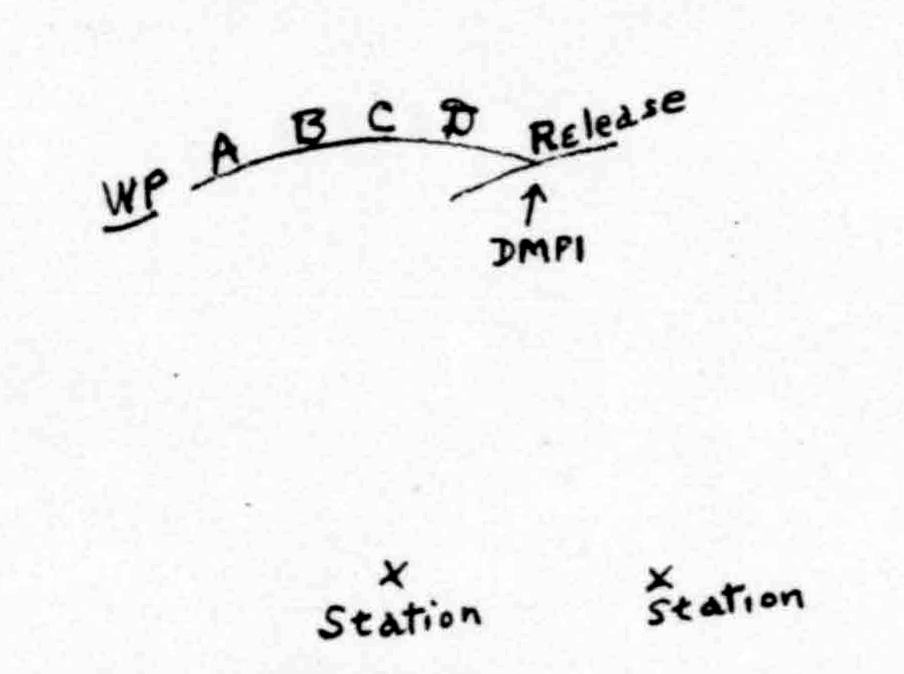
The ground station first picks up the PFF aircraft at the WP, waiting point, or a little before. Equipment will sound the call letters of the plane at that point. First, a solid tone and then the call letters in dot-dash. The equipment continues to give a steady tone as long as the aircraft is on the course. There will be only one Pff aircraft with equipment in the bombing formation. The next bombing formation on the same channel will follow at least 15 minutes later. Thus only one aircraft will be using the equipment for one channel of the equipment. There are four channels called 11B, 11C, 12 and 13. Thus you can put 4 aircraft over the target, one for each channel, at 1100 o'clock, for example, and the next 4 aircraft would have to wait until 1120 o'clock.
If the PFF aircraft gets off the cat course and inside the circular course, the equipment on cat sounds dots, and if the aircraft is outside, it sounds dashes. If, by chance, the aircraft gets 5 miles off the course, the equipment sounds an "X", and at 10 miles off, it sounds "Y", and at 15 miles off course, it sounds a "Z". In order to call off the mission, the equipment sounds "J" on both cat and mouse.
Mouse gives a steady tone with a break at points "A", "B", "C" and "D" at which points the letter is sounded twice. At the release point, the mouse sounds 5 dots and then a dash.
The bombs are released at the end of the dash which lasts about 3 or 4 secs. The aircraft turns off its equipment as soon as it has crossed the target, so that the following PFF aircraft on the same channel can use the equipment. The other aircraft which follow the PFF aircraft in the bombing formation do not affect the signals as the PFF aircraft has the only equipment that shows up on the ground station equipment.
The position of the PFF aircraft is shown at all times on the grid tubes of the ground stations. The signals from the aircraft are displayed on the radar tubes. They are accurate to 200 yards in range. As the aircraft goes in, it is watched on the long range finder. When it is within 5 miles of the target, the range finder is expanded on its time base. At that time it is possible to put the location of the aircraft down to an accuracy of one mile. The tube is 10 inches across. So after the expansion, 2 inches equals one mile. The image is expanded again when the aircraft is one mile from the target. On the last mile the ten inches represents one mile and the release point can be accurately gauged on a large scale. The line PT represents 5 miles, then 1 mile, and then 1/5 mile.
[### Reel A0856 - Page 0602 ###]
RADAR PERSONNEL WITH FIRST PATHFINDER SQUADRON (M) PROVISIONAL
Certainly no history of Pathfinder Squadron would be complete without an account of the story of the men who developed Oboe so that 9th Bomb Division of the 9th Air Force could pursue their valuable bombing of enemy installations without the bomb-less cloudy days of visual bombing that permit the enemy to recuperate. As far as Germany is concerned, bombing through clouds by Oboe and First Pathfinder Squadron (M) Provisional were synonymous. But Oboe technique was developed by a small group of American enlisted men who had members who came to England as early as 1941 to study radar with the RAF. They nurtured the Oboe through its transitional stage from Mark I to Mark II. They studied it at the Massachusetts Institute of Technology and improved the equipment, and made new parts for it. They studied at the Tele-communication Research Establishment called TRE in England at Great Malvern. They attended the BBRL, the British Branch of Radiation Laboratory, which carried on the work done at MIT. They installed the equipment in heavy bombers of the 8th AF, then took the equipment out of the heavies and installed it in the medium bomber B-26s. They never lost confidence in Oboe. They listened patiently to the criticisms of the first failures. They withstood the banter of impatient pilots eager to quit the experimenting and to get into battle. They scrounged. In fact, there would be no bombing on cloudy days for the AAF to be proud of if they had not scrounged. For their superiors failed to give them official status and a claim to the equipment they needed. Their friends in the RAF looked the other way as they took what they needed from the British supply rooms. When in their endeavors they were ready to make a go of Oboe in the heavy bombers, they were told that Oboe was a tactical and not a strategic weapon, and they started all over again with the medium bombers. To their everlasting credit, they saw it through, and the numerous citations that their work brought to their pilots, and their Air Forces, would indicate that such an important part of the plan of battle of the United States Armed Forces should have graduated from its Provisional status to full recognition and a Table of Organisation many months before V-E Day.
It is an odd commentary that although the Sergeants who trained the successive crews who flew the PFF aircraft, and who flew many missions with them in their faithful performance of their duties, were assigned to the 96th Station Complement in September 1944 and later to the 98th Station Complement, and these Station Complements are not entitled to campaign bronze battle stars on their service ribbons. Was Pathfinder a myth made of men on DS and not a part of the war, or was First Pathfinder Squadron a battle weapon entitled to battle honors? All the ground force officers and men suffer because the deserved recognition never came before V E Day. It meant lack of discharge points, and worry because duty well done and sacrifices endured were apparently not appreciated as they should be. A glance at the statement of T/Sgt Fred A Trotter in the Appendix will tell the story of one of the radar men who with T/Sgt Edward D Sobieski and T/Sgt Chester J Stubecki were with Oboe and First Pathfinder all the way through.
Note 6. Statement of T/Sgt Fred A Trotter App Exh E; Hq IX BC SO 51, 20 Feb 44 App Exh F, Hq IX BD SO 10, 19 May 45 App Exh G.
Statement of S/Sgt J E Beasley and S/Sgt R G Stockton App Exh "H" Extract Hq 8AF 8 Feb 1944 SO 37 Par 3 App Exh "I" Statement of T/Sgt E D Sobieski App Exh "J"
[### Reel A0856 - Page 0605 ###]
ANALYSIS OF INTERROGATION REPORTS OF CREWS FOR MARCH
A detailed study was made of every mission for the month of March 1945. Reports of Interrogation by Intelligence Officers were especially examined for comets of crew members recorded thereon. The incidence of bombing on oboe equipment, GEE and Norden was analysed and the results are included in Section XI of this History Supplement, above. On a normal bombing of primary target on oboe equipment without incident, there is not ordinarily any remark on the Report. But when the bombs were not dropped as planned, there was usually a comment.
"No release signal" is the most common complaint for failure to bomb on Oboe. One version was that the altitude was too low on the distant targets to take advantage of the signals. The Allied Armies were making rapid advances, and the distance from the ground stations to the targets was becoming greater as the advance continued. Very frequently the remark is that "A", "B"and "C" came in clearly, but the "D" and release were indistinct. The Bombardiers were alert and there is one example where the cat signals after "A" were missing, but the pilot estimated the proper course and the Bombardier dropped on mouse and the results were announced as "Excellent". The Pilot was 2d Lt W D Bond with the 410th BG on the morning of 3 March. Once when there was nothing after "B" until the Release was received, the PFF could not drop because the SOP was to wait for "C" before opening the bomb doors, and so when the release was received the bomb doors were closed.
1st Lt A B Johnson on 4 March with the 410 BG reported: "Signals very good until 1 1/2 min after 'D'. Current dropped to 0, and was out 10 to 20 sec. Current then came back and 30 sec later PFF aircraft was 'J'-d off. They were on beam until failure of current. There was no release signal." The lack of current on ammeter would indicate no signals were being received.
There were indicator lights on the instrument board to show the Pilot when the Bombardier would be opening his doors at "C" and prepare the Pilot to apply the additional power necessary. On 9 Mar the report of 1st Lt J L Nichols states that special equipment indicator lights were off. These lights were obtained by special order and were difficult to obtain, and often were not replaced immediately. They were an extra aid for the Pilot.
It was important that the PFF after passing the target should turn off his equipment so that it could be used on the next PFF aircraft on the same channel. On 23 Mar Pilot 2d Lt E M Demouche with the 397th BG reported that he was "J"-d off 4 1/2 minutes past "D" according to signals. His plane was 8 miles off according to GEE.
GEE could be jammed by the Germans. It was practically impossible to jam Oboe. The GEE fix of the PFF aircraft and of formation aircraft sometimes did not agree. On 1 Mar under the account of the attack by the 416th Bomb Group on the Giessen Ordnance Depot, Mission Summary #55 of 9th Bomb Division stated: "In describing where bombs landed, the PFF fix and group fixes in formation aircraft differ. The former gave Nieder Emmel (L-410430) and the latter gave a point (1-470550) as location of strike. These two points are 20 mi and 10 mi, respectively, southwest of SMPI, secondary mean point of impact, which was in this case the Eller Railway Bridge (L-575670)." The bombs were dropped on the secondary briefed target with which Oboe has nothing to do. Moreover, Oboe does not give a fix.
1st Lt G B Davis on 23 Mar reported that his ship leading the 397th BG got a release signal when it was over Gahlen which was 4 1/2 mi south of DMPI which was the Shermbeck Communications Center. 2nd Lt E M Demouche led the 394th BG on the afternoon of 11 Mar, but returned his bombs. He reported equipment failure - a solid tone to the right - then he was "J"-d off.
There were many malfunctions of the bomb rack which interfered with a successful run. Once, only one bomb dropped when the PFF planes released the bombs, and the Group dropped on the one bomb. This was with the 397th BG on the afternoon of 2 Mar with Capt H A Epperson.
On 8 Mar both boxes of the 323d BG complained that "B" channel of the radio was not being monitored. The group boxes would not follow PFF aircraft and the latter could not make radio contact with the Group, and so they returned without bombing. On the 9th of March 1st Lt E B Grubb returned his bombs because his receiver was dead.
Many times the PFF crews would bring glowing reports of the way the Group formations followed the PFF aircraft. The formation would be classified "Superior","Excellent" and "Very Good". But, occasionally, they would have a suggestion to make, pilots would recommend that crews after bombing make a hasty getaway from the target area to make room for oncoming ships. They would also recommend changes of altitude such as that window ships should fly lower. There were complaints that the group and box formations were too far off course, or not on time, or that prior formations were not out of the way in time for an unobstructed bomb run. 1st Lt E B Fitch flying with the 386 BG on 9 Mar reported that he could not keep up with the A-26 aircraft after they had bombed the target and started for the home base. On the return trip alone the PFF aircraft was attacked by an Me-109. Tail Gunner Cpl T H Mulkins received credit for damaging the attacker. When an Me-109 attacked 2d Lt W D Bond's PFF aircraft on the same occasion, his tail Gunner S/Sgt L W McFarren received official credit for destroying the German plane.
On a mission on the afternoon of 9 March, 1st Lt J M DuBois poses the question: Why doesn't the Group follow the PFF aircraft off the target? He lead the 1st box of the 323rd BG on that mission.
On 5 Mar Capt D A Phillips with the 387th BG led his 2d box and also the 1st box which was headed by 1st Lt L H Carrington's PFF aircraft which suffered equipment failure. This also occurred with the 391st BG and has happened at other times. Also, on this occasion the 2d box of 322d BG could not follow the 1st box which chose to drop on the 2d box of the 344th BG, and so the 20 aircraft of the 2d box of the 322d BG returned to base with their bombs. On 13 Mar 2d Lt W D Bond reported that 391 BG took over on the run, and then gave the lead back. It was too late to make a run for the PFF aircraft which was off course after the 360 degree turn. On the afternoon of 17 Mar 2d Lt R L Voorhies with the 394th BG also mentioned this point: "The Group should either follow or elect to turn back (Note: This probably means elect that PFF aircraft is released to turn back to base.) The 360 degree turn takes too much time. We were briefed not to go thru cloud layer at Group, but Group left PFF aircraft when we encountered clouds. After Group got back, it was too late to attack. GEE jammed." On afternoon of 15 March 1st Lt G B Davis reported that 416 BG got ahead of PFF aircraft when it led them down thru clouds.
On afternoon of 17 March 1st Lt H D Wilgus with the 397 BG reports: "Should make it definite on weather briefing on medium clouds, and let Group know what decision is. Bombs were returned because of no signals, but though briefed to stay below clouds, the Group went above." On 2 Mar Capt H A Epperson reported that 386 BG wandered about after taking over, so PFF aircraft bombed alone. On 17 Mar in the morning, the 1st box of the 410 BG led by 1st Lt J M Foster turned lead over to the 2d box led by 2d Lt R L Voorhies which did not bomb, and entire Group returned bombs. Signals were poor and GEE jammed.
It should be noted here that the above incidents are just isolated cases that are given for the purpose of covering all kinds of experiences in Pathfinder bombing. The intention here is not to criticise, but to show the source of error.
Misunderstandings can arise in communications by radio, by flares or other signals. The place of rendezvous, and the time, must be thoroughly understood, and the more adequate and complete the communications are, the better the results. On 8 Mar 1st Lt P J Hughes stated that the Group following him did not recognize the color of the flare he fired according to the information they had. They had been briefed on different colors, and remained 300 to 500 ft behind the PFF aircraft. As has already been stated the great majority of the bomb runs were normal runs on the primary target with the Oboe equipment. A few causes for failure to bomb on Oboe have been set forth. Another not mentioned before is the failure to make rendezvous with the friendly fighters which furnish the protective cover against enemy aircraft. In the case the fighters do not appear, the bombers drop on the secondary briefed target or an alternate casual target, and on these occasions the PFF planes sometimes bombed alone.
[### Reel A0856 - Page 0611 ###]
REPORTS OF SECTION HEADS
The words of the men who performed the duties of the various sections would be the best evidence of what was done if such statements were available. In the early issues of the Squadron War Diary some of the experiences are recounted. But time has changed the picture and the first personnel have long since departed. An effort was made to get a statement from the heads of all departments. Many statements were obtained from Officers and key Enlisted Men. Some officers were reluctant to give statements. Actually there never was a recognized organisation. Many officers and men assigned to other organizations were placed on DS at a certain spot and called the 1st Pathfinder Squadron (M) Provisional. They did a first rate battle performance from the very start. They were praised officially. The ground personnel were assigned to the 96 and 98 Station Complements. These were not located in the Combat Area, although the men they spared for the DS with Pathfinder were. Nevertheless the men with Pathfinder take on the no-combat character of the Station Complement rather than the battle character to which they should be entitled. They are thus discriminated against in comparison with their ground force brethren who served with the Groups to which they were assigned who have the same combat stars as their organization. A man on DS with a combat organization cannot get a combat star without participating in a mission no matter how important his organization was in the maximum war effort and actual battles of his Army, if such organisation was Provisional as Pathfinder was.
Major RA Porter was the first Commanding Officer and he flew the first Pathfinder aircraft to see combat. He was the Pilot of the PFF aircraft which led 17 aircraft of the 322d BG in an attack on Coxyde A/D in Belgium on 21 Feb 44 one week after the Provisional Squadron was activated. "Photo Reconnaissance showed a good concentration of 100 lb bursts on the target." The remainder of the crew were Co-Pilot Capt Harold G Lamb, Navigator 1st Lt William Harper, Bombardier 1st Lt Clemenzie, Eng Gunner S/Sgt Carter G Johnson, Radio-Gunner T/Sgt Lewis B Shane (Shein), Tail-Gunner S/Sgt Gilbert H Grady. Lt Clemenzie was borrowed for this mission only from 452nd Bomb Squadron. These early pilots and crews have long since finished their tours and returned to the States.
The first Operations Officer was Capt Norman L Hainey. His first Assistant was Capt Charles E Crain. Capt Crain succeeded Capt Hainey as Operations Officer and Capt Vance A Smith was his chief assistant. Capt Smith then became Operations Officer and Capt Gerald W Shirey was his Assistant. At the time the 1st Pathfinder Squadron (M) Prov lost its identity after V/E Day, Capt Gerald W Shirey was filling the position of Operations Officer. Each Operations Officer had thus served a term as Assistant before filling the top position.
The Chief squadron Navigators in order of their service in the Squadron from Activation to V-E Day were Capt William J Harper, and Lt Otto R Kirkpatrick. Each served under two different Operations Officers.(8)
The Chief Squadron Bombardiers in order of service were Capt Theodore J Climelik and Lt Albert J Simone. Lt Simone served under the last three Operations Officers.
The first office used by Operations was a small room about 15 by 10 feet with counters running lengthwise. Tar dripped from the ceiling when the room got warm. It ruined half of the papers. On 28 Sep 44 we moved to Beauvais, and in January to Perrone. At Perrone near Monchy la Gache the Navigators working quietly at their maps in the temporary wooden building were startled by the crash of a B-26 of the 397th BGp which in taking off had experienced an engine failure and had catapulted over the Operations building. The roof of the Operations office was caved in and only a 4 ft by 4 ft map case kept the wall of the Navigators' Room from falling in upon the men working there.
Notes.
7. Statement of Capt Gerald W Shirey App Exh "L"
8. Statement of Lt Otto R Kirkpatrick App Exh "M"
9. Statement of Lt Albert J Simone App Exh "N"
10. Photographs of crash of B-26 on 4 April 45 App Exh "K"
The original Operations Clerks were: T/Sgt Frank G Cornell, S/Sgt Stephen A Piller, S/Sgt Lowell J Janke, Sgt James M Godwin.
They were all with the squadron all the way through. Their number was increased when S/Sgt Fred V Royals and Cpl Raymond E Sampson joined them.
A very important office of the Pathfinder Squadron was the Intelligence Office. Capt Gilbert C Hine has recently completed a very detailed account of the operation of Pathfinder Intelligence for Bomb Division and this report is incorporated in this History. Lt Francis V Lindon was the first Intelligence Officer to come to the Squadron in February of 1944. At the time of breaking up of the Squadron Capt Hine and Lt Lindon were with the Squadron and the other officers in the Intelligence Section included Capt George Yarnell, Capt B Frank Watson, Lt Clifford Whiddon, and Lt Harry Scarmess. Each officer served as Briefing Officer in rotation. It would be his duty to prepare the target information and maps, lay out the route to be followed by Pathfinder aircraft leading all the different Groups, and brief the crews on routes, flak, enemy aircraft, and target. The Communications Officer and the Weather Officer also took part in the Briefing which was presided over by the Operations Officer. Plastic overlays were prepared in the Intelligence Office and taken to the Briefing Room map for the Briefing.(12)
Notes 11 Report on Pathfinder Intelligence by Capt Hine App Exh "O" 12 Photograph of Map showing Routes. App Exh "P"
As Capt Hine indicates in his Report, the Intelligence officer on duty included in his briefing the data concerning the altitude of the target as well as its description, and the pass-words.
At the Briefing, the Bombardiers will receive the canvas covered 4-section folders which the Intelligence Duty Officer and his Sergeant Assistant have prepared during the night. Pictures of this folder have been included with Capt Hine's report in the Appendix.(12) The photographs do not represent the various parts of one mission as show by Capt Hine. In actual practice they will cover the target area and the route in and out from the target, and will show the WP, waiting point, flak, location of PW camps, and the Bomb Line. The Bombardier has the 1:500,000 map for the long stretches of the route, and the 1:25,000 and 1:250,000 for the approach to the target. The photographs will also indicate the AP, aiming point, for the Bombardier receiving the folder, and indicate a North arrow for orientation. If good photographs are not obtainable, sometimes it is better to use the large scale maps for the approach. The AP is circled on the respective maps, or rather, on the acetate covers of the various sections of the folder with tickmarks for orientation of the loose maps.
The target data is phoned and teletyped with description of the coordinates in six numbers as shown on map GSGS 4416. This map with its 1:100,000 scale is easily compared with photographs and with 1:25,000 maps to pin-point the target. It is assumed that the printing is uniform on the entire series of each such map. In the photograph shown in the appendix , it will be noted that the circle does not enclose the Ordnance Depot for which the Coordinates (W) W-991911 appear at the bottom of the photograph. This Ordnance Depot at the lower right hand of the photograph has already been bombed, and such a photograph would be used in briefing some other target possibly in the woods nearby. However, there should be a North arrow. As shown the top of the photo is a little north of due West. The Steinlach Canal is the heavy line which runs from left center to the right top of the picture, with only one turn of approximately 45 degrees.
The Nurnberg map showing the route which is photographed with the Tubingen photograph in two parts of the Bombardier's folder shows a fictional route as selected by Capt Hine. The last turn before approaching the target would be the WP, waiting point, on an actual mission. The wavy black line from NW to SE represents the Bomb Line and for that reason no flak is shown west of it.
When to Squadron was formed at station 485 on 15 Feb 44, the Communications Personnel including telephone and teletype men consisted of just 24 men. Lt Homer B Whitaker was the Communications Officer during the entire life of the Squadron. The first Communications Section Chief was T/Sgt Gerald Savard. The Flight Chiefs at the start were S/Sgt F L Kennedy, S/Sgt P E Kennedy, S/Sgt Henry Hass and S/Sgt Allen Johnson. During March 1945, T/Sgt William Spillers became Section Chief of Squadron "A" Line and M/Sgt Joseph St Arnaud became Section Chief of Squadron "B" Line. Because of the unwieldy size of the Squadron Line, it was divided into sections "A" and "B" as indicated.
At the outset of the Squadron, there was absolutely nothing in the way of signal and communications equipment. Telephone facilities were handled through a 12 drop English type switchboard. This served while the Squadron remained in England and it was not until the Squadron moved to France that telephone switchboard facilities were obtained capable of handling 50 drops. At the breaking up of the Squadron, the squadron had 2 BD 91-B switchboard.(13)
A very interesting account of these early days is furnished by one of the enlisted men who was with the squadron all the way through. He lends emphasis to the existence of the scrounge to exist policy. However, at one time the Lieutenant and the Enlisted Men chipped in their funds to send to London to buy tools. He also mentions "moonlight requisitioning", a handy means of supplying a provisional squadron.
Notes
13. App Exh "Q"
14. App Exh "R"
The Engineering Section was required to be ever alert to maintain the aircraft so they would always be ready for the great demands made upon them. Lt Walter A Spencer was the first Engineering Officer, and Lt Donald A Madden was in this office at the time of dissolution of the Squadron after V-E Day. There were two sections of the Squadron line called "Squadron A" and "Squadron B". The Line Chiefs were M/Sgt G E Cook and M/Sgt P J Healey.(16) Supply was also affected by the lack of official recognition. S/Sgt J R Rodriguez worked hard to meet the demands made upon his inadequate stocks. His statement in the Appendix tells of some of his trials and tribulations.(17)
The Squadron was under the medical attention of Flight Surgeon Captain Maurice Kaufmann, MC during the latter part of February 1944. His first assistant came to the Squadron on 11 June 1944 and was with the Squadron to the end. He was Sgt Isaac Postar of the 201st Medical Dispensary.(18)
Armament was under Capt J L Kreuger from Feb 44 to May 45. He was assisted by Lt Charles K Bettice who joined the Squadron on 28 July 1944. Special Service was under Lt Lux.(20)
Notes
15. Statement of Lt Donald Madden App Exh "S"
16. Statement of M/Sgts G E Cook a P J Healey App Exh "T"
17. Statement of S/Sgt J R Rodriguez App Exh "U"
18. Statement of Corp I Postar App Exh "V"
19. Statement of 1st Lt C K Bettice App Exh "W"
20. Statement of 1st Lt James O Lux App Exh "X"
It hardly seems necessary to make a report for the 96th and 98th Station Complement Sqs. Because the only organization or would-be organization, Pathfinder men talked about was the 1st Pathfinder Sq (M) Provisional. The original order stated that this squadron was "activated". But the study conducted by this Historian indicates that a lot of officers and men operated as a battle unit under the name of 1st Pathfinder Sq which was not listed among the battle units of the US Army. How this happened is outside the scope of this report. But we would be lax in our duty if after making such an exhaustive study we did not offer a solution for giving battle honors to the men of Pathfinder who were on DS from Station Complements which did not get battle honors.
Our solution is based on the rule that a man on DS to a recognized unit which receives battle honors is entitled to these honors even though he is assigned to another unit. Of course, since 1st Pathfinder Sq (M) Prov was not recognised as a "unit", it is necessary to bring it within this rule on a basis other than technical authorisation. This should be a simple matter. The unit with a T/O receives the battle honors because a certain percentage of its men were in the combat zone or participated in battle. If this same test were applied to 1st Pathfinder Sq (M) Prov, as in fairness it should be applied, then the Pathfinder personnel on DS to the Sq could receive their combat stars and additional points as they should. For the record of Pathfinder has been synonymous with battle since it was "activated".
The first articles and reports on 1st Pathfinder Sq were classified for every precaution was taken to prevent the secrets of Oboe from being divulged. In the last month before V-E day on the ninth of May, the undersigned office as Public Relations Officer forwarded several releases for home town papers. Finally, a press release describing the history of the Squadron was accepted. It was written by Sgt J G Swarts who came to the Squadron from Bomb Division.(21) Lt. Col Bill E Hale came to Pathfinder to succeed Lt Col Robert A Porter, late in December 1944.
Col. Hale was a veteran of the air campaign in the foggy regions of the Aleutians where he served early in 1942 as a fighter and dive-bomber pilot. His home is at Ashland, Ky. Col Hale who is 28 years old graduated from Center College. On 29 Jan 1945 General Charles De Gaulle awarded the Croix de Guerre with Palme to Col Hale for his aid in the Liberation of France as Commander of a Marauder Squadron.(22)
Many noted pilots served with Pathfinder Squadron and their names appear throughout the Squadron War Diary previously submitted as the Squadron History. During the month of April, 1945 three Pathfinder Pilots completed their tour of duty of 55 missions about the same time. One was 1st Lt Louis H Carrington of Galena park, Texas who was capping off his second tour of duty. He had already finished his first tour in Tunisia, Morocco and Algeria, totalling 40 missions before February, 1944.(23) He plans to fly another tour in the Far East.
Notes
21. Press Release on 1st Pathfinder Sq. App Exh "Y"
22. Photograph of Lt Col Bill E Hale App Exh "Z"
23. Photograph of 1st Lt Louis H Carrington App Exh "AA"
Another of the Pilots finishing his 55 missions was 1st Lt Richard G Johnson. Lt Johnson's crew bought a thoroughbred Scotty dog in the United States. They named him McTavish and brought him to Europe where he completed his "tour" of 55 missions and was then shipped back to the States. A picture of McTavish with his flying friends is in the Appendix.(24) Lt Johnson is on the left.
The third pilot to finish was 1st Lt J R McAlpin. All three put on Captain's bars before starting home. Capt McAlpin assisted in Operations.(25)
A Pilot who is known to everyone who has ever been with Pathfinder is Captain Matthew H T Ferguson. Her received the Distinguished Flying Cross from Major General Samuel E. Anderson of the Ninth Bombardment Division. He also held the Silver Star.(26) Captain Ferguson was Squadron Training Officer. Due to his absence during the last few weeks of the Squadron, it was impossible to obtain from him a statement concerning his excellent squadron training program.
Notes
24. Photograph of crew of Lt R G Johnson with McTavish. App Exh "BB"
25. Photograph of Capt J R McAlpin App Exh "CC"
26. Press Release on Captain Matthew H T Ferguson, App Exh "DD"
When 1st Pathfinder Sq was wound up about the middle of May, it was necessary to relieve all personnel from DS with the Squadron. This was accomplished for Combat Personnel by Pars 6 and 7 of HQ 9AD 16 May 1945,(27) and for Ground Personnel by Pars 1 and 3 of HQ IX AD 19 May 1945.(28) The orders mentioned cover the greater part of officers and men, but there were a few covered by separate orders. The 96th Station Comp Sq remained at Venlo to close up the affairs of the Squadron. The Pathfinder Squadron came to an end when its personnel were relieved from DS with it.
For reference, a copy of the April Squadron History account of essential information previously submitted in accordance with the questionnaire in par 4b of Memo 20-3 of IX BC 21 May 1944 is included in the Appendix.(29)
Notes
27. HQ IX AD 16 May 1945 Pars 6 and 7 App Exh "EE"
28. HQ IX AD 19 May 1945 Par 1 Extract App Exh "FF"
HQ IX AD 19 May 1945 Par 3 Extract App Exh "G"
29. Essential information for April, Copy. App Exh "GG"
[### Reel A0856 - Page 0623 ###]
CITATIONS AND COMMENDATIONS
"The proving of Pathfinder" is the title of an article published in the weekly "Intelligence Report to Combat Crews of Operations" by Ninth Bomb Division for the week of 16 to 23 March 1945. It states that a glance at recent achievements of the 1st Pathfinder Sq ({M) Prov "causes one to wonder what the Division would have done without its blind bombing techniques throughout the period of the last eight months." We quote from this account as follows:
"In the first fifteen days of this month, for example, Pathfinder salvaged 13 days for operations. Of February's 28 days, 22 were operational because the Division could depend on Pathfinder leadership. Twelve of January's and 11 of December's 31 days were salvaged for operations by Pathfinder. And so the record goes ... back to 6 June 1944, and to 13 Feb 1944, both important dates in the history of Pathfinder Squadron, Provisional.
It was on the February date that the squadron was officially organized, late in a winter that had showed the necessity for blind bombing technique if medium bombardment was to pay its way in Europe's overcast skies.
"The new squadron had many obstacles to overcome, many problems to be solved. It had no authorized T/O & E, so the personnel, drawn from Groups within the Command, had to carry on their work without adequate transportation, tools or administrative items. Not only did the crews have to be trained in the use of the equipment for both day and night operations, but the squadron also had to train its own personnel in the maintenance of highly technical equipment, The equipment itself had to be tested time and again before it was considered in perfect operational condition.
"Nonetheless, Pathfinder was ready to lead its first missions in March, and in March, April and May of 1944, the new technique was used in attacks against V-weapon launching sites and coastal defense batteries with enough success to justify the Squadron's faith in the new equipment and the whole Division's hopes for the Squadron.
"The D-Day Test"
It was on D-Day and in the anxious, overcast days that followed that Pathfinder really proved itself. When the ground forces had the greatest need for medium bomber cooperation, and visual bombing was impossible, the Division attacked the vital targets on Pathfinder. By the end of June, Pathfinder had led a total of 103 missions with many excellents scored. Operations for May and June showed a 90 per cent equipment efficiency for Oboe; the RAF, on the basis of over a year's experience, had said that a 60 to 70% equipment efficiency was good.
"In recent weeks, such excellent results as were obtained last week at Kreuztal, Wetzlar, Giesecke, Siegen and Neustadt marshalling yards, and Bad Durkheim and Eitdorf Communications Centers have not been uncommon.
"the squadron's record of achievement is also studded with such feats as one commended by the Commanding Officer of the 99th Wing and transmitted by General Anderson in the following message to the Commanding Officer of the Squadron:
IT IS A PLEASURE TO PASS ON TO YOU THE FOLLOWING MESSAGE FROM THE COMMANDING OFFICER, 99TH BOMBARDMENT WING: 'IT IS DESIRED TO BRING TO YOUR ATTENTION CAPTAIN EPPERSON OF THE 1ST PATHFINDER SQUADRON WHO LED THE 322D GROUP UNDER SUCH DIFFICULT CONDITIONS TO COMPLETE ITS ATTACK ON PRIMARY IS A COMMENDABLE DEMONSTRATION OF THE OUTSTANDING LEADERSHIP AND JUDGMENT WHICH GUARANTEES THAT THE FIGHTING POTENTIAL OF THIS DIVISION WILL NOT IN THE CRITICAL DAYS BE THWARTED. I ADD MY CONGRATULATIONS TO THOSE OF THE COMMANDING OFFICER OF THE 99TH WING."
There is an interesting account of the manner in which this Squadron fulfilled one of the needs proven by battle experience in "Time Over Targets", the story of the Ninth Bombardment Division is used by the "Stars and Stripes", a publication of the Information and Education Division of the ETOUSA. It states:
"From D-Day bad weather had been as ugly an enemy as the Germans, but as early as January, 1944, the Division had been working on an antidote. A new method of blind bombing had been developed - on paper. First the Division had to make it work in practice. Foreseeing the tremendous value of a blind technique which could partially defy North European weather, the Division formed its Pathfinder Squadron, provisionally, and fought hard to make it a permanent unit. That could not be done, and the squadron embarked en a career of begging and borrowing to keep alive.
"Months of practice of trial missions, of intense study followed. Personnel had be be specially trained, ships had to be elaborately equipped. At one point the whole project hung in the balance. Should it continue? It was a drain on resources; there were so many things to be done. Then the latest results were determined, and it was clear that the Squadron, overcoming every difficulty, had triumphed. The Division had a new and priceless technique.
[### Reel A0856 - Page 0625 ### [page is illegible]
[### Reel A0856 - Page 0626 ###]
"In May, Pathfinder planes were leading Division formations on successful attacks from above the clouds. Six formations were led by Pathfinders June 6. During the following summer, Pathfinder planes led Marauders to fuel dumps and communication targets, and on night flights to targets in France. The Division ran several night missions to Beaumont-le-Roger airfields, to the Laval fuel dump where huge fires were started. It was a costly pioneering effort, but it developed into a force that could attack at night with precision bombing.
"With the autumn clouds covering the sky, Pathfinders, who were doing so well with so little, showed their true value and 'salvaged' many days that otherwise would have been lost."
A similar commendation was received on 11 July 1944 from Hq IX BC in a letter on "Results of Pathfinder Operations". It stated that the blind bombing operations during the months of May and June, 1944, "prove conclusively that the Pathfinder Squadron with its blind bombing technique is a definite supplement to visual bombing when poor weather conditions necessitate its use."(30) On 28 Oct 1944 Major General Hoy S Vandenberg, Commanding the Ninth Air Force, cited The "1st Pathfinder Squadron (M), (Provisional), 9th Bombardment Division (M)" as a "unit" for "outstanding performance of duty in action against the enemy" under the provisions of section IV, Circ No 355 WD 1943.(31) He mentions particularly the period from 13 Feb to 31 July 1944. He states that this Squadron is the first American medium pathfinder squadron to utilize precision blind bombing, and gives it credit for the successful development and establishment of precision bombing as an integral part of medium bombardment technique. "Only at the cost of unstinting labor and great hazard was this innovation in operations accomplished."(31)
Notes
30. Hq IX BC Ltr 11 July 1944 "Results of Pathfinder Operations" File 373.2 App Exh "HH"
31. Hq 9AF GO 254, 28 Oct 1944. App Exh "II"
"Their achievements are in keeping with the highest traditions of the Army Air Forces." So concludes the citation order of General Vandenberg. Is any higher tribute desired? Our officers and men of 1st Pathfinder Squadron (M) Provisional are happy that they have had an opportunity to play an important role in destroying the enemy and saving lives by helping to speed final victory. They gave the battle all they had, and the results speak for themselves. They assisted the Ground Forces for they deprived the enemy of an opportunity to marshall his forces during the cloudy weather that could not be breached by visual bombing. They permitted the Ground Forces to follow up every attack by furnishing "flying artillery" to drop bombs in place of shells far beyond the front lines. They thus gave our Armed Forces the power to win success by keeping everlastingly at the attack. In so doing they fulfilled their mission, regardless of whether they did it as a unit with a T/O or just a bunch of Yanks with a lot of intestinal fortitude.
1st Pathfinder had its losses. The men who gave their lives and the men who were wounded and who were Missing in action took their fate in the line of duty. The other men who fought for Pathfinder were ever ready to meet the demands made upon them. Theirs is a record which will long live in the annals of the young generation which fought the Second World War.
[### Reel A0856 - Page 0628 ###]
INDEX OF THE APPENDIX
EXHIBIT
D. Interview with Capt J C Thayer regarding crash landing
E. Statement of T/Sgt Fred A Trotter
H. Statement of S/Sgt J E Beasley and S/Sgt R G Stockton
I. Extract HQ 8 AF 8 Feb 1944 SO 37 Par 3
J. Statement of T/Sgt E D Sobieski
K. Photographs of crash on Hqs Building and Radar Truck 4 Apr 45
L. Statement of Capt Gerald W Shirey App Exh "L"
M. Statement of 1st Lt Otto R Kirkpatrick App Exh "M"
N. Statement of 1st Lt Albert J Simone App Exh "N"
O. Report on Pathfinder Intelligence by Capt Hine App Exh "O"
P. Photograph and Map showing Route in Bombardiers's Folder
Q. Statement of Communications Section
R. Statement of [blank] of Communications Section
S. Statement of Lt Donald Madden, Engineering Officer
T. Statement of M/Sgts G E Cook and P J Healey
U. Statement of S/Sgt J R Rodriguez of Supply Section
V. Statement of Cpl I Postar of Medical Section
W. Statement of 1st Lt C K Bettice of Armament Section
X. Statement of 1st Lt James O Lux, Special Service Officer
Y. Press Release on 1st Pathfinder Sq
Z. Photograph of Lt Col Bill E Hale
AA. Photograph of 1st Lt Louis H Carrington
BB. Photograph of crew of Lt R G Johnson with McTavish
CC. Photograph of Capt J R McAlpin turning in gear
DD. Press Release on Captain Matthew H T Ferguson
EE. HQ IX AD SO 7 16 May 1945 Pars 6 and 7
FF. HQ IX AD SO 10 19 May 1945 Par 1 Extract
GG. Essential information for April,1945. Copy.
HH. HQ IX BC Ltr 11 July 1944 "Results of Pathfinder Operations"
II. HQ 9AF GO 254, 28 Oct 1944
[### Reel A0856 - Page 0630 ###]
APP EXH "A"
AUTH: CO, IX B.C.
DATE: 13 Feb 44
INIT:
E-SHN-4
HEADQUARTERS IX BOMBER COMMAND
APO # 638 13 February 1944
GENERAL ORDERS)
NUMBER......28)
ACTIVATION OF PROVISIONAL UNIT
1. Pursuant to authority contained in teletype F-694, Headquarters, Ninth Air Force, dated 11 February 1944, the following unit is activated effective 0001 hours, 13 February 1944, and is assigned to AAF Station 485:
1st Pathfinder Squadron (M) Provisional
2. Personnel will be attached from organizations within this command by this headquarters. Table of Organization and Equipment 1-127, dated 26 March 1943, including column "Radio V", will be used as guides and will not be exceeded. Provisions of WD Circular 227, 23 Sepember 1943, as emended, will be complied with.
By command of Brigadier General ANDERSON:
RICHARD C. SANDERS,
Colonel, Air Corps,
Chief of Staff.
OFFICIAL:
C. C. VEGA, JR.,
Major, Air Corps,
Adjutant General.
DISTIBUTION "A"
[### Reel A0856 - Page 0631 ###]
CONFIDENTIAL
APP EXH "B"
HEADQUARTERS
IX BOMBER COMMAND
APO # 638
14 February 1944
SPECIAL ORDERS)
NUMBER......44)
EXTRACT
15. MAJ Robert A Porter, O424666, AC, is designated CO of 1st Pathfinder Sq (M) Prov.
16. Following named O and EM, air crews, orgn indicated are placed on DS, WP 1st Pathfinder Sq (M) Prov, AAF Sta 485.
From 386th Bomb Group (M)
Capt Benjamin R Ostlind O438435 P
1st Lt Harry J Lester O738194 CP
1st Lt Murray S Abriss O731245 N
1st Lt Edgar C Dickinson O732815 B
S/Sgt James W Hankemeyer 37183442 RG
S/Sgt David E Corbin 6966493 EG
S/Sgt Robert E Coyle 13077836 TG
2nd Lt Richard J. Ulvestad O731700 P
2nd Lt Thomas W. Deering O672041 CP
2nd Lt Arr K. Jorgenson O732854 B
2nd Lt Robert M. Sherman O797087 N
T/Sgt Charles A Martyn 15071529 RG
S/Sgt Willis G Kelce 15100111 EG
S/Sgt Stephen M Stankard 32458437 TG
1st Lt Gilbert Howe O731586 P
F/O Oliver L McCaskill T186565 CP
1st Lt Nathan E Offenhiser O667191 N
1st Lt Warren B Hinchee O666665 B
T/Sgt Jack C Darby 18007616 RG
S/Sgt Eugene G Godziewski 12037799 EG
S/Sgt Edward T Kozlowski 13090842 TG
1st Lt William R Turk O667603 P
2nd Lt William M Dawson O796324 CP
1st Lt Herbert H Putkey O732898 B
1st Lt Carl M Caudill O798749 N
T/Sgt Lawrence J McNally 32451570 RG
S/Sgt Harold A Raub 17067379 EG
S/Sgt Anthony J Catalano 15329050 TG
1st Lt Robert T Harris O667513 P
2nd Lt Stanley Guistwite O803811 CP
2nd Lt Milton Saltzman O797078 N
2nd Lt Richard L Noll O678505 B
S/Sgt Robert E Brose 36242840 EG
S/Sgt Frank L Ferri 32452004 RG
Sgt Spencer A Volpp 16141452 TG
1st Lt John C Hipp O667516 P
2nd Lt Norman F Williams O803327 CP
1st Lt James I Wade O669143 N
1st Lt Thomas J Boyd O665985 B
T/Sgt Arthur Warner 16084930 RG
S/Sgt Charles E Wyman 31116740 EG
S/Sgt John W Sorensen, Jr 36381149 TG
From 322nd Bomb Group (M)
Capt Norman L Harvey O791690 P
Capt Theodore F Chmelik O662247 B
1st Lt Jack W Maynard O791716 CP
1st Lt Albert A Riede O665937 N
T/Sgt Francis J Houlihan 31073180 RG
T/Sgt Virgil R Hester 18085015 EG
S/Sgt Mark E Titus 19060356 TG
Capt Harold E Lamb O726421 P
1st Lt Richard A Young O792330 CP
1st Lt Arthur D Trottenburg O672996 B
1st Lt William J Clark O791566 N
T/Sgt Louis B Shein 19100406 RG
S/Sgt Gilbert H Grady 33091612 TG
S/Sgt Curtis G Johnson 18102489 EG
Maj Robert A Porter O424666 P
1st Lt Walter P Markot O791714 CP
1st Lt James ? Amis O741121 B
1st Lt William J Harper O796997 N
T/Sgt Stanley T Keiper 33185909 RG
Sgt Robert E Worden 39164843 EG
Pvt Edward A Rivenberg 12096245 TG
From 323rd Bomb Group (M)
Capt Robert C Lauppe O728091 P
1st Lt William F Meehan O793811 CP
1st Lt Melville A Erickson O791804 N
1st Lt Philip J Hughes, Jr O731190 B
S/Sgt William R Beecher 15085805 EG
S/Sgt George W Clausen 16099563 RG
T/Sgt Joseph E Casper 12065632 TG
Capt Charles E Crain, Jr O662629 P
2nd Lt Dale R Bartels O678960 CP
1st Lt Oscar Zweig O792516 N
1st Lt Howard V Mcdonald O731207 B
S/Sgt Jesse V Nichols, Jr 14078268 RG
S/Sgt Joseph R Havrilla 13057903 EG
Sgt Luther W Miller 19105941 TG
Capt Chester L Harris O791689 P
1st Lt Arthur J Smith O791865 N
2nd Lt Harold W Hancock O738381 CP
1st Lt Robert W Covarrubias O730710 B
S/Sgt William P Clingman 15088931 EG
T/Sgt Henry E Bull 37166098 RG
S/Sgt Thomas Yester 11045094 TG
From 391st Bomb Group (M)
Capt Mathew H T Ferguson O409884 P
2nd Lt Henry ? Hannett, Jr O6070532 CP
1st Lt James R Downing O669016 N
2nd Lt Warren E Frandsen O666021 B
T/Sgt George T Dutton 13033627 RG
Sgt Zoltan J Lucas 32245960 EG
S/Sgt Frank Bothel 13048052 TG
Capt James H Gilmore O412102 P
2nd Lt Donald G Defoe O693011 CP
1st Lt Morris W Johnston O669053 N
2nd Lt Denny R Blackburn O744235 B
Sgt Joseph J Brode 36566678 EG
T/Sgt Harold R Milner 35459616 RG
S/Sgt Bryce E Burkett 19062183 TG
1st Lt Charles G Aldous O727827 P
2nd Lt Hillis E Quick O687634 CP
2nd Lt Paul W Kenzer O669059 N
2nd Lt Eugene E Braverman O241230 B
S/Sgt Joseph R Little 11038778 EG
Sgt Max E Hawkes 36550440 RG
S/Sgt Dawson U Kershaw 32457359 TG
17. Following named O and EM, orgn indicated, are placed on DS, WP 1st Pathfinder Sq (M) Prov, AAF Sta 485.
From 322nd Bomb Group (M)
1st Lt John L Krueger O1548897 ORD
1st Lt John U Hailes, Jr O561239 AC
M/Sgt James C Condon, Jr 6264977 (751)
M/Sgt William F Marriott 39381349 (513)
M/Sgt Philip J Healy 6872936 (513)
T/Sgt Ulon D Smith 14063461 (750)
T/Sgt Robert E Hinton, Jr 14052945 (750)
T/Sgt Charles L Mutter 14016169 (502)
S/Sgt Calvin O Lofler 37014078 (750)
S/Sgt Neil W Lacey 38078029 (747)
S/Sgt John C Duda 32176940 (501)
S/Sgt Jesse H Lewis 18063474 (911)
S/Sgt Evan M Cook 17021419 (911)
Sgt Thomas E Sonnanstine, Jr 15068645 (747)
Sgt James C Davenport 18108784 (911)
Sgt Marian Prada 6896614 (911)
Sgt George R Nahodil 13047339 (911)
Sgt James S Donaldson 33117753 (687)
Sgt John E Haggard 36056219 (687)
Sgt J C Bowden 18040119 (929)
Sgt Robert C Coburn 11042515 (747)
Sgt Gerald E Snyder 6657501 (501)
Sgt Richard E Hammer 12045258 (911)
Sgt Sheldon Lyman 35283575 (911)
Sgt Thomas F Callahan 31016694 (911)
Sgt Harold L Reich 33235980 (237)
Cpl Frank B Clarkson 13055093 (555)
Cpl James F Kelleher 32305226 (256)
Cpl George O’Driscoll 31068516 (902)
Cpl Dale B Crawford 18069799 (928)
Cpl John C Bellow 32396798 (929)
Cpl Jesse C Keith 19114897 (929)
Pfc Raymond T Downing 12029472 (911)
Pfc John Krusko 32303283 (237)
Pfc Paul V Kelly 13044475 (685)
Pfc Thomas A Loughland 19173602 (256)
Pfc Steve Alloe 33018012 (902)
Pfc Louis J Damiani 32270424 (932)
Pvt Thomas A Verni 12039643 (911)
Pvt Samuel Scheichet 32358667 (929)
Pvt James B Carter, Jr 14046790 (505)
From 323rd Bomb Group (M)
M/Sgt Wilfred J Delarosa 6968492 (751)
T/Sgt Donald D Crosthwait 34137157 (750)
T/Sgt Eugene L Pechon 34153887 (750)
T/Sgt Charles P Loomis 31071650 (750)
T/Sgt Joseph D Burgess 14062004 (750)
T/Sgt Earle A Thompson 13015625 (502)
T/Sgt Gerard H Savard 11024907 (542)
S/Sgt Frank G Cornell 12088821 (501)
Sgt Edward J Wierzbowski 35303089 (747)
Sgt Wallace G Jones 34260025 (747)
Sgt Harold R Keipe 36221844 (911)
Sgt Joseph H Pelletier 11018518 (754)
Sgt Albert P Martell 39527136 (755)
Sgt Leo J Kane 36316619 (686)
Sgt Abe Mish 32331912 (901)
Sgt Thomas A Devlin, Jr 14044256 (309)
Sgt Charles E Scott 6907167 (505)
Cpl Thomas J Devine, Jr 11018271 (501)
Cpl James J McCarron, Jr 11021449 (911)
Pvt Harry C Bachler, Jr 13151384 (309)
Pvt George F Boylos, Jr 6937835 (309)
Cpl George C Babich 16092946 (678)
Cpl Raymond W Glibas 31125549 (755)
Cpl William G Weirs 32403737 (755)
Cpl Walter J Forrest 31131660 (237)
Cpl Raymond F Baran 33248387 (555)
Pfc Richard J Downey 32389988 (911)
Pfc Andrew J Papp 36147209 (911)
Pfc Donald W Noerr 13153623 (911)
Pfc Samuel Roth 32399943 (237)
Pfc Charles F McCarthy 32607725 (901)
Pfc Hazen L Amos 16038920 (929)
Pvt John R Miller 12062708 (501)
Pvt Jack N Nilsen 33133854 (237)
Pvt Joseph H Linge 15073486 (901)
Pvt Frank M Milliman 12098437 (901)
Pvt Parmer C Martin 34380219 (901)
Pvt James Doran 12039851 (929)
Pvt Charles E Frakes 35148585 (929)
Pvt Donald D Callahan 36568016 (929)
From 386th Bomb Group (M)
M/Sgt Grady E Cook 6292731 (752)
T/Sgt Charlie D Russell 14045332 (505)
S/Sgt Charles H Osborne 13049199 (750)
S/Sgt Irving Jacobs 37206019 (501)
S/Sgt John H Sawyer 31101004 (621)
S/Sgt Billy M Greer 17016095 (911)
S/Sgt Robert E Jameson 14080873 (238)
T/Sgt Wilbur C McIntosh 6299731 (686)
T/Sgt Kenneth J Polson 16028025 (751)
Sgt Otto S Bender 39242606 (750)
Sgt Joseph G Gilbert 32442099 (501)
Sgt Allen L Johnson 18031265 (754)
Sgt Jack A Travis 20758607 (754)
Sgt Earl H Welch 34036051 (932)
Cpl Fred P Deutschlander 32452519 (747)
Cpl William H Hall 31087592 (747)
Cpl Elton F Sheehan 14084480 (750)
Cpl Howard Finkel 33302544 (501)
Cpl Marvin G Ober 11084021 (911)
Cpl Theodore P Ginsborg 32293939 (754)
Cpl Herman N Peterman 16095259 (754)
Cpl James W Crowder 35255660 (555)
Cpl John K Urmson 31145363 (911)
Pfc Daniel J McElhinney 31093961 (747)
Pfc Richard E Allen 39095269 (911)
Pfc Daniel E Cahalan 37419269 (911)
Pfc Salvatore V Pierro 32309111 (932)
Pvt Jerome Rabinowitz 32217556 (239)
Pvt Raymond E Sampson 14070380 (502)
Pvt John W Poitevent, Jr 6299155 (501)
Pvt Charles Z Coleman 16144318 (911)
Pvt John J Mulligan 11065938 (683)
Pvt Robert E Ingram 35459237 (754)
Pvt Helmuth T Hoffmann 12065475 (755)
Pvt Edward McNary 15322860 (755)
Pvt Michael A Alukonis 31161053 (932)
Pvt J B Strange 38185859 (911)
Pvt Donald M Tull 13006101 (911)
Pvt James W Sprouse 14073113 (932)
From 387th Bomb Group (M)
M/Sgt John W VanAlstine 13031871 (751)
T/Sgt Paul M Tarrant 17048145 (757)
T/Sgt Alfred L McCarthy 32355098 (501)
T/Sgt Raymond L Rogers 18000867 (911)
S/Sgt Samuel Schenk 34402594 (501)
S/Sgt Oris B Bess 18043032 (911)
S/Sgt Percy E Kennedy 34610818 (754)
S/Sgt Hiram Clac 6652403 (911)
Sgt Elmer C Witte 37184091 (750)
Sgt Cecil C Jenkins 38159828 (750)
Sgt Carl E Rowden 38178605 (750)
Sgt James J Keating 13102373 (757)
Sgt Welton K Fulton 33089797 (501)
Sgt Fred L Martin, Jr 34116769 (826)
Sgt Alfred R Jack 37087883 (686)
Sgt John R Stewart 18085032 (050)
Cpl Robert A Housaman 13128368 (911)
Cpl Lawrence A Smith 33272836 (683)
Cpl Albert A Abbruzzese 33323978 (888)
Cpl John F McDonald 31120173 (813)
Cpl Jacob C Shanks 39175034 (911)
Pfc Floyd A Riggs 34192835 (747)
Pfc Raleigh G Allen, Jr 37333627 (747)
Pfc James T Cristoni 19087967 (678)
Pfc Francis M Marlowe 37170801 (555)
Pfc Meyer L Gordon 36707903 (901)
Pvt Samuel Abrams 36320948 (747)
Pvt James M Godwin 18108441 (501)
Pvt John P Petrulak 33286588 (683)
Pvt Raymond Bornstein 32467944 (81?)
Pvt Beatty D Hanlon 35431480 (901)
Pvt Cecil A Musick 15102208 (901)
From 391st Bomb Group (M)
1st Lt Raymond J Harrell O512113 AO
T/Sgt Jerome J Racunas 16028887 (750)
T/Sgt Jason Montague 6265083 (750)
T/Sgt Marion D McCuistion 39252120 (750)
S/Sgt Roy C Warmey 37271246 (685)
S/Sgt Francis L Kennedy 31144547 (862)
S/Sgt Claude M Elliott 38113738 (501)
Sgt Ira J Weatherford 15066570 (747)
Sgt Charles W Martin 36190307 (747)
Sgt Sidney R Rosenstein 12064048 (501)
Sgt Henry Hass 32453835 (862)
Sgt A W Fowler 38180143 (862)
Cpl Walter E Rychel 32582581 (747)
Cpl Wong D Chew 34402863 (501)
Cpl Henry C Flonacher, Jr 36708317 (502)
Cpl Mark H Wagner 35466235 (678)
Cpl Leonard Austin 31341284 (678)
Cpl Edwin J Thayer 6768797 (678)
Cpl Gerald C Agnew 37295991 (754)
Cpl Norman Fleischman 12152679 (754)
Cpl Harry L Burger 32262855 (685)
Cpl Frank J Petkus 31037028 (685)
Cpl James O Cole 13043324 (685)
Cpl Sydney Paul 13005884 (901)
Cpl Lisle R Hancock 33151678 (932)
Cpl William A Spillers 38286124 (862)
Pfc Clayton B E Brown 15335491 (501)
Pfc Robert J Rieken 37603932 (678)
Pfc Joseph C Hunt 31243845 (902)
Pfc Dominick Demonaco 32701771 (902)
Pfc Morton Guise 32630758 (901)
Pfc Walter L Hurney 31225412 (901)
Pfc Arthur N Branum 32463214 (929)
Pfc Paul G Nagy 32384719 (932)
Pvt Bernard Sonnenfeld 12186594 (501)
Pvt Herman W Perlmutter 12037084 (???)
Pvt Anthony R Molina 39552220 (929)
Pvt Harold R Whipkey 13042936 (932)
18. 2nd Lt Homer B Whitaker, O16387725, SC, 322nd Bomb Gp, is placed on DS, WP 1st Pathfinder Sq (M) Prov, AAF Sta 485.
By command of Brigadier General ANDERSON:
RICHARD C. SANDERS,
Colonel, Air Corps,
Chief of Staff.
OFFICIAL:
C. C. VEGA, JR.,
Major, Air Corps,
Adjutant General.
[### Reel A0856 - Page 0636 ###]
DIVIDER
Stoves OK
Doors OK
Keep inside
[### Reel A0856 - Page 0637 ###]
APP EXH "C"
COPY
14 May 1945
RESULTS OF INTERROGATION OF CAPT. PAUL H. JONES AND LT. ROBERT L. RICHMOND UPON RETURN FROM PRISONER OF WAR CAMP.
The Oboe equipment went out on the first run over the target. Conditions were visual and Jones had asked the Group leader if he wanted to take over but the Group leader told Jones to go on over. Just after this the equipment went out completely. On the second run Jones took No. 4 position in the lead flight. There was no bomb sight in the PFF plane which prevented the bombardier from making a visual release on the first run.
About one minute from the target on the second pass two E/A FW 190's (long nose) were seen coming up out of the clouds. They were first seen at an altitude of about 9000 ft. They passed out of the range of vision of the pilot and co-pilot toward the rear. The attack came directly afterwards from approximately 7 to 8 o'clock low. On the first pass by the E/A the right engine of the PFF plane was hit and it exploded and started to burn. This caused the plane to leave the formation and further developments of the attack were unnoticed. The Radio Gunner bailed out immediately after the ship was hit.
The plane dropped from approximately 15,000 ft to a little over 10,000 ft. The pilot turned the ship westward in an effort to reach the bombline. The fire in the engine increased and it was decided to abandon ship. The balance of the crew with the exception of the pilot bailed out between 10,000 and 9,000 ft. The pilot remained with the plane until it reached approximately 5,000 ft. The plane went straight in and exploded upon hitting the ground.
The pilot, co-pilot and engineer gunner landed somewhere between Wetzlar and Giessen. The pilot landed within 4 half mile of the plane while the other two landed further away. The pilot was picked up by the Home Guard while the other two were picked up by a mixed party of Home Guard and civilians. In the case of the co-pilot the first person to reach him was a soldier of the Wehrmacht who motioned for his pistol and upon receiving it turned and walked away leaving him to the next party which arrived right afterward. Jones was taken to a civil jail in GIESSEN where he was held until after dark when he was put into a truck in which Richmond and Decew were. They were then in the hands of the GAF. They remained together from then on until the time of their liberation on the 29th of April, except for the fact that the EM was quartered with the EM while they were at Nurnberg.
Their itinerary was as follows;
2nd - 5th March GIESSEN
5th - 12th March FRANKFURT INTERROGATION CENTER
12th - 13th March TRAVEL TIME (all travel was on foot)
13th - 15th March WETZLAR TRANS. CAMP
15th - 18th March TRAVEL TIME
18th March to 4th April NURNBERG P/W CAMP
4th - 21st April TRAVEL TIME
21st -29th April MOOSEBERG P/W CAMP
29th April LIBERATED FROM MOOSEBERGE P/W CAMP
The only place where the three were subjected to any other than routine questions was at the interrogation center on the outskirts of FRANKFURT. Here the line of questioning was slightly different in each case.
Each of the three was first questioned by an officer who used threatening methods to obtain their group, target, weather over target, etc. Lt Richmond was taken before this officer three times and Jones once. Each interview lasted approximately a half hour. They had no way of knowing whether it was the same officer or not although they were taken separately to the same office. This officer gave no indication of wanting to know more than name, ASO, group, target and weather over target.
They were next interviewed by a second officer. In the case of Capt Jones, he was interviewed twice by the same officer. At the first interview this officer used a questioning line of attack. The question which he seemed to put the most importance to was the weather over the target and even held the answer to this question as a means of getting moved on to his final camp. This interview lasted thirty minutes.
At the second interview he started the interview by telling Jones that he was leading the 394th Bomb Group and that he was assigned to the 1st Pathfinder Squadron. He next showed Jones a map showing the location of all Groups of the Division. The 1st Pathfinder was shown as still being with the 322d. He then started to show Capt Jones a diagram which he claimed was the way PFF worked.
Capt Jones declined to even look at the drawing at which he put it away. He next asked Jones again about the weather over the target, which Jones said he could see no harm in answering so he said it was clear and that was all the information he would supply.
This officer next showed him a wall map on which the route flown by the group was correctly plotted in every detail. He claimed they had found the navigator's log for the mission. This Jones did not believe true because as far as he knew the navigator had taken nothing with him when he left the ship and as the ship exploded when it hit the only way they could have gotten it would have been for it to have blown out. When he declined to make any comment on the route or give any more information the interview was ended.
It is the opinion of Capt Jones that the Germans had complete knowledge as to the theory of Oboe and were merely seeking verification of what they knew or their theory on the way it worked. He referred to the equipment as Oboe, M.I. and PFF, and had full information on all signals used on the bomb run.
The German Officer also told Capt Jones that his Commanding Officer was Lt Col Bill E Hale.
In the case of Richmond, he was interviewed by the second officer. He was before this officer four times in all. The first were along the questioning line. At the third interview the officer did not question but gave Richmond the following information reported to have been given by Capt Jones:
1. That they were leading the 394th Bomb Group
2. That he was assigned to PFF and that he could give the date of his transfer from the 344th to PFF if me wanted it. (He did not give the date when Richmond made no comment on this.)
3. He said that PFF ships were leading all groups of the 9th Bomb Wing.
4. That the 1st PFF Squadron was stationed at Perrone, France.
5. He said that PFF had (?) number of ships (Richmond could not recall the number he gave but believes that the number he used was 42 - Actual Operational Aircraft at that date were 37 B-26s and 1 TB 26).
6. He also told him that he was shot down on his 21st mission (was in error there by one mission as it was the 20th).
7. He then showed Richmond the route plotted on a wall map. It was correct in every detail, turning points, waiting point and target.
8. He next showed Richmond an identification card (not AGO) belonging to Lt Hoenshel and having his picture on it.
9. He then asked whether he thought Douglas was a good school and how he liked it and that part of the United States. He then said that is in Arizona, isn't it? (this information could have been obtained on instrument rating card which Richmond had with him at the time he was shot down and captured.)
10. Richmond was shown a diagram of the PFF bomb run which was correct in every detail as to beam and tracking and signals XYZ-ABCD and release.
11. He was shown a detailed drawing of Mickey and how it worked and asked if it was the way the Oboe equipment looked.
12. He was asked what system and call signs were used when the PFF ship called the ground station at the start of the run, and what system was used on the plane to plane contact and plane to ground.
At the next interview the questioning was along the same line, At this time he was told that they knew that it was not necessary to maintain a constant speed or altitude and that the navigator had to tune his set to the ground station.
He was also asked how he liked Bill E Hale as a CO. His interviews ended when he told the interrogator that he knew nothing about how the equipment worked.
From comparing notes with the Engineer Gunner it was learned by Jones and Richmond that the same line of questioning was used in his case. His interviews with the second officer ended when he told him at the first one that he was stationed in the back of the plane and was only on the intercom system and did not know what went on up front during the run.
Their treatment was a little rough at first while they were in the hands of the Home Guard, but greatly improved when they were taken over by the GAF.
The food was very poor and scarce but when the Red Cross packages came through they were faring as good if not better in most cases than their guards. They averaged about one of these packages per man per week.
[Page 643 - titled "CALCULATIONS OF RESULTS OF BOMBING THROUGH CLOUDS" - blank page !]
Occasionally the guard had food and things that they would bring and trade for cigarettes. In some cases these men would ask the PWs they were dealing with to sign a paper saying that they had received good treatment from this man and ask that he be treated well if he were captured by the Americans.
The first interrogating officer tried to force each to sign a statement that they had received good treatment. Both Capt Jones and Lt Richmond said that they were treated very well considering everything and that at no time did they see any force or brutality used. On the long march from Nurnberg to Mooseberg the first day they were marched 20 miles and after that the distances became less each day.
s/ George H Yarnall
GEORGE H YARNALL
Capt., Air Corps
Interrogating Officer
I certify the above to be a true copy.
B FRANK WATSON
Captain AC
Historical Officer
[### Reel A0856 - Page 0645 ###]
APP EXH "D" STATEMENT OF CAPT J C THAYER, PILOT:
Capt Thayer took off on the Afternoon Mission on the 19 April 1945 with the 387th BG from their Base as No. 2 of the Lead Flight. His airplane carried a bomb load of 4 bombs weighing 100 lb each. After the plane had attained an altitude of about 150 feet, the right engine started back-firing. It back-fired 4 times, and then went completely dead. The plane pulled violently to the right and started over on its right side. The air speed was 150 miles per hour and the plane was too low to attempt a single engine "go-around". Capt Thayer cut the power off from the left engine and re-trimmed the airplane with the rudder trim tab. At the same time he notified the crew over the intercom that he was going to make a crash landing. He then cut the mixture controls to "idle cut-off", and turned the battery switches and main line switch to "Off" position. There was no choice about landing so he crash landed the plane straight ahead in an open field with the wheels up and flaps up. The crew kept to their positions and braced themselves for the fall. It was only one minute from the time of take-off to the time when plane started down on the crash landing. The plane did not catch on fire. None of the seven crew members was injured. The bombs did not explode. But the airplane was damaged so much it was a total loss.
CAPTAIN J C THAYER AC
20 May 1945
I certify the above to be a true copy.
B FRANK WATSON
Captain AC
Historical Officer
[### Reel A0856 - Page 0646 ###]
APP EXH "E"
STATEMENT OF T/Sgt FRED A TROTTER p1
This is a rough sketch on the Personnel of the Radar Section. It would not only be hard but unfair to do such a sketch without first giving the background of training of these men, as far as possible, for the specific job. I will also include my version of the introduction of Oboe into the US Army, which to me is the only way to get a true picture of the origin of the 1st Pathfinder Squadron of the 9th AF. This is the report as I saw it as a technician, The dates are approximately correct.
Oboe, Mark I, was first used by the RAF in Dec 1942. After several successful operations, the U S Army and the 8th AF became interested in it, and sent on DS to TRE (Tele-communication Research Establishment) at Great Malvern, England six Sergeants to learn what they could about the equipment. They were E D Sobieski, C J Stubecki, O D Scott, C Corbitt, Irvin McClintock, and Fred A Trotter, the undersigned. All of these Sergeants were former members of the Civilian Technical Corps. This was a unit of the RAF whose members had status similar to our U S Army Technical Representatives. They were a group of men who in Sept or Oct of 1941 volunteered to come to England and work on Radar equipment. With this British schooling and one year's experience behind them, they transferred to the U S Army expecting good jobs which were promised by the Signal Corps. These promises were made without basis and never materialized. They received their first U S Army Course on British GEE, navigation equipment, and were sent by the 8th AP to the TRE. While at TRE, these men were exposed to the very heart of Oboe, worked with the men who developed and tested it. And they at that time watched one of the test flights conducted on the then purely unproven Mark II Oboe with Sgt Corbitt flying in the plane. They not only studied the already familiar British systems, but were required to build the test gear needed to maintain operational ships and to outfit two test trucks needed.
One of the most important things achieved at TRE was the making of contacts with the people that proved invaluable in securing parts and equipment later when such equipment was otherwise unobtainable. At one time or the other, all six of the Sergeants were sent on DS to the Mosquito Squadron 109 of the RAF to learn the problems experienced in actual operation of Oboe. From there they were all assigned to the 82nd Bomb Gp where they worked diligently training crews to fly the gear which would soon be operational for them. It was about then that the six Sergeants broke up. Sgts Corbitt and McClintock became interested in GEE T/O's of neighboring fields and Sgt Scott, now 2d Lt, became interested in Mickey, the Pathfinder equipment used by 8AF at present. Sgts Sobieski, Stubecki and Trotter continued in their fight to create the proper interest in the proper places to forward Oboe in the U S Army.
This brings us up to the approximate date of June 1943 with still no officer to go to bat or assist in the Oboe development in general. This meant endless hours of flying, teaching and working with discontented air crews who thought we should be doing "ops" even in that early date. The RAF would not release Oboe for daylight operation. This was then justifiable because they were having such great success that they didn't feel it advisable to risk losing the gear to the enemy. About this time we fell heir to two Oboe trainers to attach to our link trainers. These were taken over by Sgt Stubecki who then trained one of the link men in its operation. The link operater thus trained was Sgt Frank Learman who was destined to remain with us until the Squadron broke up, in that capacity. It was now about the time that the powers that be decided we needed more than our existing 4 B17's. We received 8 more plus equipment and this requiged more help. From the GEE section we appopriated Sgt H W Kraske and Sgt L F Renker, and later Sgt E H Post. With this additional help we were able to carry on with our training. Then the 8 AF decided to organize a Pathfinder Group as the 482d BG at Alconbury, England. We were assigned to the 813th Sq of this Gp, with whe other squadrons using Mickey.
Finally, in early October 1943 rumors had it that we were about to go operational and we now received an officer, Lt Sax. A few days before going operational, we found that our gear had to be equipped for immediate detonation before it woudd be released for daylight operations. Sgt Trotter was sent back to TRE to help make up a proto-type for this job and upon his return, the entire radar crew, now six men and an officer, worked day and nignt putting the detonation equipment on the aircraft. When our first mission was scheduled, Lt Col Coward and Maj Schmidt were showing a great deal of interest in the gear, as both understoad fully the potentialities of a gear with such accuracy used to lead a formation of heavy bombers. This was as yet an unemployed technique. After much discussion and planning, they deemed it worth while to send us mechanics on the first few missions to doubly ensure success. Our first mission whas scheduled for 17 Oct to Duren, Germany but it never materialized, as after several hours in the air, the formations were called back due to weather at the home base. The next was set for the 19 Oct and was carried out to the same target. It was not too successful due to the crews being so high strung and excited at this being the first trial of an already very much doubted system. The weather reports for October and November of 1943 will show why we were called beck and scrubbed so many times. We did,however, visit Duren again, and Wesel, Gelsenkirchen twice, and a few other strategic targets with not the best results. However, we had now worked out most of the normal operational hazards and were ready to enjoy some more successful results. Then we were introduced to Mark II Oboe which the British were already using with some success, simultaneously with Mk I.
Mk II gear was not too much different from Mk I except in the Radio Frequency part of it. It was developed employing the then quite new centimeter technique. It did, however, necessitate that we learn the new system which we did by going again on DS to TRE and we here picked up another Corporal from the GEE section, Corp C E Foltz who was sent with us. We saw something new at TRE from the similar organization in the US, the one at MIT (Massachusetts Institute of Technology). A branch was set up there called BBRL, British Branch of Radiation Laboratory. They were developing the American section of the Mk II Oboe which was now being manufactured in the U.S. and being sent overseas in fully equipped planes, both B 17s and B 24s. We also learned that back in Sept 1943 Radiation Lab at MIT had started work on this and were at the time training 12 Corporals to accompany the planes to the United Kingdom. The first, a B17, arrived just before Christmas. Cpl J H Anderson was the mechanic tc accompany it. The other Corporals were: E.K Long, C D Edmond, H G Black, C R Rogers, R G Stockton, E J Bennett, R Spindleman Jr, J E Beasley, H V Dorsman, W. L. Fenton and S R Rizzo. They arrived during the next two months.
Some of these men came to the 482d B Gp at Alconbury, England. We started experiméntal night flights with the Mk II. We had several very successful runs plus the expected few failures. Then came the rumor that the 8th AF was thinking of dropping Oboe completely. They considered it more of a tactical weapon than a strategical weapon. This seemed to us little fellows very, very wrong as we with plenty of help were just now for the first time prepared to do a good job with both Mk I and Mk II Oboe. At that time Sgts Stubecki, Post, Kroske, Renker, Feltz and Trotter plus about half of the Corporals were at Alaonbury, hoping that there was some mistake about the rumor and that we would eventually start doing the dmmage to the enemy that we knew the gear was capable of doing. Capt H P Lindsay AC and Sgts Ralph D Tobin and Robt V Clark joined us at TRE in the BBRL and came out at Alconbury with us. They had been sent by the Army to learn the gear so as to carry out 3d and 4th echelon work on the gear as the Army does now with all other AC equipment. These men from the Service Group were the ideal men for the job.
But the 8th AF turned the Oboe equipment over to the 9th AF. Capt Lindsay, Sgts Tobin and Clark and T/Sgt Sobieski who was still at BBRL were sent to Great Saling to start the work on Mk II in the B 26 aircraft of the 9th AF, in the middle of January. In February the rest of the boys were transferred as a group from the 8th to the 9th AF to join the now organized 1st Pathfinder Squadron (M) Prov. (Hqs IX BC SO 51, 20 Feb 44).
The changeover in practice was not as smooth as it appeared to be on paper. Many of our undesireble experiences were repeated. Capt Lindsey organized his group into three sections headed by the three older Sergeants, Sobieski, Stubecki and Trotter. Each was in charge of one third of the ships and one third of the personnel. We were not only required to do the 1st and 2d echelons of maintenmance, but also the 3d and 4th echelons, which we continued to do until the Squadron dissolved at the end of the war. We tried copying the British trainers. We obtained two Oxford planes from the British and installed Mk I gear which was now operationnally kaput. This did not work out as our pilots did not like flying the planes. This was the same thing we were up against trying to use A-20 type planes.
We also in February came by some more personnel, Pvt Gable, Cpl Amico, Sgt Dehl, Sgt Dehering, Sgt Fowler, Pvt Hendericks, Sgt McCarty, S/Sgt Cape, S/Sgt Cicceralli, Pvt Smith and Sgt Delenenzo who went to the link trainer. Of these Cpl Amico and Pvt Gable were all that remained with the section as the others were sent to school and trained to maintain the GEE in the Squadron. Their section head was then Lt Fred Fitting who came to the section about the same time. At this time our boys with much hard work during both day and night were keeping all of our ships in the air most of the time. We later found it necessary to organize a fairly large "Putt-Putt Section" which was taken over by Pvt Gable and Cpl Damico, plus two more additions to our section: Pvt Frakes and Sgt Saunders. Before we left England in September, we were assigned another officer, Lt Fred W Sixt, to assist Capt Lindsey.
A good portion of our men were placed on flying status and flew many hours training new crews as the older crews left for home after finishing their tours of duty. This also involved flying combat which they did without protest. Incidentally, because the Squadron never was officially recognized and remained Provisional until the end, the men who flew missions were thus entitled to campaign battle stars; but the ones who did not fly missions, being members of only a provisional unit, were not entitled to battle stars even though their organization was engaged in active combat with the enemy for the entire time they were in it. Men who were promoted were on paper transferred to and back from a Bomb Group on paper and for that instant of assignment to a Bomb Group, they are entitled to the campaign star for that campaign. Most of the boys have enjoyed at least one and some several prpmotions and after V-E Day and the demise of the Pathfinder Squadron they went to strange organizations where they are now sweating out the army point system, hoping it will get them home and end their long tour overseas.
14 June 1945
T/SGT FRED A TROTTER
[### Reel A0856 - Page 0653 ###]
APP EXH "F"
HEADQUARTERS IX BOMBER COMMAND
G-P-4
APO 638, US Army 20 February 1944
SPECIAL ORDERS)
NUMBER 51)
1. The following named EM, having reported this Comd in compliance with par 3 SO 37 Hq Eighth Air Force dated 8 Feb 1944, are further trfd in gr to orgns as indicated and placed on DS, WP 1st Pathfinder Sq (M) Prov, AAF Sta 485. TDN by govt MT.
322ND BOMBARDMENT GROUP (M)
T/Sgt Fred A Trotter 10600521 (854)
Sgt Lee F Renker 35317986 (854)
323RD BOMBARDMENT GROUP (M)
Sgt Harold W Kroske 32077023 (854)
Cpl Emerson J. Bennett 32514209 (854)
386TH BOMBARDMENT GROUP (M)
Sgt Charles E Foltz 32381525 (854)
CpL John E Beasley 11083540 (854)
387TH BOMBARDMENT GROUP (M)
T/Sgt Chester J Stubecki 10600535 (854)
Cpl James H Anderson 37314995 (854)
344TH BOMBARDMENT GROUP (M)
Sgt Edward H Post 32447838 (854)
Cpl Herber G Black 34388417 (854)
Cpl Estes K Long 33212798 (854)
Cpl Roy G Stockton, Jr 38313206 (854)
391ST BOMBARDMENT GROUP (M)
Sgt Frank H Learnan 12066805 (854)
Cpl Warren L Fenton 12188841 (854)
2. Under auth contained in Memo 35-11, Hq Ninth Air Force dated 26 Nov 1943, a board of O is aptd to meet at the call of the senior member thereof for the purpose of examining such personnal of 391st Bomb Group and associated adm units as may be atzd to appear before it, and to determine and report on the suitability of applicants for initial acceptance as O candidates.
DETAIL FOR THE BOARD
MAJ JOSEPH O DILLINGER O3682286 AC
CAPT ANDREW B EINSPANIER O560964 AC
1ST LT EDWARD E SMALTZ O417422 AC
1ST LT WILBUR G PRESSLER O649839 AC
1ST LT GLENN E BOWEN O571043 AC
The board will be governed by AR 625-5, dated 26 Nov 1942, Cir 74, Hq ETOUSA dated 12 Sep 1943, Memo 35-11 Hq Ninth Air Force dated 26 Nov 43, and other pertinent regulations.
3. 2ND LT JAMES W LAVOIE, O1034938, CWS, having reported this Comd in compliance with par 7 SO 44 Hq 13th Repl Control Depot dated 14 Feb 1944, is further asgd WP 40th Sta Complement Sq, AAF Sta 169. TDN by govt MT.
4. The following naned O, having reported this Comd in compliance with par 15 SO 47 Hq Ninth A F 16 Feb 1944, are asgd to Hq & Hq Sq, IX Bomber Comd and detailed to dy in Sec indicated, this Hq.
CAPT CLARENCE C WALKER O485013 Sig C to dy w/ Comm Sec
F/O DAVID G PROSSER T1190708 AC to dy w/ A-2 Sec
5. MAJ STEWARD H NICHOLS, O467494, AC, in addition to his other duties is aptd Comd Traffic Officer.
6. 1ST LT GRACE E DOLLENMAYER, L-501067, WAC, is granted leave of absence for eight (8) days. O will keep this Hq informed as to her whereabouts at all times. (AR 605-115)
7. The following named AAF civilian employees, OR Sec this Hq, WP London and such other sta as may be necessary for the purpose of conferences on research activities. Upon completion of temp dy will ret to proper sta. Per diem of $5.00 atzd in accordance with existing laws and regulations, TDN by MT, mil acft or rail. 91-5 P 432-02 A 212/40425.
Mr. Fred L Mohler Mr. Robert M Snow
8. S/Sgt William P Burke, 15068188 (821), 97th Combat Bomb Wg, is atchd to Hq & Hq Sq, IX Bomber Command for qrs, rat and adm.
9. MAJ FOSTER M STEWART, O904675, AC, WP Air Ministry and Hillingdon House on temp dy for two days 22 Feb and 23 Feb 1944, for the purpose of A-2 activities. Upon compiction of temp dy O will ret to proper sta. Where Govt billets are not available reinbursement is atzd for actual cost of qrs not to exceed $4.00 per day (Govt billets available in London through Billeting O, CBS, 5 N Audley St) and per diem of $1.25 in lieu of subs in accordance with USAAF-UK Policy 30-1, 9 Nov 1943. TDN by MT and rail. 91-5P 432-02 A 212/40425.
10. The following named EM, having reported this Hq in compliance with par 10 SO 27 Hq IX Air Support Command, dated 13 Feb 1944, are further trfd in grade orgn indicated and will report to the CO therof. TDN by MT.
S/Sgt James T Fortson 20452127 (174) 323rd Bomb Gp (M)
Sgt William F Reid 19054287 (539) 322nd Bomb Gp (M)
Sgt Clarence O Zinn 36075129 (539) 386th Bomb Gp (M)
Cpl John H Lindvall 34404237 (685) 386th Bomb Gp (M)
11. CAPT VERA E VON STEIN, L900154, WAC, WP ETOUSA on temp dy for two (2) days for the purpose of attending WAC Officers conference, leaving at the proper time to report to Senior Officers Club, 45 Park Lane, London not later than 0930 Hours 26 Feb 1944. Where govt billets are not available reimbursement for actual cost of qrs not to exceed $4.00 per day (Govt billets available in London through Billeting O, CBS, 5 N Audley St) and per diem of $1.25 in lieu of subs in accordance with USAAF-UK Policy 30-1, 9 Nov 1943. TDN by MT and rail. 91-5P 432-02 A 212/40425.
12. The following named EM, orgn indicated, are placed on DS, WP 1st Pathfinder Sq (M) Prov, AAF Sta 485. TDN by govt MT.
322ND BOMBARDMENT GROUP (M)
Pvt George D Gabel 13115922 (862)
323RD BOMBARDMENT GROUP (M)
Sgt Charles C McCarty 35482478 (862)
Sgt Leo J Schnitzer 39021278 (862)
386TH BOMBARDMENT GROUP (M)
Sgt Anthony F DiLorenzo 31144076 (862)
Sgt John A Bodenlos 35316659 (862)
387TH BOMBARDMENT GROUP (M)
Cpl Michael A Amico 33350752 (754)
Pfc Warren D Smith 32144150 (754)
416TH BOMBARDMENT GROUP (M)
T/Sgt Henry A Cicarelli 12096301 (862)
S/Sgt Andrew J Cope 12132189 (862)
Pvt James (NMI) Hendrix 14108325 (862)
13. In compliance with par 1c, Adm Cir 37, Hq SOW? ETOUSA, 22 June 1943, CAPT LAWRENCE M MACKEY O4??570, CMP, 1176th MP Co, is trfd to Det of patients 121st Sta Hosp. WD??? Form 66-1, allied papers, personal clothing and equip (excepting Ord equip) will be forwarded to 121st Sta Hosp.
(Paragraphs directing travel are pursuant to auth contained in Ltr Hq, ETOUSA, 3 Nov 1943)
By command of Brigadier General ANDERSON:
RICHARD C SANDERS
Colonel, Air Corps,
Chief of Staff.
OFFICIAL:
C. C. VEGA, JR.,
Major, Air Corps,
Adjutant General.
DISTRIBUTION: "B"
[### Reel A0856 - Page 0657 ###]
APP EXH "G"
HEADQUARTERS
9TH AIR DIVISION
G-CW-1
APO 140, US Army
19 May 1945
SPECIAL ORDERS)
NUMBER 10)
EXTRACT
* * * * * *
3. The following named pers are reld fr asgmt to 96th Sta Comp Sq, are further reld fr DS w/1st Pathfinder Sq (Prov), are asgd, trfd in gr, WP orgns indicated. Weapon will accompany pers upon transfer. EDCMR 23 May 1945. TDN by govt MT, rail a/o mil acft.
322nd Bomb Group (M)
1ST LT JOSEPH J TANNER, O863827, AC
1ST LT HOMER B WHITAKER, O1638778, AC
M/Sgt (750) Albert H Moraw, 6833900
T/Sgt (502) John C Duda, 32176940
T/Sgt (750) Donald D Crosthwait, 34137157
T/Sgt (750) Aaron M Harrison, 14045480
T/Sgt (750) Calvin O Lofler, 37014078
T/Sgt (750) Reiber A Postlewait, 39252164
S/Sgt (505) Wendel H Bonkosky, 19085536
S/Sgt (631) James A Berret, 20327961
S/Sgt (683) Harold E Spicer, 37117114
S/Sgt (750) Donald W Walsh, 31077817
S/Sgt (826) Joe R Rodriquez, 18102129
S/Sgt (860) Charles C McCarty, Jr, 35482478
S/Sgt (862) Leo J Schnitzer, 39021278
Sgt (014) Earl H Welch, 34036051
Sgt (055) Charles L Easley, 34870956
Sgt (405) Thomas J Devine, Jr, 11018271
Sgt (555) Merrill E Anderson, 31342751
Sgt (678) Leonard Austin, 31341284
Sgt (686) Oscar C Abdouch, 37124552
Sgt (687) John E Haggard, 36056219
Sgt (750) Arthur E Allstott, 38240164
Sgt (754) Donald W Buerklin, 37433168
Sgt (754) Joseph H Pelletier, 11018518
Sgt (824) Wayne A Roach, 35423795
Sgt (826) Raymond F Baran, 33248387
Sgt (860) AW Fowler, 38180143
Sgt (860) Joseph Nomovicher, 32504971
Sgt (901) Steve Alloe, 33018012
Sgt (911) Daniel E Cahalan, 37419269
Cpl (017) Nicholas G Murano, 31190037
Cpl (620) George A Surretto, 31219488
Cpl (683) John J Mulligan, 11065938
Cpl (754) John Krusko, 32303283
Cpl (754) Abraham Melshenker, 32409097
Cpl (861) John E Shanks, 13120671
Cpl (901) Anthony P Cicala, 32592531
Cpl (911) Stanley A Dow, 32404030
Cpl (911) Richard J Downey, 32389988
Pfc (014) Leonard B Jaks, 36110262
Pfc (573) Edward Honning, 36982538
Pfc (932) Paul G Nagy, 32384719
Pfc (945) Frank R Hanson, 39563828
Pvt (060) Herschell L Bradshaw, 34056690
Pvt (911) Herman H Huff, 6987796
386th Bomb Group (M)
2ND LT HARRY SCARMEAS, O875008, AC
M/Sgt (750) Philip J Healy, 6872936
T/Sgt (542) Sidney A Hunt, 6383874
T/Sgt (683) William J Marsh, 13021485
T/Sgt (750) Leslie A Bissell, 33111857
T/Sgt (750) Gabriel Levine, 31070816
T/Sgt (750) Carl E Rowden, 38178605
T/Sgt (750) Donald L Whaley, 6936209
T/Sgt (911) Raymond L Rogers, 18000867
T/Sgt (970) John T Hamblen, 6914585
S/Sgt (631) Claude M Elliott, 38113738
S/Sgt (678) James A Dickerson, 6290032
S/Sgt (750) Thorne F Dellinger, 3412384
S/Sgt (754) Allen L Johnson, 18031265
S/Sgt (862) Francis L Kennedy, 31144547
S/Sgt (911) James C Davenport, 18108784
S/Sgt (911) Jessie F Lewis, 18063474
Sgt (555) Frank B Clarkson, 13055093
Sgt (685) Harry L Burger, 32262855
Sgt (686) Leo J Kane, 36316619
Sgt (750) Domenico E Musico, 11114174
Sgt (754) Theodore P Ginsborg, 32293939
Sgt (754) Herman N Potterman, 16095259
Sgt (821) Harry D Irwin, 16061584
Sgt (911) George R Nahodil, 13047339
Sgt (911) Jacob C Shanks, 39175034
Cpl (060) Maxino V Corvantes, Jr, 39847330
Cpl (060) Fred P Deutschlander, 32452519
Cpl (911) Dominick Demonaco, 32701771
Cpl (911) Morton Guise, 32630758
Cpl (911) Joseph C Hunt, 31243845
Pvt (911) Glenn E Hall, 35160241
Cpl (650) Joseph A Szala, 32291035
Cpl (678) Robert L Saas, 15170681
Cpl (683) Louis L Rosenthal, 32399897
Pfc (014) Edward E Wilson, 33763298
Pfc (555) Edward S Gogla, 39178269
Pfc (862) John P Valliere, 31110978
Pfc (911) Lee Ferguson, 35869074
Pfc (941) Vincent J Allenson, 33683188
397th Bomb Group (M)
CAPT JOHN L KUUEGER, O1548897
1ST LT FREDERICK N FITTING, O488660
1ST LT CLIFFORD T WHIDDON, O379950
M/Sgt (750) James T Gates, 15041683
T/Sgt (683) Wilbur C McIntosh, 6299731 [blank]
T/Sgt (750) Wilfred S Jones, 11018316
T/Sgt (750) Carl G O'Dell, 37228387
T/Sgt (754) Gerard H Savard, 11024907
T/Sgt (854) Henri V Dorsman, 34247867
T/Sgt (856) Cloyes R Rogers, 37233376
T/Sgt (399) John L Palko, 13003906
T/Sgt (945) George J Granke, 36129926
S/Sgt (620) Jennings B Cox, 15055097
S/Sgt (631) Jerome E Davidson, 32229135
S/Sgt (750) Melvin I Goichman, 12018565
S/Sgt (750) Charles W Martin, 36190307
S/Sgt (750) Robert F Shoemaker, 14071408
Sgt (687) Ralph J Provenzano, 12186294
Pvt (620) Fred W Stroupe, 36887846
Sgt (747) Walter E Rychel, 32582581
Sgt (747) James D Saunders, 33791052
Sgt (747) Dominick J Siniscalchi, 12189951
Sgt (747) Thomas E Sonnanstine, Jr, 15068645
Sgt (747) Richard T Solesbee, 39281844
Cpl (060) William R McFatrich, 33324676
Cpl (060) Lucas Ramos, 39252718
Cpl (555) Edward J Spryszak, 36518805
Cpl (747) William R Scott, 35267685
Cpl (747) Norman L Speed, 18110650
Cpl (747) Mathew J Wade, 33323155
Cpl (754) John M Stonz, 33322205
Cpl (754) Lewis E Wardwell, 12155992
Cpl (901) Walter L Hurney, 31225412
Cpl (953) Blake J Cate, 34498525
Pfc (060) Milton Mintz, 32347428
Pfc (932) Robert A Wright, 36731225
Pvt (945) Ulysses A Carlini, 36749106
391st Bomb Group (M)
CAPT B F WATSON, O474414, AC
1ST LT FRED W SIXT, O867524, AC
1ST LT JOHN J SPACER, O862499, AC
M/Sgt (750) Grady E Cook, 6292731
T/Sgt (647) Robert V Clark, 16125129
T/Sgt (683) Evan M Cook, 17021419
S/Sgt (750) John S Dovoikis, 36316982
T/Sgt (750) Zigmund J Indyke, 36502529
T/Sgt (750) Marion D McCuistion, 39252120
T/Sgt (750) Frank A Sharp, 38106085
T/Sgt (854) Estes K Long, 33212798
T/Sgt (856) Clarence D Edmond, 38319734
T/Sgt (856) Edward H Post, 32447838
T/Sgt (856) Fred A Trotter, 10600521
T/Sgt (862) William A Spillers, 38286124
T/Sgt (866) Edward D Sobieski, 10600533
T/Sgt (955) Heber G Black, 34388417
S/Sgt (505) John T Phillips, 33479437
S/Sgt (631) Marshall N Harris, 31105757
S/Sgt (678) Edwin J Thayer, 6768797
S/Sgt (750) Leo R Carson, 37100402
S/Sgt (750) Elmer C Witte, 37184091
S/Sgt (854) James H Anderson, 37314995
S/Sgt (854) John E Beasley, Jr, 11083540
S/Sgt (854) Roy G Stockton, Jr, 38313206
S/Sgt (860) Henry Hass, 32453835
S/Sgt (953) Ralph D Tobin, Jr, 16112986
Sgt (750) Thomas A Loughland, 19173602
Sgt (754) Gerald C Agnew, 37295991
Sgt (826) Urban J Wegman, 32471738
Sgt (854) Emerson J Bennett, 32514209
Sgt (854) Robert Spindleman, 16151471
Sgt (911) John K Urmson, 31145363
Sgt (952) Gabriel Zuckerman, 12065775
Sgt (955) Warren L Fenton, 12188841
Cpl (678) Mark H Wagner, 35466235
Cpl (683) Robert L Reeder, 35681169
Cpl (754) Norman Fleischman, 12152679
Cpl (754) Herman W Perlmutter, 12037084
Cpl (911) Marvin G Ober, 11084021
Pfc (686) Oscar E Knudson, 38439951
Pfc (911) Howard L Marnock, 39531820
Pfc (911) Max H Robb, 15354884
Pfc (911) John P Semal, 31142367 [31142637]
Pfc (932) Salvatoro V. Pierro, 32309111
Pfc (970) Dale A Middaugh, 36199050
Pfc (945) Harold E Hoffman, 6981275
394th Bomb Group (M)
1ST LT RAYMOND LAMBERT, O1167947, AC
1ST LT JAMES O LUX, O758823, AC
M/Sgt (750) Thomas W Handlon, 16034301
T/Sgt (505) Charlie D Russell, 14045332
T/Sgt (685) William L Farris, 37390425
T/Sgt (750) Henry A Lis, 31071104
T/Sgt (860) Charles E Foltz, 32381525
T/Sgt (866) Chester J Stubecki, 10600535
T/Sgt (911) Jackie W Smith, 6852441
S/Sgt (683) Rudolph J Nomic, Jr, 38321834
S/Sgt (750) Alfred C Casedy, 33989454 [33080454]
S/Sgt (750) Elton F Sheehan, 14084480
S/Sgt (911) Oris B Bess, 18043032
S/Sgt (945) Welton K Fulton, 33089797
Sgt (060) Albert J Taylor, 35313715
Sgt (274) James G Swarts, Jr, 17000875
Sgt (542) Charles E Lipscomb, 15019555
Sgt (631) Howard Finkel, 33302544
Sgt (686) Carlos M Sera, 33448643
Sgt (747) Bonnie F Gray, 34268171
Sgt (747) William H Hall, 31087592
Sgt (747) Cecil C Jenkins, 38159828
Sgt (747) Wallace G Jones, 34260025
Sgt (911) Thomas F Callahan, 31016694
Cpl (678) James T Cristoni, 19087967
Cpl (747) Lawrence W Mulligan, 32467022
Cpl (747) Isaac E Nordan, 32221989
Cpl (747) Ellsworth Rox, 39463750
Cpl (750) Joseph A Frey, 19082357
Cpl (754) Harry W Nielson, 37318729
Cpl (754) George E Zingery, 15324793
Cpl (911) Andrew J Paap, 36147209
Pfc (555) William S Murray, 31429433
Pfc (750) John S Jagger, Jr, 31071254
Pfc (835) Marvin A Tanenbaum, 42176813
Pfc (911) Cline M Morgan, 33443896
Pfc (911) Felix C Robles, 38003965
Pfc (911) J B Strange, 38185859
Pfc (911) Levi Swift, 35701397
Pfc (911) Carl Uran, 6763634
Pvt (932) Everett J Smith, 32490050
93rd Fighter Control Squadron
S/Sgt (862) Anthony F DiLorenzo, 31144076
Sgt (014) Dale B Crawford, 18069799
Sgt (014) Elmer E Hardin, 38043744
Sgt (862) George D Gabel, 13115922
Sgt (953) John J Malone, 16099949
Sgt (955) Samuel L Rizzo, 32549780
Cpl (014) Virgil G Wehmeyer, 39188344
Cpl (345) Charles E Frakes, 35148585
Cpl (862) Charles K Causey, 33720206
Cpl (862) Lorand L Hoffley, 18201226
Cpl (862) Raymond G Hurd, 37279572
Cpl (962) Philip H Locker, 32145960
Cpl (862) John J Moore, 12158121
416th Bomb Group (L)
1ST LT ANDY B MOORE, JR, O569452, AC
M/Sgt (750) John W VanAlstine, 13031871
T/Sgt (750) Neil W Lacey, 38078029
T/Sgt (750) Kenneth J Poulson, 16028025
T/Sgt (860) Andrew J Cope, 12132189
S/Sgt (502) Henry C Flonacher, Jr, 36708317
S/Sgt (620) James D Strange, 20452182
S/Sgt (750) James J Molloy, 32402067
S/Sgt (860) Henry A Cicarelli, 12096301
Sgt (747) Patrick J Larkin, 32244863
Sgt (747) Joseph J Lease, 33130221
Sgt (747) William A McBride, 31066482
Sgt (747) Daniel J McElhinney, 31093961
Sgt (747) Irving Moinkes, 12182712
Sgt (747) Harvey B Suttles, 34282456
Sgt (750) John J McGrath, 31072400
Cpl (055) Sheldon Lyman, 35283575
Cpl (055) Kenneth G Mackey, 19073081
Cpl (747) Perry A Smith, 19080671
Cpl (747) Neal R Welch, 39678803
Cpl (860) James A Hendrix, 14108325
Pfc (747) Harry Goldman, 16036931
409th Bomb Group (L)
M/Sgt (750) Robert Chow, 6889269
T/Sgt (750) David F Gorrie, 34260054
T/Sgt (750) Charles H Osborne, 13049199
T/Sgt (750) David W Smith, 15069145
S/Sgt (685) Stanley A Dudek, 36349339
S/Sgt (686) Ralph D Martin, 6583315
S/Sgt (901) Abe Mish, 32331912
S/Sgt (941) Emil R Fischer, 39022162
Sgt (750) James F Kellehor, 32305225
Sgt (750) Richard E Martin, 12041453
Sgt (901) Sidney Paul, 13005884
Cpl (853) Jack H Pontz, 33233564
Cpl (862) Paul B Gorsmeyer, 37282452
Pfc (055) Girard W Villano, 42114304
Pfc (941) Raymond A Michalek, 16151456
410th Bomb Group (L)
1ST LT FRANCIS V LINDON, O572420, AC
M/Sgt (750) William F King, 13057900
T/Sgt (750) Clarence D Conley, 35326508
T/Sgt (750) Wayne A Hagan, 39240669
T/Sgt (750) Eugene L Pechon, 34153887
Sgt (687) James S Donaldson, 33117753
T/Sgt (750) Ulon D Smith, 14063461
S/Sgt (685) Roy C warmey, 37271246
S/Sgt (750) William F Marriott, 39381349
S/Sgt (862) John D Johnson, 33351495
Sgt (685) Frank J Petkus, 31037028
HQ & HQ SQ. NINTH AIR FORCE
T/Sgt (502) Irving Jacobs, 37206019
T/Sgt (502) Alfred L McCarthy, 32355098
T/Sgt (502) Samuel O Schenck, 34402594
S/Sgt (502) William S Swanson, 16024537
Cpl (055) George O Swanson, 36271526
196th Medical Dispensary
Cpl (060) Beatty D Hanlon, 35431480
Hqs. 97th Combat Wing (L)
Pvt (060) Victor Schertzman, 32342742
399th Signal Company
CAPT HOWARD P LINDSEY, O439252, AC
82nd Station Comp Sq
2ND LT WILLIAM V WOOD, O582617, AC
90th Sta Comp Sq
S/Sgt (405) Richard L Mitchell, 35543651
199th Medical Dispensary
Sgt (673) Edward J Szymanski, 33086580
305th Sta Comp Sq
Pfc (060) Charles Z Coleman, 16144312
Pfc (060) John W McMurray, 33247154
Pfc (060) Earl P Smith, 38468773
Pfc (345) John R Cox, 15099679
Pfc (345) Charles F McCarthy, 32607725
Pvt (345) James Doran, 12039851
Hq & Hq 9th Air Division
1ST LT WILLIAM SAVAGE, O856540, AC
Pfc (747) John Forgatch, 32544897
Pfc (747) Veeze E Price, 15196542
Pfc (747) Harold Sharfman, 32535597
Pfc (747) Hollis A Williams, 14065665
Pfc (911) Stirling G Huntley, 33452214
387th Bomb Group (M)
CAPT GILPERT C HINE, O561279, AC
1ST LT WILSON W JOHNSON, O868608, AC
1ST LT WALTER A SPENCER, O857897, AC
M/Sgt (750) Wilfred J Delarosa, 6968492
T/Sgt (750) Joseph D Burgess, 14062004
T/Sgt (750) Robert E Hinton, Jr, 14052945
T/Sgt (750) Joseph W Roy, 11032221
T/Sgt (826) Fenton T Kirk, 6254329
T/Sgt (866) Harold W Krosko, 32077023
T/Sgt (970) Frank H Learnan, 12066805
T/Sgt (409) Leo E McGinnis, 20803866
S/Sgt (505) Thomas P Mulvihill, 7023049
S/Sgt (686) Mayor Lovin, 13054345
S/Sgt (750) John M Leech, Jr, 34300186
S/Sgt (750) Edward J Wierzbowski, 35303089
Sgt (555) James W Crowder, 35255660
Sgt (678) George J Babich, 16092046
Sgt (685) James O Cole, 13043324
Sgt (747) Riley H Courrogos, 38282733
Sgt (747) Paul L Edwards, 37332474
Sgt (750) Gaetano T DeVito, 32515686
Sgt (754) Michael A Amico, 33350752
Sgt (860) Glen R Zoller, 35311215
Sgt (911) Andrew R Thompson, 32837249
Sgt (941) Edward A Rowe, 13000377
Cpl (060) Harry V Tenpenny, 14159122
Cpl (060) Thomas F Tucker, 36478726
Cpl (555) Edwin H Craig, 39042817
Cpl (747) Kenneth H Fuller, 32342013
Cpl (747) Delmont H Lee, 33160198
Cpl (754) Warren D Smith, 32144150
Cpl (821) Louis Yazzio, 18016423
Cpl (861) Salvatoro C Alfano, 32643844
Cpl (911) James J McCarron, Jr, 11021449
Cpl (911) Donald W Noerr, 13153623
Pfc (345) Russell L Kelley, 35667276
Pfc (555) Jackson R Hopkins, 33821971
Pfc (686) Jessie B Campbell, 38343327
Pfc (754) Lawrence R Hern, 32337683
Pfc (754) Joseph Malo, 32491761
Pvt (747) Victor E Fischer, 32528298
Pvt (826) James W Dahl, 39172850
344th Bomb Group (M)
CAPT GEORGE H YARNALL, O364530, AC
M/Sgt 750 Clarence M Meyer, R-1097137
M/Sgt (911) Mike Anuzis, 6827884
T/Sgt (750) Edwin Balzamowski, 32376277
T/Sgt (750) Zadoc D Harrison, 14063717
T/Sgt (750) Jerome J Racunas, 16028887
T/Sgt (750) Lawrence E Wester, 15110734
T/Sgt (854) Lee F Renker, 35317986
T/Sgt (911) Arthur A Gokey, 6835378
T/Sgt (911) Gerald W Upton, 11068291
S/Sgt (683) Lawrence A Smith, 33272836
S/Sgt (750) George T Lehrkinder, 32246151
S/Sgt (821) Louis C Sabo, 15070336
S/Sgt (826) Robert H Grupe, 5277830
S/Sgt (860) Justin H Dehring, 35333916
S/Sgt (860) Richard W Diehl, 37437398
S/Sgt (911) Harold R Keipe, 36221844
Sgt (511) Charles E Scott, 6907167
Sgt (620) John L Pasqualone, 33369736
Sgt (683) John P Petrulak, 33286588
Sgt (686) Alfred R Jack, 37087883
Sgt (747) Otto S Bender, 39242606
Sgt (747) James T Buchanan, Jr, 14067753
Sgt (747) Theodore Cohen, 35484938
Sgt (747) Robert D Poole, 19179521
Sgt (747) Ira J Weatherford, 15066570
Sgt (750) Russell W McCarty, 15043254
Sgt (911) Richard E Hammer, 12045258
Sgt (911) Donald Mead, 32138767
Cpl (060) Joseph J Sprio, 17043749
Cpl (685) Louis Kochis, 32186883
Cpl (747) Francis H Doyle, 17122831
Cpl (747) Wylie E Dunn, Jr, 39275682
Cpl (754) Francis L Botting, 32378863
Cpl (754) Glen G Oakes, 16168976
Cpl (901) Meyer L Gordon, 36707903
Cpl (911) Frank J Barnet, 32950782
Cpl (911) George F Boylos, Jr, 6937835
Cpl (911) Charles J Grimes, 32405323
Pfc (754) Erick R E Henske, 12089076
Pfc (835) Earl L Bryson, 33010585
Pfc (911) Donald S Fisher, 36635097
Pvt (747) Herbert E Dietz, 35479637
Pvt (911) Lamar H Dukes, 14085432
* * * * *
(Travel directed is PAC Ltr, Hq European TO USA, file 300.4 MPM, 22 Nov 1944)
By command of Major General ANDERSON:
RICHARD C. SANDERS
Brig Gen, USA,
Chief of Staff
[### Reel A0856 - Page 0662 ###]
STATEMENT OF S/SGT J E BEASLEY AND S/SGT R G STOCKTON
The undersigned Sergeants were with the 8th AF until 1st Pathfinder Sq (M) Prov was organized about one month after their arrival in the ETO. (See App Exh "I") While in the United States they attended the Radiation laboratory at Massachusetts Institute of Technology which was operated by MIT, but was working for the US Government. The RAF also worked with MIT to organize the laboratory. They furnished two pieces of their equipment to the US for running test flights in the USA. But the control junction box, modulator and antenna were American made. The modulator came from the Navy sea-land service, and the other two were made at MIT. Pathfinder Sq used Oboe Mark II and Mark III. The RAF were using Oboe Mark I before turning Oboe over to the US Government.
Twelve Corporals went to Boca Raton. Fla with the 12 heavy bombers in which the first American Oboe equipment was installed. They flew across the Atlantic with these bombers and reported to the 8th AF. Altogether, 20 men came to the 1st Pathfinder Sq from the 8th AF in February 1944. The Oboe installations were pulled out of the heavy bombers and put it in the B 26 Marauders. Radio men came to the Pathfinder Squadron from the Bomb Groups to handle the GEE equipment.
T/Sgt E D Sobieski and T/Sgt F A Trotter received special training in Radar. They were originally with the RAF and were transferred to Pathfinder Sq from the RAF via the 8th AF. They worked in the Laboratory of the 8th AF known as the "Music Room".
Radar mechanics were just not available until about Christmas, 1944. Then we got two and later we got 4 about 1 week before we left Monchy la Gache at the end of April, 1945. We had 37 at the time the Squadron was broken up. Some worked on the put-put engine, some on maintenance on the line, some were stock clerks, and some trained navigators on the ground and some trained them in the air. Some were specialists on Oboe who trained pilots to fly the beam. About 19 men did all the work of Radar for the Squadron up to V-E Day on 9 May 1945.
At Monchy la Gache when the runaway B 26 from the 397th BG hit our headquarters building and one of our radar trucks, a couple of the enlisted men had just brought this truck off the line, and had intended to stay in it and go back to the line in it. One of the men was unexpectedly delayed, so the other two got out and got into the next truck just before the plane hit the truck they had been sitting in. (See App Exh "K")
Sgt Beasley worked in the office and on the line. Sgt Stockton worked on the line where he maintained the sets installed in the planes and he also trained the Navigators in the use of the equipment in the air.
The equipment in the plane weighed about 400 lbs. The antenna, modulator, inverter and voltage regulator were in the rear bombay. The rest of the equipment including the receiver, filter and control junction box was in the Navigator's Compartment.
The best results of navigation with Oboe instruments were obtained when the target was less then 100 mi from the ground stations, but Oboe has reached up to 200 mi from the ground station with Cat only. The heavy bombers could use Oboe for greater ranges because of the high altitudes they used.
Cat operates on the following ,principle: It gives a steady tone when the aircraft is on the course. But if the aircraft gets off the Cat course and inside the circular course, the equipment on Cat sounds dots, and if the aircraft is outside, it sounds dashes. If, by chance, the aircraft gets 5 miles off the course, it sounds an "X" and at 10 mi it sounds "Y" and at 15 mi off course it sounds "Z". To call off the mission, the equipment sounds "J" on both Cat and Mouse.
Mouse gives a steady tone with a break at points "A", "B", "C" and "D" when the letter is sounded twice. At the release point, the mouse sounds 5 dots and then a dash, and the bombs are released at the end of the dash. As long as you continue to get the signal, the ammeter will show a current reading. If it shows 0, there is no signal coming through.
The 8th AF uses Mickey which was taught at Langley Field and was used by the heavies which did not use Oboe after First Pathfinder Sq (M) Prov was formed.
S/Sgt J E Beasley
S/Sgt R G Stockton
30 May 1945
[### Reel A0856 - Page 0665 ###]
HEADQUARTERS EIGHTH AIR FORCE
Office of the Commanding General
8 February 1944
SPECIAL ORDERS)
NUMBER 37)
1. The Following C in asgmt and dy are directed. WP. TCNT. TDN. Reimbursement for actual and nec expenses not to exceed $4.00 per day for qrs and an allowance of $1.25 per day the cover excess cost of subsistence is auth where govt qrs and rations are not furn or available while travelling only. 91-5 P 431-92 A 212/40425.
NAME RELD FROM ASGD TO
COL RICHARD W. GIBSON O15787 AC Hq Eighth AF Dst of Patients, 298th Gen Hosp
(Auth: par 1c. Adm Cir 37, Hq SOS, ETOUSA, 22 June 1945)
1ST LT CARL E. J. OLSON O650002, AC 21st Stat Con Unit Hq VIII Ftr Comd
1ST LT BURL K. BUSH O1574622 QMC 9th Air Depot Gp Hq Eighth AF (QM Sec)
2D LT KENNETH J. GOOD O1587283 QMC Hq Eighth AF Hq VIII AF SvC
2. So much of par 1. SO 8, this Hq, 10 Jan 1944, as pertains to 1ST LT WILLIAM E. BARNETT O731791 AC, is revoked.
3. The following EM are trfd in gr fr 482nd Bomb Gp to Hq IX Bomber Comd. WP. TCNT. TDN. 91-5 P 431-02 A 212/40425.
T Sgt Fred A. Trotter, 1600521 T Sgt Chester J. Stubecki, 10600533
Sgt Harold W. Kroske, 32077023 Sgt Lee F. Renker, 35317986
Sgt Edward H. Post, 32447838 Sgt Charles E. Feltz, 32331525
Cpl James H. Anderson, 37314995 Cpl Herber G. Black, 34388417
Cpl Roy G. Stockton, Jr., 38313206 Cpl Warren L. Fenton, 12188841
Cpl John E. Beasley, 11083540 Cpl Emerson J. Bennett, 32414209
Cpl Estes K. Long, 33212798 Sgt Frank H. Learnan, 12066805
4. Under Public Law 455, 77th Congress, 16 February 1942, DP, the following O now on AD with AAF are promoted in AUS (AC) to gr indicated. Dte of rank is date of this order.
NAME FROM TO
1ST BOMBARDMENT DIV
ARTHUR J. GAGNON O1642078 SC 2d Lt 1st Lt
EARL D. CARLSON O395112 AC Capt Major
2D BOMBARDMENT DIV
JAMES H. McKAMY O2044965 AC 2d Lt 1st Lt
7TH PHOTO GROUP RCN
EDWARD O. GWYNN O236239 AC Major Lt Col
GEORGE A. LAWSON O436518 AC Major Lt Col
5. The following EM, 417th Sig Bn, are trfd in gr to Hq & Hq Sq VIII Bomber Command. (No travel invlolved):
Pvt Eugene J. Lynch 12088856
Pfc Benjamin J Maiaepi 33578539 [Maialetti]
By command of Major General DOOLITTLE:
JOHN A. SAMFORD,
Brigadier General, U.S.A,
Chief of Staff.
OFFICIAL:
EDWARD E. TORO,
Colonel, AGD,
Adjutant General.
DISTRIBUTION: "B", Plus 2 cys TAGO, O Promotion Sec 4 cys 201 files ETO (0 par 4)
[### Reel A0856 - Page 0667 ###]
Ex "J" Statement of T/Sgt E D Sobieski (being written)
[### Reel A0856 - Page 0575 ###]
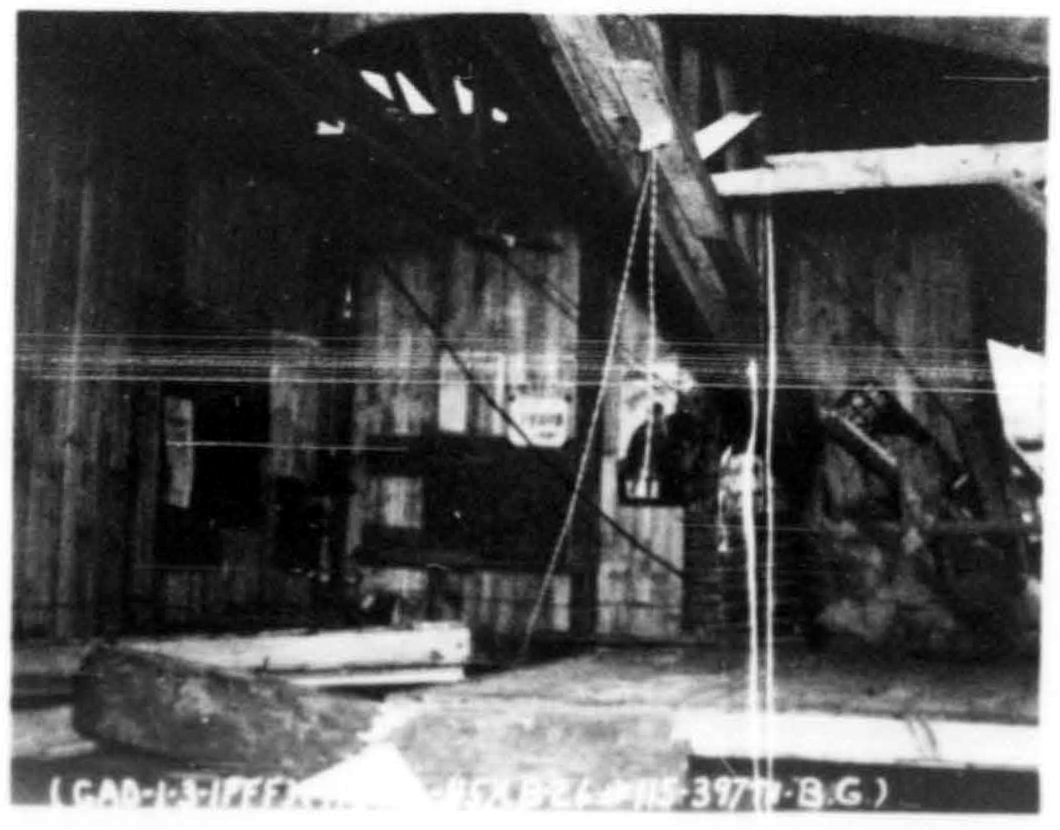
APP EXH "K". Photographs of crash on Hqs Building and Radar Truck, 4 Apr 45
[### Reel A0856 - Page 0576 ###]
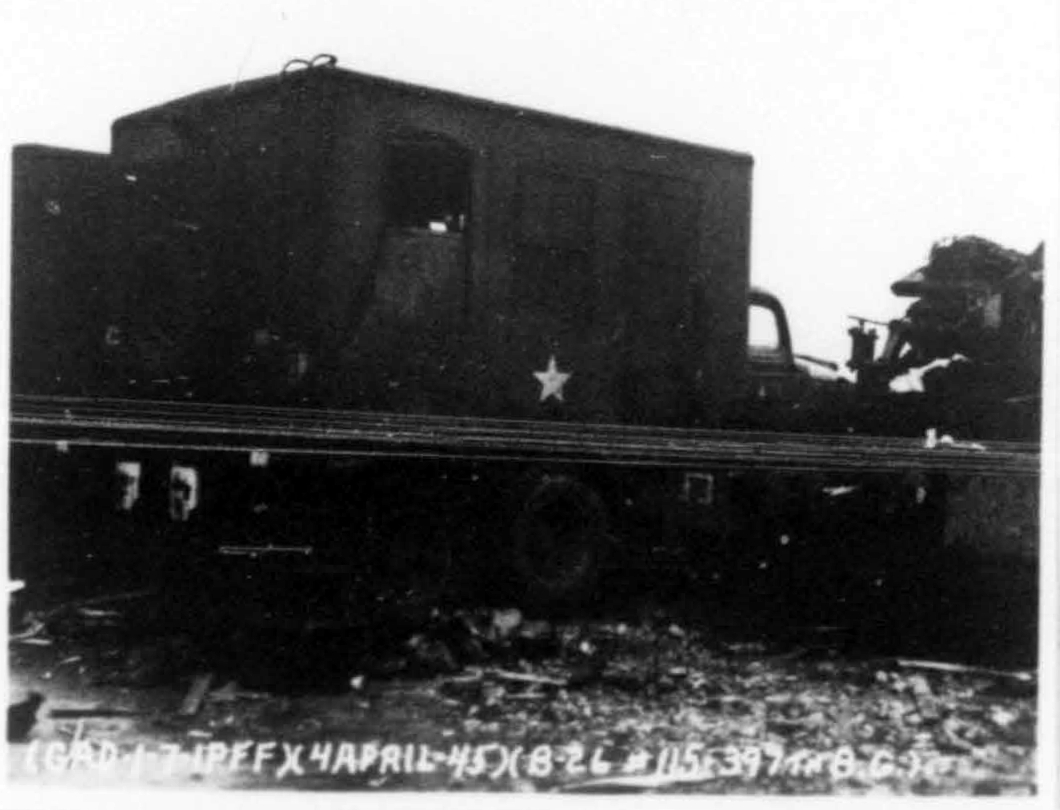
APP EXH "K". Photographs of crash on Hqs Building and Radar Truck, 4 Apr 45
[### Reel A0856 - Page 0577 ###]
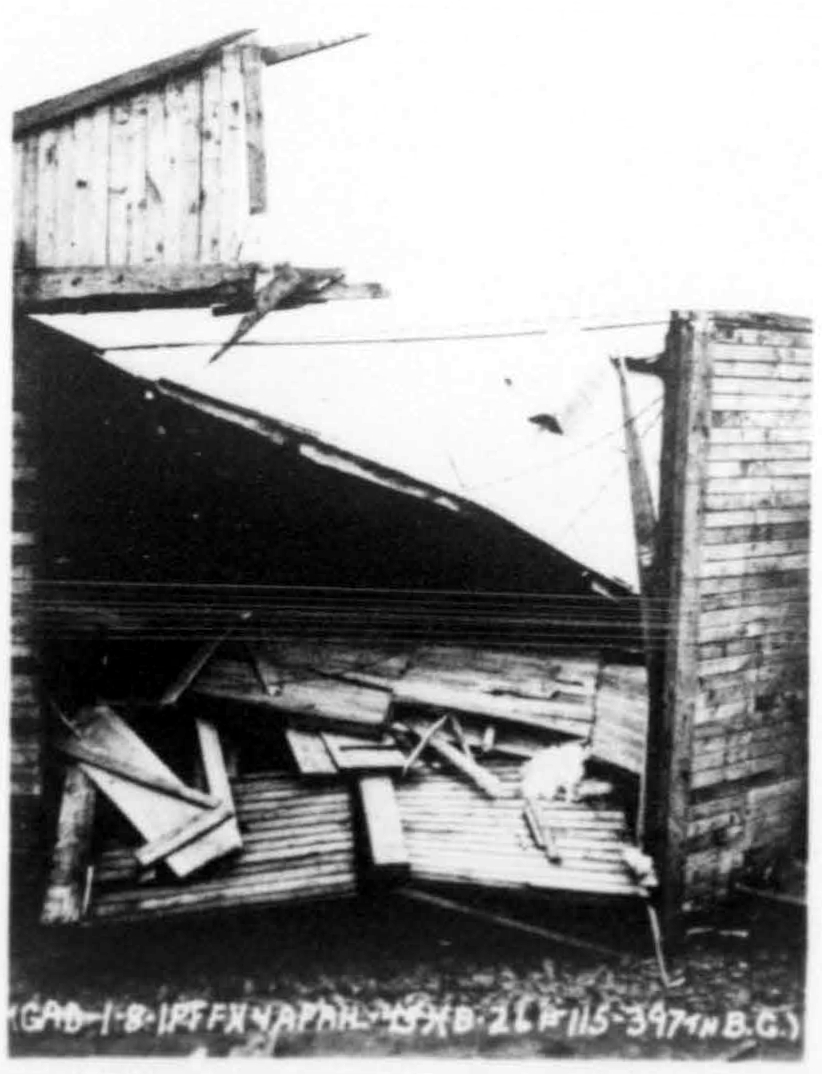
APP EXH "K". Photographs of crash on Hqs Building and Radar Truck, 4 Apr 45
[### Reel A0856 - Page 0578 ###]
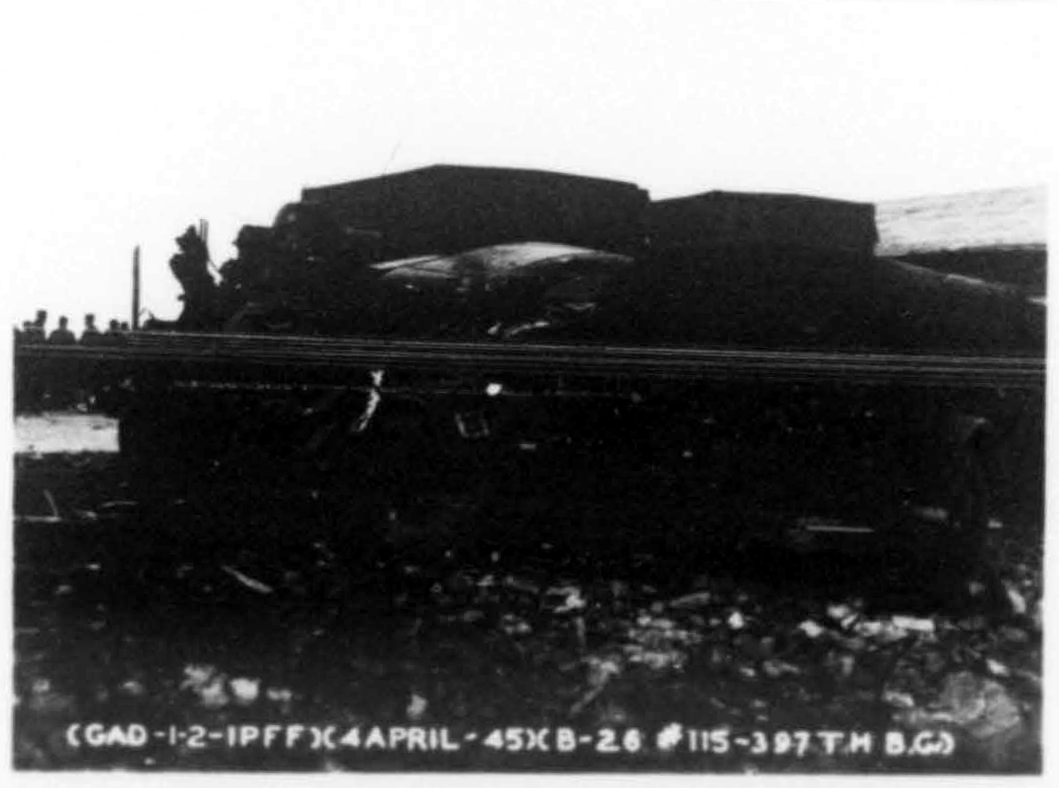
APP EXH "K". Photographs of crash on Hqs Building and Radar Truck, 4 Apr 45
[### Reel A0856 - Page 0579 ###]
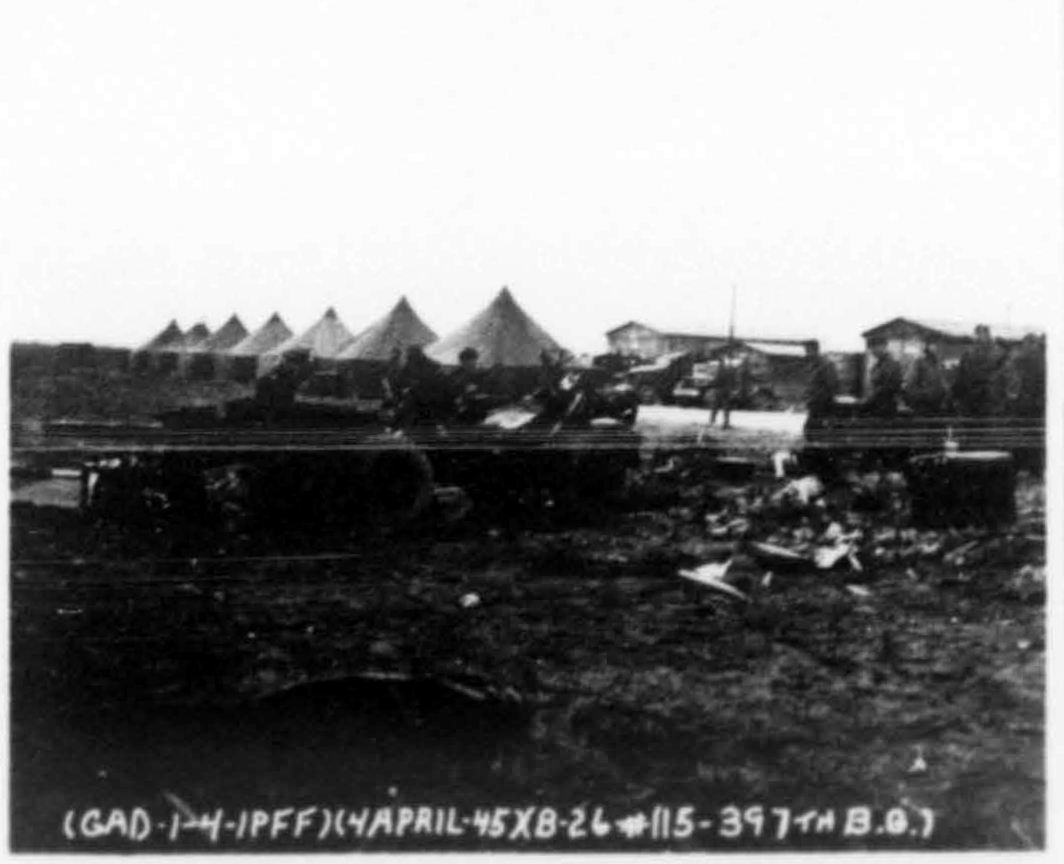
APP EXH "K". Photographs of crash on Hqs Building and Radar Truck, 4 Apr 45
[### Reel A0856 - Page 0580 ###]
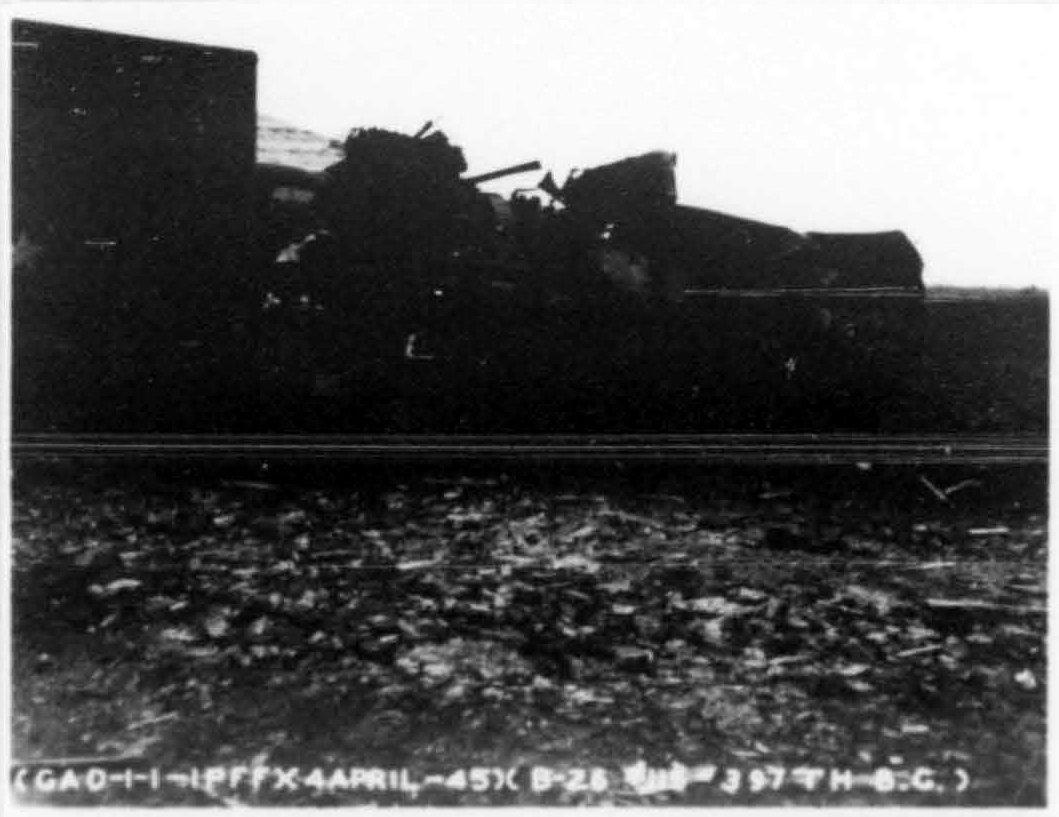
APP EXH "K". Photographs of crash on Hqs Building and Radar Truck, 4 Apr 45
[### Reel A0856 - Page 0581 ###]
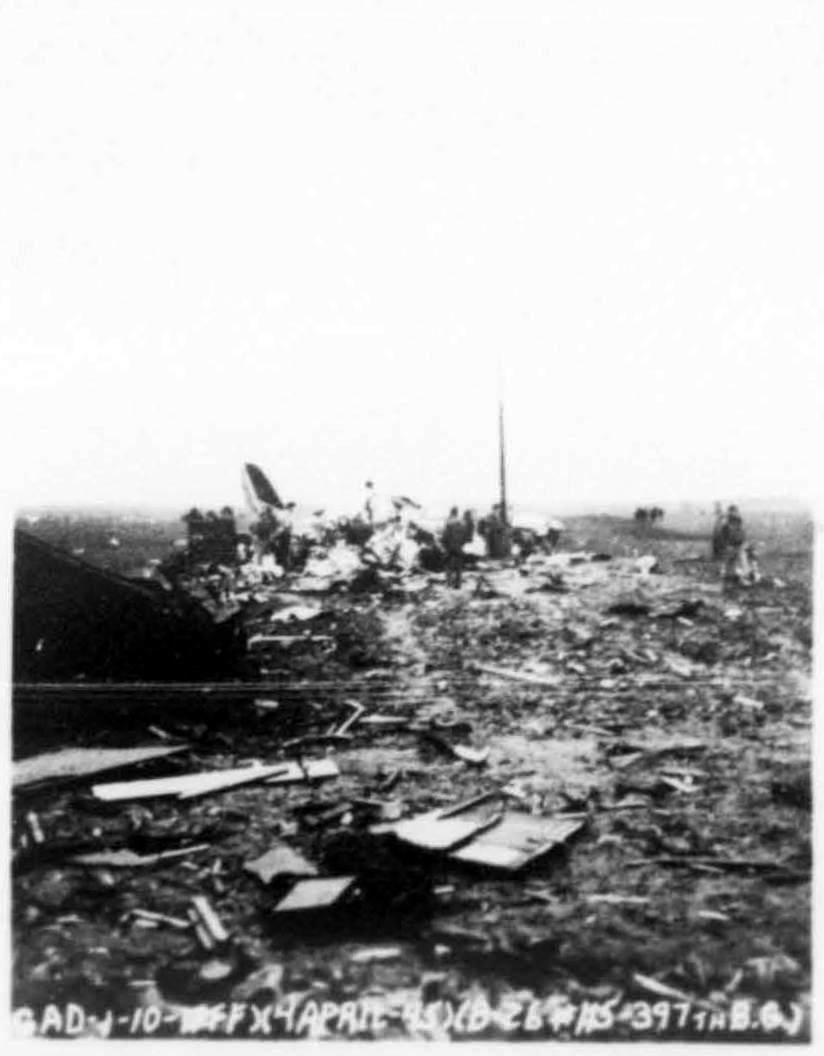
APP EXH "K". Photographs of crash on Hqs Building and Radar Truck, 4 Apr 45
[### Reel A0856 - Page 0582 ###]
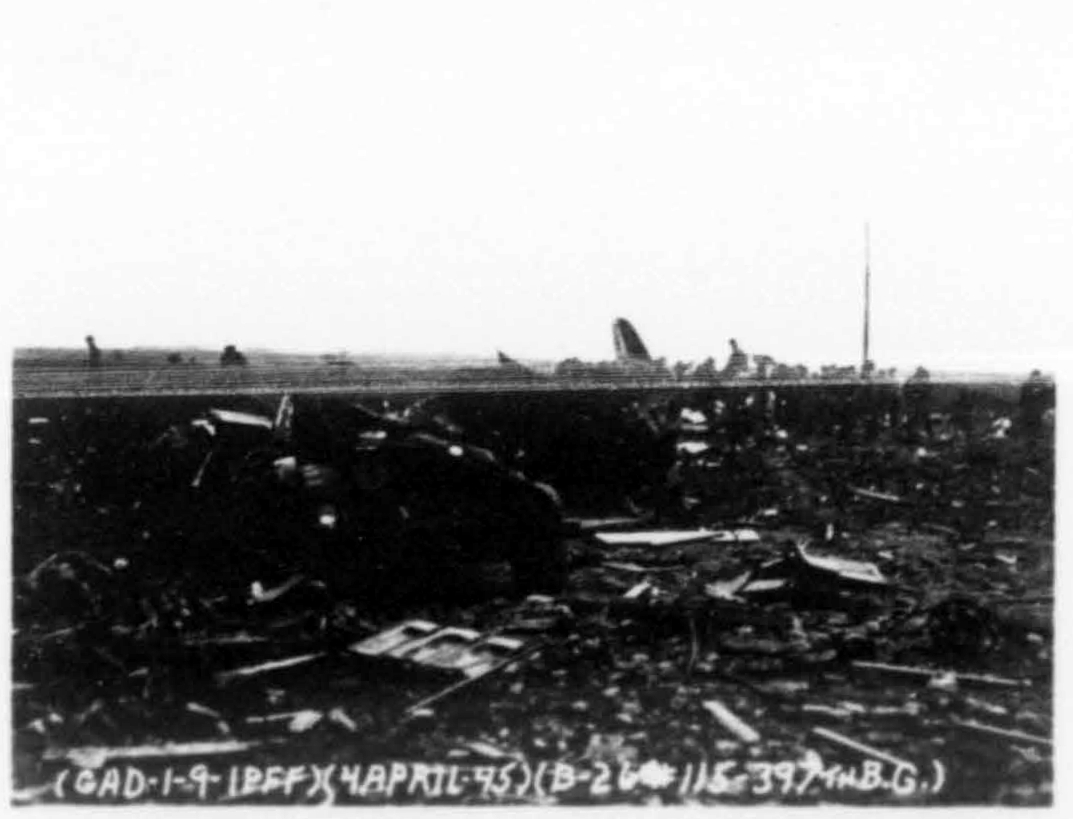
APP EXH "K". Photographs of crash on Hqs Building and Radar Truck, 4 Apr 45
[### Reel A0856 - Page 0583 ###]
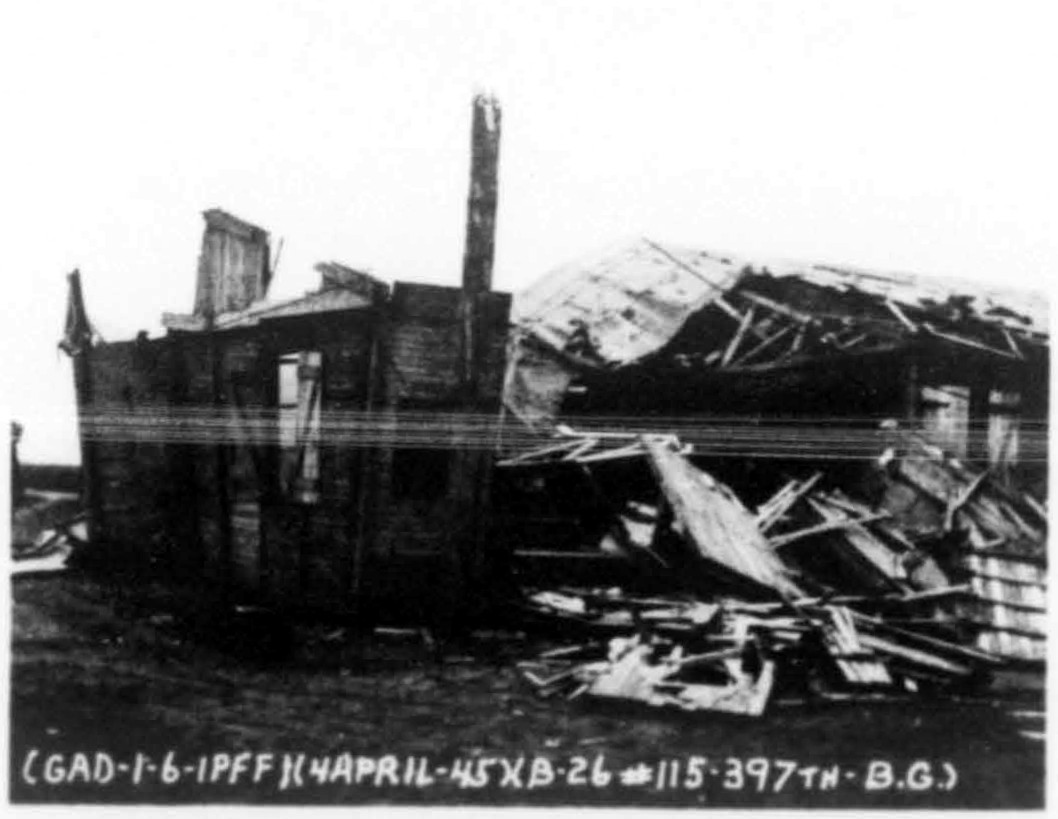
APP EXH "K". Photographs of crash on Hqs Building and Radar Truck, 4 Apr 45
[### Reel A0856 - Page 0668 ###]
APP EXH "L"
STATEMENT OF CAPT GERALD W SHIREY, OPERATIONS OFFICER:
Under the worst possible conditions - complete and surprising success! Under ideal conditions - complete and also surprising failure! Oboe is as temperamental as a beautiful woman, and I am asked to write down the reasons for success or for failure.
Surprisingly very few failures are due to the standard excuse: "Equipment failure." A conservative estimate would be 20 per cent.
One of the major reasons for failure was misunderstanding, first among the PFF crew members, and second, between lead crews and the groups. A faulty hearing of a signal from the pilot, a misunderstood word over an overworked interphone system, no contact over interphone system, no definite understanding with group and box leaders for cloud procedures, turn off target procedure, flare procedure - All added to lack of success.
The measures taken to overcome this? Long talks with new crews and old ones in the same session of different problems of the dearest teacher, Experience. Then, if possible, letting the same crew fly with the same group as much as they could. Thinking Oboe, sleeping it, eating it, hating it, loving it, cursing it, despairing of it, bragging of it, and finally, wondering about it, and all its problems. That is the foremost factor for the high success of Oboe equipment.
There was the organization factor, too. Operations, Intelligence, Radar, Communications, GEE, Engineering and Armament all had to be coordinated through Operations who in turn took orders from Controllers at Bomb Division. No easy job in itself.
Then, too, there are the numerous times when well trained air crews have pulled a mission out of the bag, so to speak.
That is, when technically the aircraft was receiving poor signals, and ground stations were tracking just as poorly. Crews in this case can only fly with the hope that signals will improve, which very often proved the case.
To some crews, instrument weather was a hazard, while to others the same weather was taken as a matter of course and flown thru to the completion of the mission. This, then, was a problem - to pick the right crew for the job to be done, with the meager information at hand.
This statement, by necessity, is brief; but, in conclusion, may it be said, without the complete cooperation of crews, sections, and controllers at Bomb Division, along with the many unknown personnel of the ground stations, it would not have been as successful as it was proved to be.
s/ Gerald W. Shirey
GERALD W SHIREY
Captain AC
Operations Officer
20 May 1945
[### Reel A0856 - Page 0670 ###]
APP EXH "M"
STATEMENT OF 1ST LT OTTO R KIRKPATRICK, Navigator p. 1
Pathfinder blind navigation in 9th Bombardment Division was born when 1st Lt William Harper and 1st Lt A A Riede with their crews from the 322d BGp were sent through the RAF blind bombing school and they in turn trained our 15 original crews.
These pioneer navigators together with their immediate successors had to overcome the Groups' reluctance to have their lead teams follow the same boys which they had "DS"-d to that "lost corner" of Great Saling Airdrome. Not until after mutual criticisms were exchanged, records and TOT's compared and consistent good results shown were the Groups satisfied to relinquish the lead at the PFF discretion. Then, too, the Pathfinder were given priority to do the GEE bombing for they first revised the old RAF method of superstrobe bombing only to be followed in their methods by the entire bomb division.
Many problems confronted the new group before and during their operational work. Navigators had to be given many hours of group classes and synthetic training for GEE and Oboe. Excessive hours in bad weather had to be flown as the American radar equipment was still much in its infancy and had to be perfected.
Being a provisional unit there was no T/O & E on which to draw new equipment as the unit grew in size. This necessitated, shall we say, borrowing shortages from the Groups by the PFF crews. It reached the point that a scrounge list was posted daily with the targets before the crews left for the other fields.
Upon moving to France in Sept 1944, there was only one table, the plotting table on which all navigators must work at once. This would be hours before daylight for the Pathfinder must fly to their assigned Groups for their pre-briefing. Also each mission had several targets for the different crews which added to the confusion.
Poor weather - the only time Pathfinder was used - added much to the Navigator’s miseries. For the time element is vitally important and weather greatly increased the problem of making the target at the correct minute.
The only time the Navigators had a well furnished and private room was at A-72, but while the Squadron Navigator was proudly displaying it to PFF's new rivals, the Shoran boys from the 409th Bomb Group, a 397th Bomb Group ship lost an engine while taking off and tore the roof from the building overhead so that was that. (Note: see photographs App Exh "K")
The Navigators of this organization were busy men in the air too for in addition to routine navigation they had to operate the GEE and Pathfinder Oboe equipment.
s/ Otto R Kirkpatrick
OTTO R KIRKPATRICK
1st Lt AC
Squadron Navigator
20 May 1945
[### Reel A0856 - Page 0672 ###]
APP EXH "N"
STATEMENT BY 1ST LT ALPERT J SIMONE, BOMBARDIER, P1
Lt Simone came to Pathfinder from the 344th Bomb Gp (M) on 29 June 1944, when the Pathfinder Sq had 14 Marauder B26 aircraft. Bombardiers were then being taught on the job by crew members on practice missions in the air over the bombing range at Otmoor, England. Since Lt Simone had already completed 25 lead missions with the 344 BGp, he commenced flying on missions for PFF immediately as a Bombardier. He flew his first mission on 30 June with Capt R S Sliff's crew leading one box of the 410th B Gp. The target was Conde sur Noireau road center. Within the week on 5 July his crew was assigned a Noball Target with the 409 BG at Chateau de Frohen in the Pas de Calais area. The weather was 9/10 cloud cover and bombing was done by PFF. The flak was heavy putting 45 holes in the airplane. Eng Gunner S/Sgt Herman W Campbell wounded and cut by glass stuck to his post and was later awarded the Silver Star for his heroism on this flight.
Lt Simone's first night mission came on the night of 7-8 July when the crews of Capts Crain, Sliff and Leuppe led the 322d BG in an attack on Noball Hqs at the Chateau de Ribeaucourt. Lt Simone's crew was the first to light a target that night in the Pas de Calais area at 30 minutes past midnight. They dropped landfall flares as they entered enemy territory. Then enemy night fighters got on their tail a few minutes later. Radio Gunner T/S Dick (R S) Attinger threw out window and Capt Sliff did violent evasive action. But the Jerry immediately came right back at their tail firing. The Radio Gunner started shooting from waist position and the enemy fighter veered off apparently in trouble. The Group below them saw the Jerry going down to crash in the moonlight, and the Rad Gunner received a probable. Then the Germans sent up fake yellow landfall flares to confuse the Group following 30 sec behind them, but the enemy ruse did not work.
When the PFF aircraft started down the bomb-run, their plane was coned by searchlights which held them in the light during the entire bomb-run of nine minutes. The searchlights also coned the Group. This use of searchlights may have been for the use of the enemy fighters. The PFF plane dropped target indicators exactly on time as a result of successful navigation. The faint outline of the target area was all that could be seen from the plane.
The Germans continued to send up the red and green flares over a ten mile square area to deceive subsequent Allied planes, so the PFF aircraft made 3 runs across the target, each time reversing the order of the color of the flares. This rendered worthless the German efforts to copy the flares.
On the return to base, the PFF aircraft dropped flares for enemy landfall out and these flares were copied by Jerry who sent up other flares all along the coast. According to reports of the Group they were not fooled by the fake flares.
The 322d BG lost nine of its aircraft to enemy attacks that night, probably all to night fighters. Only 35 aircraft had taken off to bomb the target. It was a beautiful moonlight night.
When Lt Simone was still with the 344th BG, the Pathfinder aircraft were doing their part to destroy enemy defenses. The medium bombers went in at tree top level and strafed and bombed enemy outer mine defenses and inner machine gun defenses on the Normandy beach-head on D-Day.
It was also before Lt Simone came to the Squadron that an enemy 88 mm shell lodged in the stabilizer just fore of the rudder of his B-26 plane. The crew did not know they carried the live shell when they made the landing at Ipswich to get their bearings and the following take-off and landing at home base. The intermediate landing was necessary because their radio had been destroyed by flak, and the heavy rain prevented observations of the ground.
Black Friday was the 23 Dec 1944 for 1st Pathfinder Sq. In the first decent flyable weather during the Bastogne Bulge Campaign, we lost three crews, all being jumped by fighters during the bomb run over the targets which were enemy concentrations of troops and ammunition dumps about 20 miles back of the front line and 25 miles apart. In this battle we bombed ammunition dumps, communication centers, highway choke points, troop concentrations, and bridges. An interdiction circle was drawn around the bulge to prevent any Supplies or reinforcements from reaching Von Rundstedt's troops. Weather was very hazy with fog, and PFF equipment was used considerably.
At first. PFF used only TNT bombs of 500 lbs each. Later, they adopted 500 lbs and 1000 lbs bombs of RDX, 500 lbs liquid fire bombs, 500 lb incendiary clusters "Aimable", and 250 lb fragmentation bombs. Also, they carried tons of propaganda bombs. For a while the 9th AF was called the "newspaper boys" because they were dropping propaganda bombs by Oboe and visually.
At Le Havre the Pathfinder aircraft followed the first daylight raid of the RAF. The British planes dropped explosives from 1500 heavy bombers. Pathfinder aircraft went in singly 15 minutes after the English raid and dropped pamphlets every 15 minutes. Capt M H Ferguson flying the first PFF aircraft had to circle outside the target area while the RAF were coming out in the late afternoon.
Pathfinder also dropped pamphlets on Dunkirk, and in Holland at Rotterdam, Eindhoven, Flushing and the Hague.
New Bombardiers were started immediately on a training program including time on the bomb trainer, map reading, pilotage, dead reckoning, GEE operations, photo interpretation, effect on course of plane of bomb load, time and distance problems, ABC computations for the automatic pilot, computation of altitude, wind changes, and flight plans. Also, practice in the air on PDI range, cooperation between Pilot and Bombardier, and a course on cooperation between Bombardier and Navigator in which the Bombardier helps the Navigator as much as he possibly can during the entire mission. Bombardiers were trained to observe results on the ground, and in the air, anything that pertains to ground movement of troops, marshaling yards, freight cars, convoys, airfields, planes, and river boats.
We received new developments in Oboe from RAF who gave us marvelous cooperation. All ground station personnel at Oboe stations are RAF personnel. They have maps of the entire bomb run where 1 in equals 6 mi. As the plane approaches target, they blow up the image. They have special wall survey maps where 1 in equals 6000 yds. They plot backwards from the target.
The RAF PFF sends out reconnaissance planes to get all initial data. Photos are made by PFF ground station observers from 14,000 ft and maps checked therewith. Then the coordinates of the aiming points on targets are handed down to the 1st PFF Sq (M) Prov from higher echelons.
In the end of the German campaign when we flew long distances to the targets, the photos furnished were not as good as the ones we had in France, and the radar signals were not so clear over the long distances, so that frequently our Bombardiers and their crew members were called upon to use their ingenuity in bombing on a combination of equipment, GEE and Norden which they did with good results.
s/ Albert J Simone
ALBERT J SIMONE, 1st Lt AC
Squadron Bombardier
15 May 1945
[### Reel A0856 - Page 0678 ###]
APP EXH "O"
PATHFINDER INTELLIGENCE
MAY 1945
Arrival in France of the 1st Pathfinder took place the latter part of September 1944. The technical site was located in an open field just off one runway of Beauvais/Tille airfield. Operations and Intelligence worked together to construct a two-room building from parts of underground hutments that the Germans had left. The space allotted to Intelligence consisted of a room approximately twenty-five feet long, twelve feet wide and eight feet high. This room was the Situation room, target and map room, office and briefing room.
Under the circumstances Intelligence was obliged to use plexi-glass overlay over the situation map for briefing. Routes are drawn on the overlay and the flak, experience and gun concentrations were seen underneath the route lines. Because Pathfinder was leading virtually all the missions of the Division, usually eight and ten different routes were plotted and briefed in detail. Because of limited space only the officers of the crew were briefed. It became the responsibility of the Copilot to give all necessary facts to the gunners. Four to six crews were briefed together or less, depending upon the assignment of targets. There was no crew ready room or any other convenient place for crews to wait. Operation and communications and navigation briefed in the Operations room which was about the sane size as the Intelligence room. Interrogation was conducted in the same room. Techniques used were simplified variations of those used later at Perronne which will be explained later in this writing.
Under the new commanding officer, Lt.Col. Bill E. Hale, Intelligence started to receive requisition supplies necessary to carry on its work properly, the needed additional personnel and, by virtue of movement to Perronne, the necessary space to work. Operations had a large room. Navigation had a separate room, a large crew room approximately twenty feet wide, fifty foot long and twelve feet high. In addition to security and P/W posters and strike and recon pictures, two main maps were maintained. The briefing map in the front of the room was a gridded 1:250,000 Air map, used because of its greater clarity and its similarity to the 1:500,000 Air Map used by bombardiers and navigators. The battle situation map, maintained by Major Holland, Ground Liaison Officer and his sergeant was an Army Air 1:250,000 map. Both these maps as well as maps of the Russian, Italian and CBI fronts were mounted on plywood backing, stapled and doped with clear airplane dope sprayed on the surface. It was also discovered that mounting was improved by first spraying the plywood, then mounting the maps and then spraying the map several times.
Major Holland's situation was maintained down to division level with varying colored paper-headed pins. Colors denoted Nationality and Command level of the unit, while the numerical designation was recorded on the paper insert on the head of the pin. Both bombline and front line were shown by fastening yarn to the map with small roundhead map pins. White map pins designated front line with most recent advances shown by blue pins (advances within last twenty-four hours). Black or deep blue yarn ran along the front line with armored thrusts indicated by the use of red yarn. The bombline was shown by using white yarn and brown map pins. Acetate and grease pencil were used to reveal information on the other fronts, as well as to illustrate GLO briefings on smaller scale maps of portions of the western front.
The GLO program which was most effectively carried on by Major Holland was eagerly received by both ground and flying personnel and proved to be a full-time job for one officer and one enlisted man. Formal briefings were fitted into the operational schedule for the day and informal briefings wore conducted throughout the day. It is estimated that about 75 to 80 percent of the command was reached regularly. It is judged that the program had greater effect upon the ground personnel than upon the flying men, particularly from a morale standpoint.
Before describing in detail the briefing, an understanding should be given of the situation room and the tools at hand. The situation map is a 1:250,000 Army Air map, mounted and doped as previously described and covered with acetate. On the acetate is shown (1) the Bombline (2) the boundaries of the TAC areas (3) flak and fighter experience. Flak experience is recorded only in terms of intensity upon the map by using three symbols; a triangle signifies intense, square moderate, circle meager. In addition five colors are used for these symbols, four of which represent the four most recent weeks and the fifth, preferably blue or black, represents cumulatively the most recent flak experiences (this takes care of periods previous to the four recent weeks). Sources for this include 9th Bomb Division mission Summaries, Eighth Air Force Mission Reports, 9th Air Force Weekly Summary. Eighth Air Force Weekly Summary and Flak Teletypes. For additions reference on flak the British "Blob" map is referred to, to supplement experience information; also the 9th Air Force gun position map is maintained and kept up to date. Briefing officers must make reference to all three sources and in the event of discrepancy between the last two sources mentioned, the greater number of guns will control.
Fighter experience is recorded on the acetate by a three symbol method similar in its workings to the flak experience, one symbol for each single engine, twin engine and jet. Symbols are put on the map only in event of attack. This information is supplemented by using the jet airfield map and by and by noting also on airfield maps from the most recent of all sources received the operational airfields. The reasoning behind this particular type of handling enemy fighters as opposed to the old system of plotting numbers of operational planes at particular bases or in particular areas is that the reports which are basic for the latter started to lag behind the progress of the war to Such an extent that they gave quite apparently erroneous impressions and information. The former system mentioned seemed to cover the most recent and accurate intelligence on the GAF.
The briefing officer from this information accomplishes his briefing notes and draws routes, reproduces the flak and fighter information with grease pencil on plexi-glass sheets mounted over the acetate on headless nails which match exactly in position also headless nails affixed to the briefing map in the crew room. Thus the mission worked in the situation room and the graphic aids to briefing are transported to the crew room merely by carrying the plexi-glass to the crew room and mounting the sheets in proper position over the briefing map. Because in early days of Pathfinder the unit was grossly understaffed and the Operations representatives were also flying missions regularly Intelligence took on added burdens of briefing completely the route, target elevations and other data not usually included under intelligence. Therefore the briefing officer is required to have complete notes on route, flak, fighters, number and call letters of each aircraft, name of crew captain assigned to each aircraft, group to be led, all with reference to the correct target. Also he mist brief on hospitals, P/W camps, frontline passwords for three days and the point of crossing into TAC areas (this has been done away with).
Aside from the general briefing the briefing officer's main efforts are directed toward aiding the bombardiers. This became necessary because numerous instances of equipment failure, late on bomb run required that Pathfinder bombardiers be able to save the mission by releasing combination Nordon-Equipment or by dropping purely on Norden. Both methods have proven gratifying in saving otherwise abortive missions.
The briefing officer consequently prepares for each bombardier a glass-lined navigator's kit insert with four available "windows" or pockets. In the first is placed a 1:500,000 showing the route, bombline and flak information as it appears on the briefing plexi-glass; in the second appears a 1:250,000 Air map of the target and including the bomb run (target is circled); in the third is the appropriate 1:100,000 map with pinpoint DMPI marked; in the fourth is an illustration also with DMPI marked,
By way of aiding briefing officers and duty non coms in finding appropriate maps quickly the following method was evolutionized to the one presently used; a cardboard backed plexi-glass sheet with the grid squares drawn upon it has affixed to each side and the top, a sheet of transparent drawing cloth upon which are properly scaled map indices, one for each of the mains required in the bombardiers kit. From the work sheets (telephonic information on the mission is recorded on a coded work sheet because teletypes very often didn't arrive until after Pathfinder planes had taken off) the briefing officer pinpoints the target on the plexi-glass and then throws the sheets, one at a time over the plexi-glass. By reading the pinpoints representing the targets through the oriented indices he sets references to proper maps for eight and ten targets in a matter of minutes.
The modification of this which is presently used works as follows; The briefing officer plots the routes and targets on the plexi-glass for briefing as it is mounted on the situation map and another sheet of plexi-glass with map indices is mounted over the routes and targets. This also served as a tine saver in determining which were the appropriate maps without any wasted motion,
During a period early in the stage of bombing from French bases Wing field orders arrived at groups with only visual aiming points; the exclusion of Pathfinder aiming points led to erroneous evaluation of Pathfinder bombing. The briefing officer then had to make it SOP to brief bombardiers on Pathfinder pinpoints by grid number as well as to pinpoint it on the map and picture.
Interrogation followed the pattern set forth by Division directives and the only deviations made by Pathfinder are the omission of flak overlays, picture laydowns and fifteen minute calls. Also the interrogation form is designed to include all the information necessary to furnish all the other sections information for their reports and reference.
SECURITY: The senior intelligence officer has, since the organization's inception, met with new crews for two hours to impart specialized security rules pertaining to Pathfinder and to cover briefly the important points and latest developments in PW and Escape and Evasion. Monthly security talks are worked through the section heads and posters of our own creation and official posters are in evidence throughout the technical and living site. Civilian passes arc handled by Pathfinder Security Officer in conjunction with the base Security Officer.
WORK-FLOW SYSTEM - Everything entering the Intelligence Office is recorded first in the journal and the receipts are immediately checked. The Duty Officer is required to sign the receipts before distribution is made. In the case of teletypes the Duty officer must read and initial the teletype upon its reception. Outgoing items as well as returning receipts arc recorded in the journal when they leave the office.
Documents of general interest arc circulated to all officers until they contain initials of all officers. Specialized items go to the Specialized officers after passing over the Senior Intelligence Officer's desk. One clerk is completely in charge of general files so that they may be kept in order. Two clerks arc regularly assigned to Maps and Target section and they receive necessary assistance from the other clerks as required. It was found that the services of a draftsman is necessary to the proper working of the section for such things as gridding ungridded maps, plotting photo coverage on maps to serve as indices, etc.
In training and using clerks it was found that the most desirable method was to acquaint every clerk with the target section and with all other phases of Intelligence work. Therefore, all clerks when completely trained are capable of stepping into any function of the office. Officers similarly must be able to all phases of the work. Specialization for officers has been broken down into Responsibilities as follows: (1) P.I., Targets, Maps (2) A/C Recognition and other Training (3) Flak and Fighters (4) History and Public Relations (5) Security, Asst P.I., Targets and Maps (6) PW, INFORMATION, Reporting and Procedure and awards.
REPORTING: The duty officer is responsible for the making of reports on missions. He works with his duty clerk, all clerks having been trained in reporting. Reports are made up as rapidly as crews are interrogated and Opsflash material is given to the teletype men piecemeal. This method results in having the report virtually finished and the teletype tape virtually completely cut by the time the last completed interrogation form is received.
TARGET SECTION
MAP FILES: The following types of maps were maintained in bulk in two files G.S.G.S. 4416, 4346, 3982 and 4012. The bulk supply have been maintained at twenty copies plus five to take care of any emergencies. The general usage file maintained at a level of twenty copies and supplied from the bulk files as needed.
General information files are maintained of G.S.G.S. 4414 and various scale maps of the countries bordering western Germany as well as town plans of all the cities and towns available in France, Belgium, Holland and Germany.
BASIC PHOTO COVERAGE: Basic photo coverage to conserve space is filed by sortie number without regard to area. It was also found that the somewhat simplified the picking of photos for use as bombardier aids.
RAF INDUSTRIAL AND TACTICAL TARGET COVERAGE: This coverage including the midnights are filed in numerical order and for the selection of this as coverage reference is made to the Station Lists. Airfield Station List and Alphabetical and Numerical Indices of advances Material Issues.
TACTICAL TARGET FOLDER: Both the annotated prints and the mosaics are filed numerically by the number to the right of the slash and indexed on an index to the G.S.G.S. 4414 (1:25000) maps, areas and numbers being the same.
9th AF "T" REPORTS: Those reports are filed in numerical order until such time as it becomes an active target at which time it is removed and placed in the active target file.
DAMAGE ASSESSMENT REPORTS: Those reports are filed in the active target folders and in numerical order where target is not an active target.
ACTIVE TARGET FOLDERS: Those folders are made up as the targets become active and contain all basic photo coverage, dossier material 9th AF "T" and "D" reports and photo recon pictures as received after each attack. It is intended, now that this organization has a photo section, reproduces these photos so that the bombardiers will have the latest coverage available, This section also maintains a book of strike attack photos of all strike attack photos of attacks in which PFF planes participated supplied by the groups as well as the photo's obtained from the camera carried by PFF planes.
This is done in a manner similar to the laydowns furnished to Bomb Division. The best pictures showing the details of the strikes, the first phase interpretation report, the mission summary (extracted) covering the mission and Group, and the BD/SA issued by the 20th PID are used. This strike Photo Book will constitute a part of the pictorial history of this organization.
GILBERT C. HINE
Captain, Air Corps,
Intelligence Office
[### Reel A0856 - Page 0548 ###]
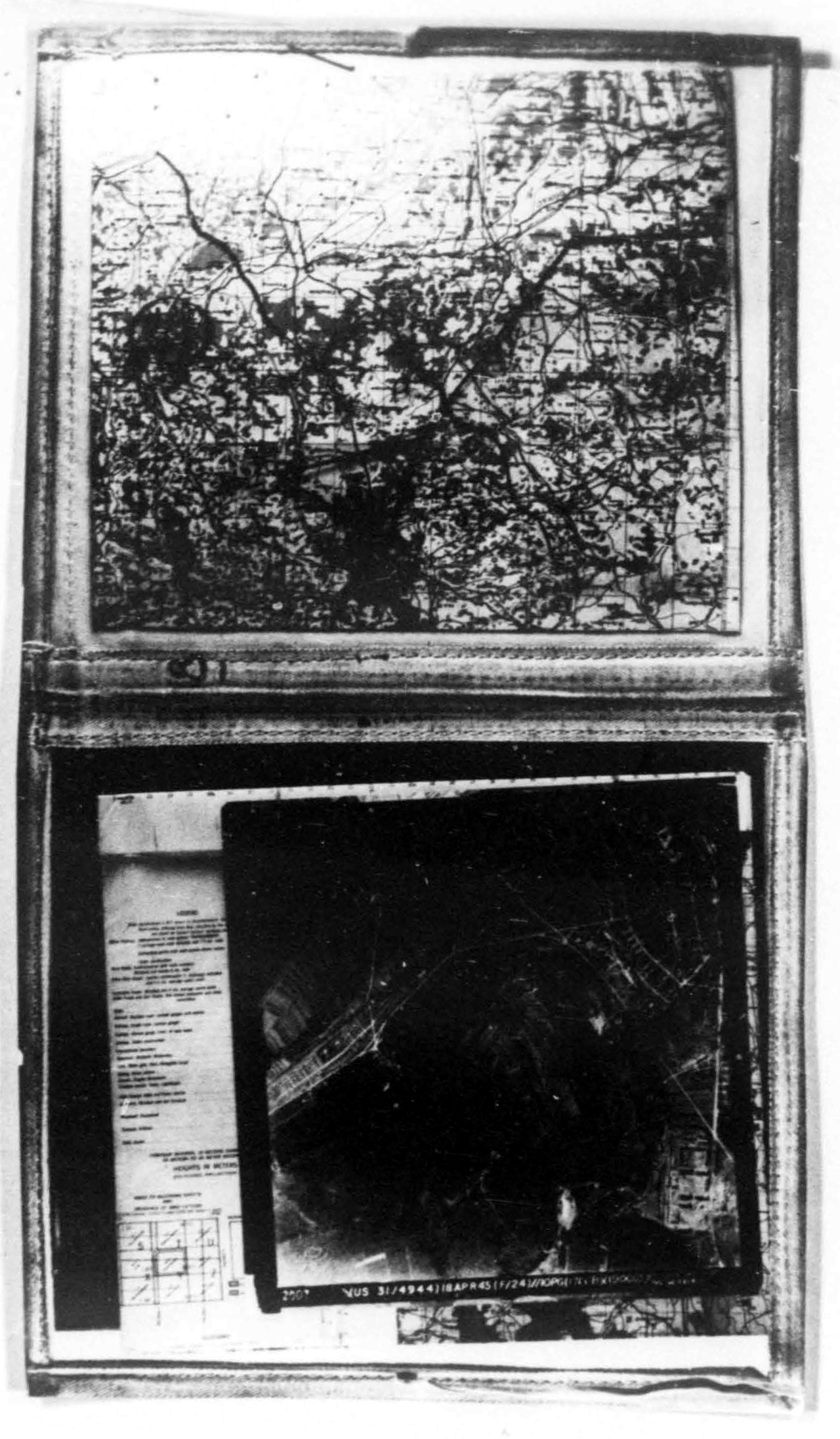
APP EXH "P". Photograph and Map showing Route in Bombardiers's Folder
[### Reel A0856 - Page 0685 ###]
EXH "Q"
STATEMENT OF COMMUNICATIONS SECTION:
When the 1st Pathfinder Squadron was first formed at Station 485 February 15, 1944, the Communications Personnel including telephone and teletype men consisted of just 24 men. Lt Homer B Whitaker was the Communications Officer at the beginning and acted in that capacity during the entire life of the organization.
The first Communications Section Chief was T/Sgt Gerald Savard. The Flight Chiefs at the start were S/Sgt F L Kennedy, S/Sgt P E Kennedy, S/Sgt Henry Hass, and S/Sgt Allen Johnson. During March 1945 T/Sgt William Spillers became Section Chief of Squadron "A" and M/Sgt Joseph St Arnaud became section Chief of Squadron "B".
At the outset of the Squadron there was absolutely nothing in the way of signal and Communications equipment. Telephone facilities were handled through a 12 drop English type switchboard, This served while the Squadron remained in England, and it was not until the Squadron moved to France that Telephone switchboard facilities were obtained capable of handling 50 drops. At the conclusion, the Squadron had 2 BD 91-B switchboards.
The Roster of Communications Personnel at the beginning was as follows:
T/Sgt Percy E Kennedy
T/Sgt William Spillers
S/Sgt Allen Johnson
S/Sgt Henry Hass
S/Sgt Francis L Kennedy
S/Sgt Leo Schnitzer
S/Sgt Thomas A Devlin Jr
Sgts Gerald C. Agnew, Thomas F Devine, Jr, Theodore
P Ginsberg, Joseph Pelletier and Herman Petterman
and Max E Talton.
Corporals Harry Bachler Jr, Norman Fleischman, Walter
J Forrest, John Krusko, Jack Nilsen, Herman Perlmutter,
Harold Reich and John M Stenz.
Pfc's Lawrence Hern, Samuel Roth and Jack Travis.
At the end, the Squadron had 48 Communications Personnel.
[### Reel A0856 - Page 0686 ###]
APP EXH "R"
STATEMENT OF [blank]
When we joined the men who were to be known as the First Pathfinder Squadron (M) Provisional, we could not find anyone of the first arrivals who knew why they were being brought together. We moved into the tents in February, and there were no stoves in them. The Station Complement had moved out of the tents into huts. Many of the men did not stay in the cold tents, but slept in the Nissen Hut of the Red Cross at the 322d BG nearby. Others slept within any warm place they could find at the 322d BG or elsewhere.
Rumors were plentiful about the "Provincial", Provisional or "Prudential" commando squadron that was being formed for the invasion. No one knew who the officers were at first. When someone mentioned the word "Pathfinder", a few days later orders from the Base came down not to mention that word to anyone. Then one day an airplane B 26 (903) came onto the line guarded by 3 MP'S. No one was allowed to approach it, for it contained Pathfinder equipment.
There was a call for a meeting of all personnel one week or two after I arrived. We were then told who the officers were for the first time. No organization had been set up before that time.
Some of the first planes sent to us from the Bomb Groups had to be immediately returned to them for they were unsatisfactory. Many of the crews did not want to learn the equipment and would not cooperate as students. They were transferred out. There was a constant shifting of personnel.
The 322d BG line was across the taxi-runway from ours. "Moonlight requisitioning" was adopted. Gradually the supplies started to come in, but we never had much at a time. We started out with one set of dypes. Later we received twelve sets for all three sections: Armament, Engineering and Communications. Never in all the history of Pathfinder Sq did we have a complete supply.
In our section, the Enlisted Men and Lt Whitaker pooled their money and went in to buy tools that our section needed. Once we heard of a rectifier lying around in the 323d BG. It was obtained for us along with 1 or 2 test meters. If it had not been for the equipment and tools scrounged, the Squadron could not have operated.
[### Reel A0856 - Page 0688 ###]
APP EXH "S"
STATEMENT OF 1ST LT DONALD C MADDEN, ENGINEERING OFFICER:
The 1st Pathfinder Squadron (M) Provisional commenced operations in February 1944 with only 3 aircraft, all of which were B-26 Marauders. Shortly thereafter, it had acquired a total of 15 aircraft, all B-26. At the same time 6 Havoc A-20 aircraft were assigned to the Squadron. However, the oboe equipment did not prove effective in the A-20 aircraft and they were reassigned.
During the early period of operations the greatest problem was the lack of trained personnel and adequate equipment. We received equipment intended for a B-17 squadron and adapted it to our use. We borrowed other equipment from the 322d BG which we also flying B-26 aircraft. That Group furnished us the first 3 aircraft we had. A large number of the Engineering personnel were not trained in the maintenance of B-26 aircraft. From the start most of the personnel received had been trained on other aircraft. At one time the maintenance personnel had been trained in the maintenance of A-20, B-17, P-51, P-47 and C-47 aircraft, but had no previous training on the B-26. Training had to be given to them on the job.
The Squadron continued to acquire more aircraft until it was operating 40 aircraft. The size necessitated the breaking up into two lines with two line chiefs for the Squadron. Each line was called a "squadron line" and became known as "Squadron line A" and "Squadron line B" of the Engineering Section. The Line Chief of "A" was M/Sgt G E Cook and of "B" was M/Sgt P J Healey.
The final size of the Squadron was 40 aircraft. From the time the Squadron was activated until V-E Day, squadron aircraft aborted only 7 times due to known engineering malfunctions. A list of these appears in the statement of Sgts Cook and Healey, App Exh "T". The number of combat sorties flown between activation and V-E Day was approximately 1700.
The first Engineering Officer of the Pathfinder Squadron was 1st Lt Walter A Spencer. He remained Squadron Engineer until the two squadron lines were formed in January, 1945, when he took over Squadron Line "B" and Lt Donald C Madden took over Squadron Line "A". In February 1945 Capt C M Higgins came to the Squadron as Engineering Officer and Squadron Technical Engineering Officer vice Captain Higgins who remained as Technical Inspecting Officer.
s/ DONALD C MADDEN
1st Lt ac
Engineering Officer
19 May 1945
[### Reel A0856 - Page 0690 ###]
APP EXH "T"
STATEMENT OF M/SGTS G E COOK AND P J HEALEY:
The 1st Pathfinder Sq (M) Prov got its first three aircraft on 14 Feb 44 from the 322d BG. They were all B-26 Marauders. Major Porter, the first Squadron Commander, flew in ship 41-31936 model B-30. It is still in use and has outlasted five different engines that have been used in it. In May, 1944, we had 15 B-26 aircraft. Of the original ships, the following aircraft were still in use on V-E Day:
41-31706 B-16 Danita
41-37722 B-21 Five Aces
41-31936 B-31 £1 Burro
41-94867 B-50
42-95872 B-50
42-96203 B-55 Terrible Turk II
42-107579 C-45 Silver Dollar
The Squadron started without supplies, tools or equipment. There were 50 Enlisted Men and one Officer in the Section, Lt Walter A Spencer. We used equipment borrowed from the 322d BG which was also stationed at the Great Saling Airfield. The aircraft we received had all flown missions for other Bomb Groups. At V-E Day, the oldest plane in use was the Terrible Turk I, no. 41-31668. It had survived one attack when a 90 mm shell passed thru its fuselage. This ship was overhauled at the shop at Stanstad where it was left from May to September 1944.
Model F and G aircraft furnished the Squadron as replacements have 34 degrees more of an angle of incidence than the older B and C models. The experience of the Squadron showed that they had less engineering trouble with the older planes with the more nearly horizontal wings.
From activation to V-E day there were only 7 known engineering malfunctions on ships going on missions which aborted due to the engine failure in the approximately 1700 sorties flown. They were:
Date - Number of A/C - Pilot - Nature of Failure
*1944*
25 April - 579 - Capt Smith - Window fell into voltage regulation box
June - 903 - Capt Lamb - Rt engine cut out. Turned back over channel.
20 July - 722 - Capt Harris - Lt engine failed due to frozen cam.
20 July - 910 - Capt Lamb - Rt engine failed.
Dec - 859 - Capt Shirey - Rt engine failed.
*1945*
19 April - 809 - Capt Thayer - Rt engine failed.
4 April - 903 - Lt Enneking - Lt engine failed
There were occasional instances of engine trouble which did not result in failure of the mission. After the return of any ship when engine trouble was reported, the aircraft was checked and if the engine ran satisfactorily during the check, it was not classified as in engineering malfunction. An engine could conk out due to vapor lock in the carburetor or could ice up on take off and fail. In the former case forced feeding of additional gasoline could clear up the vapor lock. In the latter case, the hot air on the carburetor during flight would clear the icing up. Aircraft no. 936 flew the longest period of time since activation without a single abortion. It was one of the original 3 ships. Most of the engine failures were due to bad carburetion. In one instance, it was necessary to install three different carburetors on one engine in one and one-half days and 40 minutes of flying time. The matter of carburetors became so critical that a General Order was published on the subject in November 1944, requiring that all carburetors be changed every 200 hours. The squadron had its first carburetor failure in June 1944. A new carburetor diaphragm which had been checked for everything but air was put into use, and the air had a tendency to crack it. There was no accurate marking on the outside of the carburetor to indicate what type of diaphragm was being used in it, so the carburetor could not be definitely depended upon. Sometimes they lasted 200 hours, and sometimes they did not. There was also a tendency for floats to stick in carburetors due to changing from metal to rubber caps on the needle valve.
In the early days of Squadron, we used parts from one crippled ship to repair another. In this manner we were enabled to provide the required number of ships for each of the oboe equipment channels 11-B, 11-C, 12 and 13. It was necessary to have an equal distribution of ships on each of the four channels. If there were not enough channel 11-B ships ready for flight, for instance, and there were more than enough channel 12 ships ready, the missing parts would be taken from a 12 ship to equip the 11-B ship and make it ready for the mission.
When the Squadron moved from England to France, it had flown 504 sorties with only 4 abortions.
The daily routine was for the Operations Clerk to call Engineering 5 hours before takeoff. We got up and notified Crew Chiefs. They pre-flighted the aircraft by warming up the engines 10 or 12 minutes or 20 minutes in cold weather. In cold seasons it was necessary to get the ice off the fuselage and wings. This took solution and a lot of scraping. The weather at Beauvais and Monchy-la-Gache was the roughest, because of the ice and snow.
On one day the temperature got down to 32 degrees below Fahrenheit and the ships would not start all day although officers and men worked with them all day in the cold. The crews of Pathfinder had to rise early to prepare their ships for trips to the other bases of the Bomb Groups so the Pathfinder ships could take off from the Group bases with the Groups they were to lead.
Training of mechanics on the job was always a problem. The Squadron operated without any technical publications for five months. We were on the list, but the publication never arrived. It was a case of "on the job" training in the purest sense of the word.
M/Sgt G E Cook, Sq "A" - Line Chief
M/Sgt P J Healey, Sq "B" - Line Chief
20 May 1945
[### Reel A0856 - Page 0694 ###]
APP EXH "U"
STATEMENT OF S/SGT J R RODIGUEZ OF TECH SUPPLY:
Lt Donald Madden was the first Officer in charge of Tech Supply and Personal Equipment and remained in charge from activation until Jan 1945. From that date until May 1945 at Venlo, there was no officer in the section. Then Lt W W Savage took charge. In Feb 1945 Personal Equipment was separated from Tech supply.
At first, tools were issued in bulk to us from the AF Service Command. We split them up and distributed kits to Crew Chiefs, Radio Men and Armorers. The Squadron had to get clothing for the combat men. Some of it did come from service Command, and for the balance we had to scrounge around and get it from other outfits. Spare parts were for the most part drawn from the 361st Serv Sq which was located at the same base at Great Saling, Eng. For the balance, we went around to other Squadrons and Groups and tried to talk them out of what we needed or got them from the scrap pile of airplanes on the field. These parts, of course, were tested before being installed. We received equipment intended for a B-17 Sq and adapted it to our use. We borrowed other equipment from 322d BGp on our Base which was also flying B-26 aircraft and which furnished us with our first 3 aircraft. We got 2 British Oxford trainers and we got parts for them from the British Liaison Officer. We received A-20 aircraft for experimental purposes on oboe equipment, and we got parts for them from the 416 BG.
All battle damage was repaired by our own Engineering section and one of our supply men occasionally assisted them. When we could not draw the metal, we would have to go and remove the metal from one of the crashed airplanes in the salvage pile.
The Service Command delivered the parts to the Group on the same base. We used weapons carrier to transport equipment to the Squadron. All property came to us from Service Command on a Shipping Manifest.
Tire casings were a critical item at Beauvais. They were hard to get. We had to keep surplus amount in supply to keep aircraft in flying condition. We used about 110 casings in 1 1/2 months. In England, sometimes we travelled 25 miles to Stanstad during night to get spare parts for take-off in morning. As soon as we were back, we got crew chief and he would install it for the morning take-off. We always kept man on alert so if anything went wrong during pre-flight, he could take care of it. Then supply Man would get parts for crew chief so he could get aircraft back in commission in time for take-off.
At Beauvais, France, we had a hard time getting flying equipment for combat personnel and at one time we went to England to the 8th AF, but they turned us down. We returned, and had to get along without it for a while.
Frequently we moved necessary equipment from plane to plane, so that aircraft which had to be airborne on a particular day would be equipped by parts belonging to a plane which for some other reason was out of commission on that day.
There were times when during inspection we would find aircraft needed parts that we couldn't repair by 1st or 2d echelons of maintenance, and we would have to requisition the missing parts from the depot at Burton, England. We furnished landing lights during night flying. We could not get enough of them, and we would have to ground aircraft because of it.
At first, when I came in, there were 5 Enlisted Men in the Section. I had previously attended a Gunnery School at Tindall. Field, Florida. And one of the other EM had had experience as a sheet metal man. At first I worked on the line for a while before I came to the squadron, and learned nomenclature of parts and their location on the airplane. Then I went into Tech Supply at McDill Field, Tampa, Fla. Then I came to 322d BG as Supply Man and then came to Pathfinder Squadron.
I first taught other EM in office how to make out different types of forms and how and where to draw equipment and what were the different classes of equipment, and also how to obtain stock numbers and parts numbers to draw equipment and supplies. One of the boys, Urban Wegman, had had some typing experience, and he typed property books and kept books for supply. He also kept track of not-in-stock form and cancelled orders when parts arrived. Most of the employees come from B-26 Groups.
Dampness and water rusted equipment such as sparkplugs, and we had to make a sparkplug drying box to keep moisture out of the packing box. We put tarproof paper inside a box and put 6 or 8 light bulbs in it. Heat would rise from bulbs and dry sparkplugs which were on racks above the lights. We had difficulty in obtaining "Kill-Frost" to put on wing surfaces to prevent icing conditions. During Bastogne offensive in December, we needed a lot of Kill-Frost. Several times it had to be flown from England.
When we had 24 aircraft at Beauvais, France and at Great Saling, England, we would have to have 22 of them ready to fly in the morning. When ships would come in at night, crew chief's would find out right away what was needed and we would run down the needed parts at night and have them ready and installed by morning.
This section drew parachutes from 30th Air Depot and turned them over to Parachute Section. Flak suits and flak helmets were obtained thru Ordnance. When an airplane would go down in enemy territory, we would have to survey the airplane, flak suits, and all personal equipment in the airplane. That meant 6 copies and separate sheets for each class of equipment. But when the aircraft had landed in friendly territory, we dropped airplane from flying status, and turned it over to Service Group which was on the base at the time. The parachute Dept would send a man out to salvage all they could, and what they didn't get would be surveyed.
Inspections were periodically made by the Inspectors of the Group using the same Base and by Inspectors from Bomb Division. At Great Saling, we had a building for the section, and at Beauvais, we had a tent. At Monchy la Gache, we used a tent at first in the snow and later we procured a building.
J R RODIQUEZ
Staff Sergeant
Tech Supply
20 May 1945
[### Reel A0856 - Page 0698 ###]
APP EXH "V"
STATEMENT OF CHIEF CLERK OF MEDICAL SECTION, CPL I POSTAR:
During the latter part of February, 1944, Captain Maurice Kaufmann. MC, was placed on DS from the 201st Medical Dispensary, AVN to the 1st Pathfinder Sq as Flight surgeon. No other medical personnel were present with the Pathfinder at this time, at Great Saling, Essex. England.
On 11 June 1944, the undersigned, Sgt Isaac Postar, 6145836, 201st Medical Dispensary, AVN became Capt Kaufmann's Assistant and remained his Assistant until November 1944. During the above period they took care of sick call, covering the flight line and sanitation. For a period of 3 weeks Capt Nick Bruno of the 449th Bomb Sq (M) handled sick call until early December 1944 when Capt Allen R Kannapel, MC, present Flight Surgeon, was placed on DS from Hq 322d Bomb Gp (M). On 13 Dec 1944, the following medical enlisted personnel were assigned to the 96th Sta Comp Sq and placed on DS with 1st Pathfinder Sq:
Sgt Edward J Syzmanski
Pfc Salvatore C Alfano
Pvt John E Shanks
Pvt Russell L Kelley
On 3 Feb 45, Pvt Postar was placed on DS with Pathfinder from 96th Sta Comp Sq.
T/3 Lee E McGuinnes reported from the infantry as medical technician, He was formerly with the 7th Army thru N Africa, Sicily, Italy and Northern France where he was in charge of a Battalion Aid Station.
Before the Squadron broke up, the organization of the Medical had been perfected as follows;
Capt Allen R Kannapel - Sq Flight Surgeon
T/3 Lee E McGuinnes - Medical Technician
Sgt Edward J Syzmanski - Section Chief
Cpl Isaac Postar - Chief Clerk
Cpl Salvatore C Alfano - Surgical Technician
Cpl John E Shanks - Medical Technician
Pfc Russell L Kelley - Ambulance Driver
I POSTAR, Cpl
Chief Clerk,
Medical Section
20 May 1945
[### Reel A0856 - Page 0700 ###]
APP EXH "W"
STATEMENT OF CAPT J L KREUGER, ARMAMENT SECTION:
1st Pathfinder Sq was activated 15 Feb 44 at Great Saling. England with Col R A Porter of Andrews Field as CO. The Personnel came from the 322d, 323d, 344th, 386th and 387th Bomb Groups. Total personnel in the Armament Section was 35. Capt J L Kreuger was Section Head and Sgt G E Cook was Line Chief. T/Sgt Raymond L Rogers was Asst Line Chief. Flight Chiefs were Sgt G R Nahadil, S/Sgt O B Bess, S/Sgt J L Lewis, S/Sgt H L Clay and [blank]. The first mission was flown 21 Feb 44 using one plane. We borrowed equipment from 322d BG. We continued to use their equipment until 17 Mar 44 when we received 5 BSt and 10 trailers. In 7 missions we had a total of 21 ships.
At the beginning, we had 12 B-26 aircraft, and on the last of Feb we had 18. Due to lack of personnel, the Ordnance and Armament Sections were combined. At first we flew only daylight missions. On 10 May we started to convert the planes for night operations. On 23 May our airplanes flew their 1st night mission and used British T T using 2 aircraft. Also at this time we were conducting experimental dropping of M-26 flares.
On D-Day we had 15 aircraft out and dropped a total of 14.7 tons. On 28 July Lt C K Bettice joined the outfit as Asst Armament Officer. About 1 July we added another flight having S/Sgt G C Davenport as Flight Chief. The last mission of HE bombs prior to moving was on 31 Aug. In Sept we dropped propaganda leaflets. For this we made the "Stars and Stripes" one time which gave us the title of "newsboys of the 9th AF".
Orders came through for us to move. We left England 30 Sept and arrived at our new base at Beauvais-Tille, France. In October we lived in tents. Mud was a predominant factor. On 9 Oct we flew the first Pathfinder mission over Germany with 2 ships. In November Sgt Clay was rotated and Sgt Kiepe was made Flight Chief. On 2 Jan we moved to Monchy la Gache, France. During the time we were there until the 27 April, we had an increase in aircraft to 38. Also, it was the busiest period for our outfit. We received 2 more men, and started running many missions. In February, Sgts Lewis, Nahadil, Upton and Shanks were sent to the States as hospital ship attendants. Starting the last of January and running through February we dropped a total of 158.75 tons of bombs which was an all-time high. But in March we surpassed this mark to reach a total of 391.96 tons, using our normal load of 4 x M64 (500 lb bombs). In April we started noticing the bomb shortage and dropped anything we could. In the middle of April somebody got the idea we should also perform Group functions.
In March Sgt Davenport was made Sq Armament Inspector and Sgt R E Hammer was made Flight Chief. Our last mission from Airfield A-72 was 19 April. On 27 April we moved to Field Y-55 at Venlo Holland.
We dropped a total of 2296.6 tons of bombs from activation to V-E Day.
Lt C K BETTICE
ASST ARMAMENT OFFICER
20 May 1945
[### Reel A0856 - Page 0702 ###]
APP EXH "X"
STATEMENT OF 1ST LT JAMES O LUX, SPECIAL SERVICE OFFICER:
I came to Pathfinder Sq as Special Service Officer in February, 1945. We first set up a theater in a champagne cellar. We had 2 movies there and it was taken over for quarters. We later set up theater in a barn.
We organized soft ball and volley ball teams and procured equipment from Bombay for all sorts of games.
After moving to Holland we set up a stage and built an open air theater. Also had a dance floor in the open in connection with the open air theater. We had Enlisted Men and Officer Dances.
JAMES O LUX
1st Lieutenant
Special Service Officer
20 May 1945
[### Reel A0856 - Page 0703 ###]
APP EXH "Y"
COPY OF PRESS RELEASE ON 1ST PATHFINDER PROVISIONAL SQUADRON:
14 May. It can now be revealed that Ninth Bombardment Division Pathfinders, until V-E day held on all "top-secret" lists, kept Marauder, Invader and Havoc bomber forces in the air war against Germany in the face of some of the worst weather in France's last 40 years.
With the censor "stop" now off, the spotlight was focused this week on the First Pathfinder Provisional Squadron, pioneer in "blind-bombing" for the Ninth Air Force, and on its past and present commanders, Major Robt A Porter, of Peru, Ill., and his successor, Lt Col Bill E Hale, of Richard City, Tennessee.
As V-E celebrations spread throughout Europe May 8th, officers and men of the First Pathfinder Squadron looked back on a 14-months record of achievement which showed more than 1100 missions flown against the enemy since a day in mid-February, 1944, when the distinguished unit was activated at Andrews Field, a U.S. bomber base in England.
Flying through all brands of climate - and at night, to help pioneer that type of bombardment for American bombers in the European Theater of Operations - Pathfinder Marauders of the now Famous First led all Ninth Bombardment Division medium and light bomber forces on attacks against myriad targets in then-occupied France, Belgium and Holland, then into the Reich to help smash and defeat the cornered, retreating enemy.
During Pathfinder's 14-month history, numerous dates stand out in Ninth Bombardment Division annals.
The activation date, Feb 16, 1944, saw the Ninth's infant unit "begging, borrowing and stealing" to outfit itself without benefit of a Table of Organization .... or even a legitimate membership in the Division it was to serve. Training kept pace with the demand for blind-bombing operations,however, and the Ninth's self-named "forgotten men" flew their first combat mission, leading the 322d Annihilators on a daylight attack, through solid cloud cover, against the Coxyde airfield, in Belgium. Results were recorded as" successful".
D-Day saw the Pathfinders lead 100 mediums to targets in Normandy just in advance of Allied landings that historic June morning. And at the end of Invasion Month, the First's combat history noted 179 pathfinder-led missions, including the first night mission flown by 322d Marauder-men, June 13-14, against the German-held town of Coutances, in Normandy.
German flying bomb sites were pounded heavily by Ninth bombers, flying behind Pathfinders of the First Provisional. And enemy troop concentrations, railroads, and other communications within Germany's vital defense zone in France also felt the weight of attacks carried out with what newspaper dispatches called "path finding technique".
Moving to the continent in July, the First stepped up its "blind" offensive, leading all Ninth Division bomber forces on attacks against the fleeing Hun at Falaise, the enemy's escape routes and supply points throughout northern France. When weather threatened to ground the Ninth's fighting strength, Division Headquarters called on Pathfinder to maintain the tempo of the offensive. Through "ten-tenths" cloud cover, Pathfinder Marauders pierced their way to target after target, preventing any lull in "ops" during critical phases of the war in the West.
December 23d brought both glory and first blood to the Pathfinders, whose lead Marauders took part in attacks that helped beat back Von Rundstedt's break-through in the Bulge. Three Pathfinder crews were lost during the morning offensive, which saw the Luftwaffe make its final daring challenge on the Western Front. The losses were the young squadron's first in 10 months of combat.
On into the campaigns which saw ground armies thrust into Germany, storm the Rhineland and finally drive deep inside the crumbling Nazi inner fortress, the First Pathfinder Squadron - with flying personnel representing the 'pick of the Division' - continued to blaze trails through almost-impossible weather to keep Major General Samuel E Anderson's Marauders, Invaders and Havocs in the air.
For its meritorious performance of duty, the First received the War Department Distinguished Unit Citation late in October, 1944. Her fliers and ground crews have been honored with 40 DFC'S, 6 Silver stars, 13 Bronze Stars, 13 Soldiers Medals and one British DFC.
Written by Sgt Jim Swarts
[### Reel A0856 - Page 0566 ###]
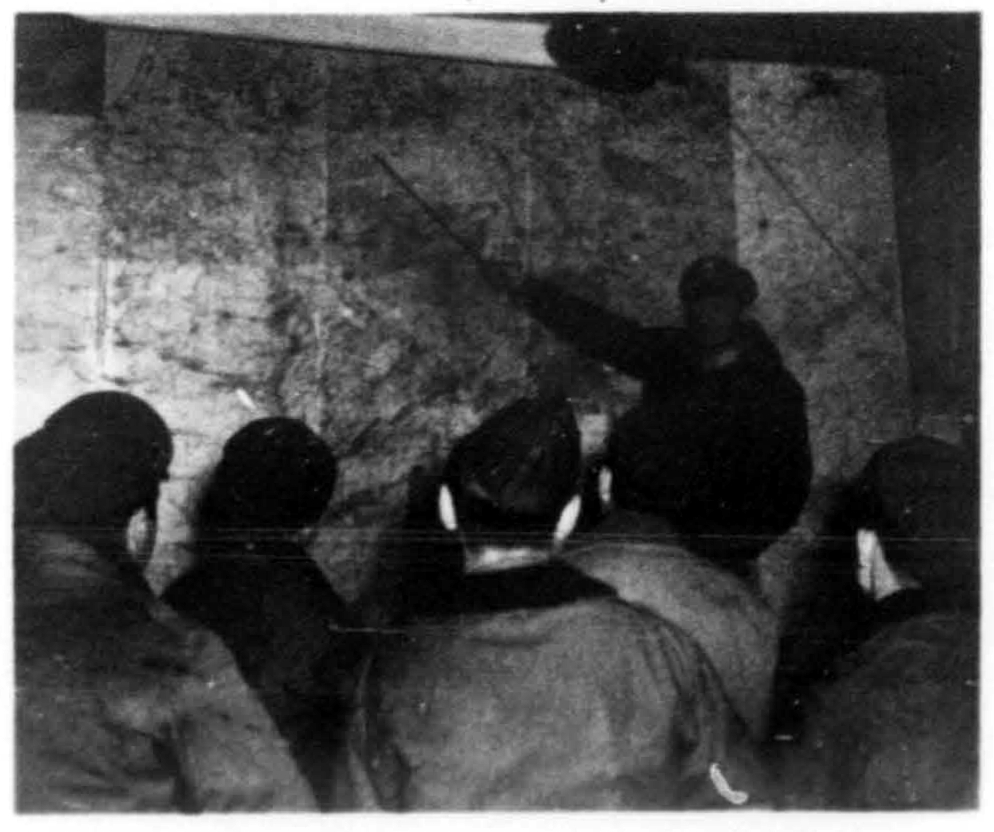
[### Reel A0856 - Page 0706 ###]
APP EXH "Z" PHOTOGRAPH AND PRESS RELEASE ON LT COL BILL E HALE:
A NINTH AIR FORCE BOMBER BASE, Holland: Lt Col Bill E Hale, of Richard City, Tenn, 28 year old commander of the famed B-26 Marauder squadron, "The Trail Blazers", briefs his fliers in preparation for a "blind bombing" attack against a vital objective deep inside Germany. An hour later, his "Trail Blazers" led several formations of Ninth Bombardment Divisions Medium Bombers through almost "impossible" weather to carry out their difficult assignment. The Tennessee colonel has directed "blind bombing" operations since taking command of the squadron in December, 1944. He is the son of Mr and Mrs D F Hale, of Richard City, Tenn. His wife, Mrs Susanne Hale, lives at 1016 Winchester Ave, Ashland. Ky.
[### Reel A0856 - Page 0553 ###]
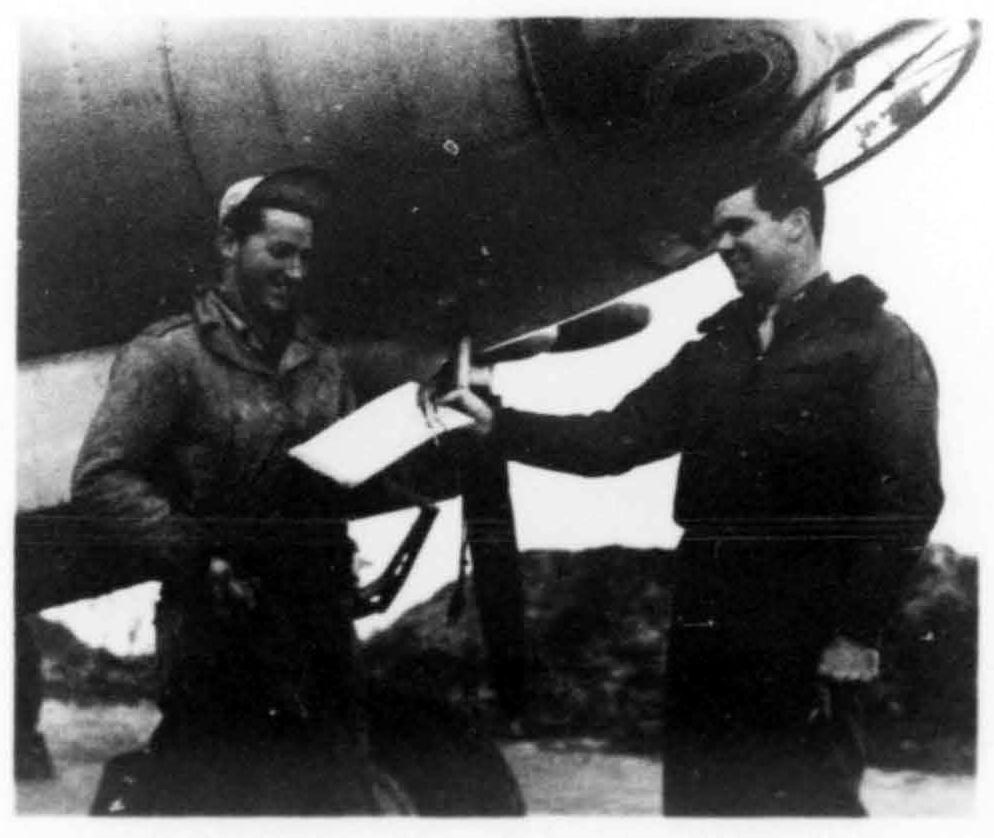
APP EXH "AA". Photograph of 1st Lt Louis H Carrington
[### Reel A0856 - Page 0557 ###]
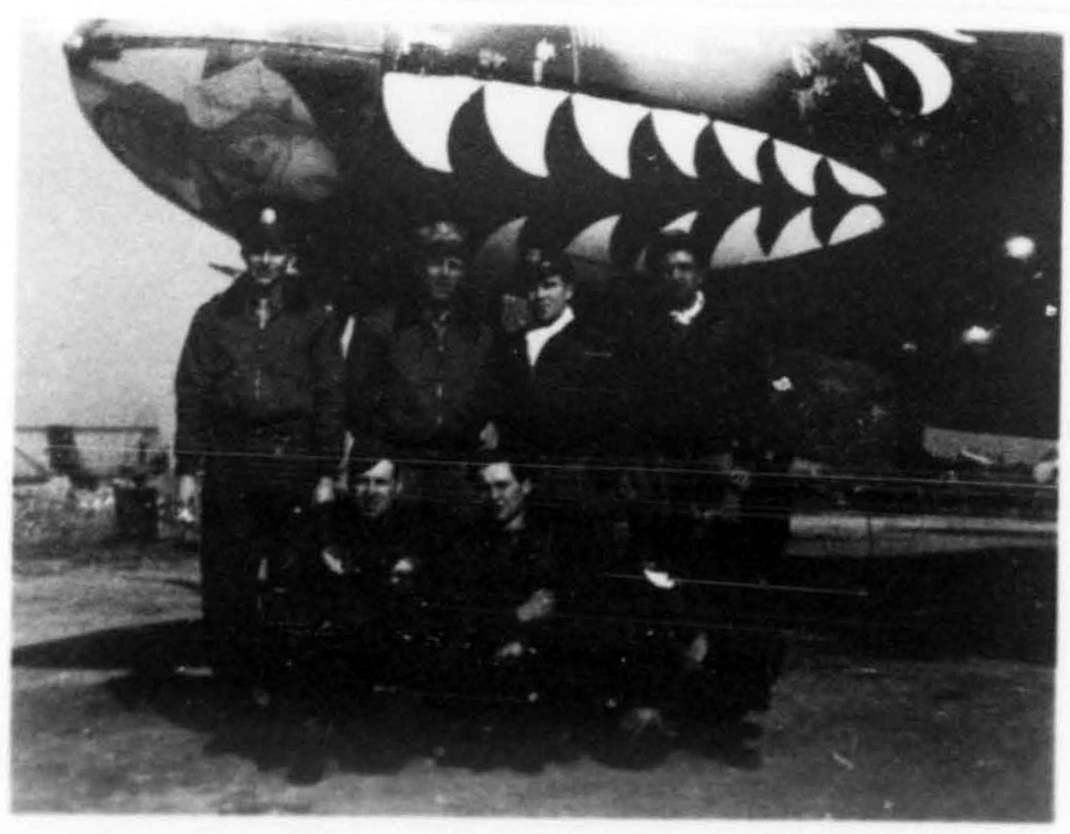
APP EXH "BB". Photograph of crew of Lt R G Johnson with McTavish
[### Reel A0856 - Page 0570 ###]
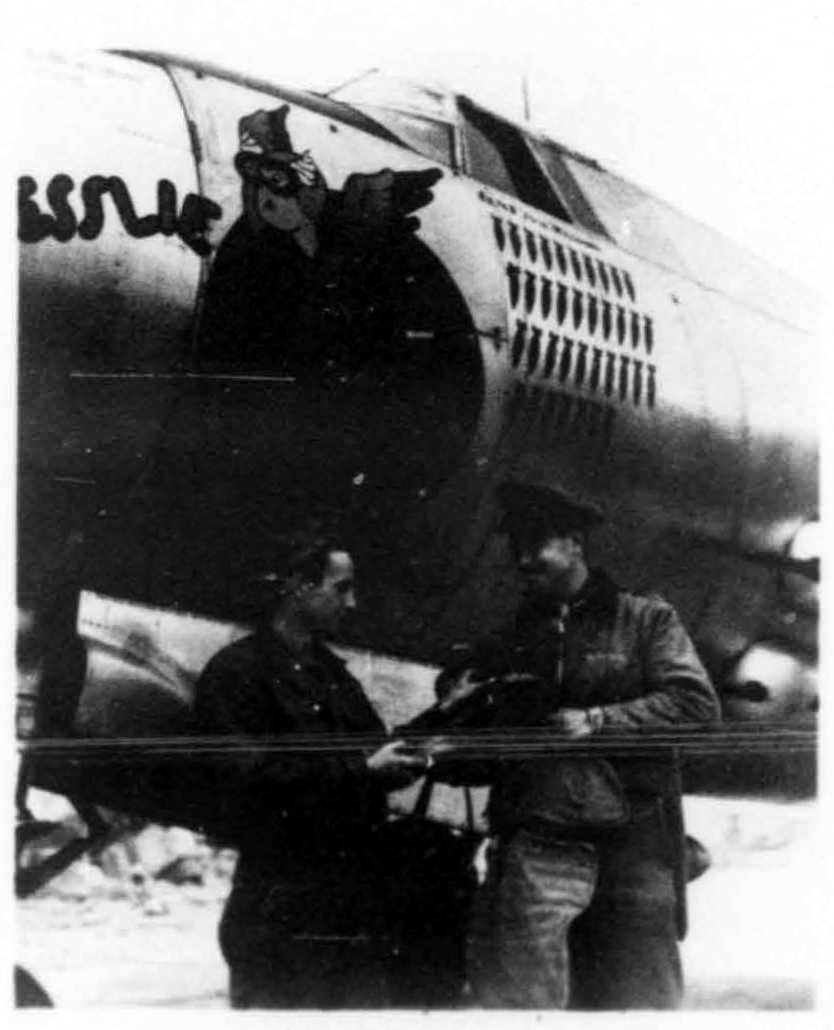
APP EXH "CC". Photograph of Capt J R McAlpin turning in gear
[### Reel A0856 - Page 0707 ###]
APP EXH "DD" PRESS RELEASE ON CAPTAIN MATTHEW H T FERGUSON:
A NINTH AIR FORCE BOMBER BASE, France: In a brief ceremony at a Ninth Air Force bomber base in France, Captain Matthew H T Ferguson, formerly of Cleveland, is shown being congratulated by Major General Samuel E Anderson, after the Ninth Bombardment Division Commander had pinned the Distinguished Flying Cross on the 28 year old Marauder pilot.
Captain Ferguson, whose wife, Mrs. Jane Blyth Ferguson, lives at 13901 Shaker Boulevard, Cleveland, won the award "for extraordinary achievement as pilot of a lead Marauder bomber on a mission flown during the battle of Normandy."
At the presentation - which followed by less than three months the award of the Silver Star in recognition of the flying captain's heroic D-Day act on - the following citation, quoted in part, was read before a formation of Ninth Air Force fliers:
"Despite extremely poor weather which forced all aircraft out of the formation except one flight, Captain Ferguson aggressively continued with the remaining flight and, despite flak damage to his own Marauder, released his bombs on the objective with telling effect."
Throughout his tour of duty - now completed after 55 combat missions - Captain Ferguson led both medium and light bombers through all brands of weather to help maintain the Ninth Air Force offensive during critical days in Western Front operations. Overseas since January, 1944, he now serves as training officer for his squadron, "The Trail Blazers", commanded by Lt Col Bill E Hale of Richard City, Tenn.
[### Reel A0856 - Page 0708 ###]
HEADQUARTERS
9TH AIR DIVISION
G-CW-1
APO 140, US Army
19 May 1945
SPECIAL ORDERS)
NUMBER 10)
EXTRACT
1. The following named pers, 96th Sta Comp Sq, are reld from DS w/1st Pathfinder Sq (Prov), WP proper orgn. No travel involved.
CAPT ARTHUR L BATTSON, O246867
CAPT JACK E DANIELS, O464347
CAPT CARL M HICCINS, O339796
CAPT WILLIAM F McCROME, O410558
1ST LT CHARLES K BETTICE, O862045
1ST LT CHARLES A HELPIG, O561255
M/Sgt (502) Earl E Block, 16008761
M/Sgt (542) Joseph E St. Arnaud, 6134625
M/Sgt (750) Frank L Arena, Jr, 14030226
T/Sgt (014) J C Bowden, 18040119
T/Sgt (097) Edward W Miller, 31358512
T/Sgt (405) Samuel W Hastey, 34353945
T/Sgt (502) Frank G Cornell, 12088821
T/Sgt (502) Charles L Mutter, 14016169
T/Sgt (510) Michael D Dorcik, 19050251
T/Sgt (566) Proson G Barratt, 14024695
T/Sgt (566) Cecil L Stephen, 6293062
T/Sgt (754) Percy E Kennedy, 34610818
T/Sgt (824) George Hastalis, 32516111
S/Sgt (055) Fred V Royals, 34438209
S/Sgt (078) Ralph C Schauer, 36200337
S/Sgt (238) Thomas A Devlin, Jr, 14044256
S/Sgt (405) Lowell J Janke, 37654211
S/Sgt (405) Stephen A Piller, 12088827
S/Sgt (502) Arthur J Waterman, Jr, 39022096
S/Sgt (510) Harold B Thornhill, 34586355
S/Sgt (610) Herman W Young, 32171461
S/Sgt (667) Billy R Land, 18047833
S/Sgt (821) Lewis E Shannon, 34575715
Sgt (055) Joseph G Gilbert, 32442099
Sgt (060) Stephen A McCall, 32389572
Sgt (060) Charles H McVeagh, Jr, 31122939
Sgt (239) Max E Talton, 33196550
Sgt (345) John R Stewart, 18085032
Sgt (405) Wong D Chew, 34402863
Sgt (405) James M Godwin, 18108441
Sgt (405) Robert J Nelles, 36521674
Sgt (405) Herbert A Shanks, 37381787
Sgt (405) Walter E Storey, 34437931
Sgt (747) Joseph L Begley, 18068224
Sgt (747) Richard H Borgfold, 36337820
Sgt (809) Ellston F Allen, 19076934
Sgt (932) Lisle R Hancock, 33151678
Sgt (932) Woodrow W Raper, 39278662
Cpl (055) Azeez Hajjar, 11021337
Cpl (070) John V Brennan, 35200836
Cpl (237) Walter J Forrest, 31131660
Cpl (237) John R Reed, 14136161
Cpl (237) Harold L Reich, 33235980
Cpl (275) David M Elber, 39555649
Cpl (345) Hazen L Amos, 16038920
Cpl (345) John C Bellow, 32396798
Cpl (345) Robert C Coburn, 11042515
Cpl (345) John F McDonald, 31120173
Cpl (345) Anthony R Molina, 39552220
Cpl (405) Albert A Bishop, 33353759
Cpl (495) John A Bodenlos, 35316659
Cpl (495) Frederick S Donaldson, 31299981
Cpl (405) Bernard Ellenberg, 12143144
Cpl (405) Joe T Keesee, 38514305
Cpl (405) John R Miller, 12062708
Cpl (405) Isham B Nichols, 34590719
Cpl (405) Isaac Postar, 6145836
Cpl (405) John E Schmidt, 32708494
Cpl (405) Bernard Sonnenfeld, 12186594
Cpl (502) Raymond E Sampson, 14070380
Cpl (650) Harry C Bachler, Jr, 13151384
Cpl (650) Raymond H Leaver, 37034492
Cpl (667) Eugene M Friedlob, 15081189
Cpl (747) Raleigh G Allen, Jr, 37333627
Cpl (756) Henry A Erbach, 32820105
Cpl (756) Joseph V Martin, 39401714
Cpl (756) William G Weirs, 32403737
Cpl (809) Julius Corsover, 32198776
Cpl (932) Arthur N Branum, 32463214
Cpl (932) Walter V Shelby, 35798246
Pfc (055) Lowell D Bruss, 35792195
Pfc (237) Samuel Roth, 32399943
Pfc (237) Paul Zesblu, 12155979 [Zesblum]
Pfc (238) Robert L Moore, 38465118
Pfc (345) Jesse C Keith, 19114897
Pfc (590) Benedetto DeLuca, 36864971
Pfc (590) Joseph F L Levesque, 31174367
Pfc (590) Joseph Lousigian, 32174722
Pfc (590) William F Nunn, 32309702
Pfc (590) Kenneth G Strange, 11009702
Pfc (650) Clark Alday, 32457236
Pfc (756) Jack A Travis, 20758607
Pfc (901) Joseph H Linge, 15073486
Pfc (901) Parmer C Martin, 34380219
Pfc (932) Michael A Alukonis, 31161053
Pfc (932) Melvin H Hanes, 13137575
Pfc (932) Nolan D Lovell, 38530351
Pfc (932) Raymond J McDonald, 36531680
Pfc (932) Wallace D McQuillin, 15099602
Pvt (345) Samuel Scheichet, 32358667
Pvt (590) Gordon P Alred, 33210054
Pvt (590) William C Hito, 33113301
2. The following named pers, 96th Sta Comp Sq, are asgd, trfd in gr, WP 98th Sta Comp Sq, wlll continue on DS with orgns indicated. No travel involved. EDCMR 23 May 45, Weapon will accompany EM upon transfer.
*** 1ST LT JAMES E CURRAN, O567817, AC
* CAPT ALBERT E BRADBURY, O432866, AC
* CAPT CHARLES S CERVENKA, O387702, ORD
* CAPT EDWARD FELTON, O562988, AC
*** S/Sgt (824) Rueben C Schutz, 36212416
* S/Sgt (060) Lynn H Simmons, 37184292
* S/Sgt (502) Robert L Patterson, 33079877
* T/Sgt (750) Albert M Beebe, 39080708
S/Sgt (805) Eugene F Ley, 12162158
** Sgt (060) Thomas H Kennedy, Jr, 32580030
* Sgt (060) Herman K Sullivan, 34275837
* Sgt (552) Paul S Duffell, 37383045
* Sgt (552) Roland J Wesley, 37203432
* Sgt (862) Wilbur T Jacob, 18208676
* T/4 (667) John C Spires, 34688376
* Cpl (405) David S Schulman, 12159667
* Cpl (521) Alexander B Kuzmanov, 32770647
* Cpl (683) William E S Dyer, 35501279
* Cpl (683) Harold Pikler, 35589839
* Cpl (805) Billy Sims, 18196782
* Pfc (237) Charles H Wetmore, 17130891
* Pfc (237) Oliver H Alpaugh, 35692876
* Pfc (555) Robert B Ehrlich, 42011201
* Pfc (911) Eugene J. O'Toole, 36453806
*** Pvt (137) Jack R Owens, 33662005
* Pvt (757) Alan R Dillon, 12188496
* Pvt (809) Gordon J Muise, 31271616
*** DS w/Air Tech Sv C Lv Hotels, Adv Det, APO 772
** DS w/American Component, Berlin Air Command.
* DS w/Hq & Hq Sq 9th Air Division.
* * * * * *
By command of Major General ANDERSON:
RICHARD C. SANDERS,
Brig Gen, USA,
Chief of Staff.
OFFICIAL:
CARLOS C WARREN,
2nd Lt, Air Corps,
Asst Adj General.
[### Reel A0856 - Page 0710 ###]
APP EXH "GG"
EXTRACT
ESSENTIAL INFORMATION FOR APRIL, 1945. HQ IX BC 21 May 44 par 4b:
1. Organization: Negative
2. Strength: 30 April 1945 2180 O, 589 EM
3. Movements: From Field A-72 to Y-55, per HQ IX BD Secret Movement Orders #32, 23 Apr 45
4 Losses: On 4 April Lt W A Enneking's crew flew in aircraft 903 with the 394th BG to Gross Aspach Supply Depot. On the way to target, one engine failed, and the ship turned back. When it came out of overcast, it was not in good position to make emergency landing, and crashed. Four were killed, two seriously wounded, and one escaped injury.
Pilot: 1 Lt W A Enneking - Killed
Co-Pilot: F/O J T Hassett Jr - Killed
Navigator: F/O R Kasch - Injured
Bombardier: 2 Lt Jerome J Moynihan - Killed
Eng Gunner: Sgt B A Ratto - Injured
Rad Gunner: Sgt W L Benton - Escaped uninjured
Tail Gunner: M/Sgt H M Linden - Killed
5. Awards to and decorations of members of the Squadron are listed in the squadron War Diary for April which accompanies this History. (History for April)
B FRANK WATSON
Captain AC
Squadron Historical officer
20 May 1945
[### Reel A0856 - Page 0711 ###]
AUTH: CG. IX B.C.
DATE: 11 July 44.
INIT:
HEADQUARTERS
IX BOMBER COMMAND
373.2
APO 140. U. S. Army
11 July 1944
SUBJECT: Results of Pathfinder Operations.
TO : Commanding Generals, All Combat Wings, IX Bomber Command.
Commanding Officers, All Bombardment Groups (M), IX Bomber Command,
Commanding Officers, All Bombardment Groups (L), IX Bomber Command.
Commanding Officer, 1st Pathfinder Squadron (M), Provisional.
1. The results obtained in blind bombing operations during the months of May and June, 1944, prove conclusively that the Pathfinder Squadron with its blind bombing technique is a definite supplement to visual bombing when poor weather conditions necessitate its use. The method of use and the results of the Pathfinder technique in this commend can and will be improved as the combat crews of the Pathfinder Squadron gain in experience, as the groups gain confidence in the leadership of the Pathfinder pilot, and as the details of planning on OBOE operation are perfected. It is expected that the month of July will show a definite improvement in Pathfinder results.
2. During the months of May and June, 1944, 2273 aircraft were dispatched on blind bombing operations. Of this number 78% attacked the designated targets while 10% were abortive due to OBOE equipment failure and 7.3% were abortive due to inclement weather. 4.7% of the aircraft dispatched were abortive due to other causes. Of the known bombing results 54.6% were classified as fair, good, or excellent while 44% of the bombing was classified as poor and 1.4% was classified as gross. The average radial error using blind bombing technique during this period was 1125 feet. 13.38% of the aircraft dispatched on blind bombing operations were damaged by flak.
During the same time period 21,040 aircraft ere dispatched to bomb targets by visual means. Of this number, 73% attacked the designated targets while 16% aborted due to inclement weather and 11% were abortive for other reasons. The visual bombing results obtained were 45.6% classified as fair, good, or excellent. 20% of the bombing results wore classified as poor and 10.4% classified as gross. The average radial error with visual bombing technique was 970 feet. 28.3% of the aircraft dispatched on visual bombing operations were damaged by flak.
3. It is most difficult to compare visual results with blind bombing results. Visual bombing is conducted during weather in which the target is not obscured by cloud cover, while blind bombing is conducted usually in completely overcast weather conditions; therefore, visual bombing formations encounter heavier flak barrage and sustain greater flak damage than do blind bombing formations. In blind bombing attacks the routes which may be selected to the target are severely limited by the technique which must be employed in using OBOE equipment. The Pathfinder formation must bomb by boxes of 16 aircraft while the visual formation can be briefed to bomb by flights of 6 aircraft each. Also, blind bombing operations are entirely dependent upon the accuracy of the controlling Ground Stations and the Pathfinder crew as to the success of the bombing results, and it is possible for only one bomb run to be made, while the visual bombing formation may make as many runs on the target as desired in order to perform a good sighting operation. Considering the above stated facts, it is not believed logical to attempt to compare visual bombing with blind bombing but rather to assess blind bombing results for their own worth.
4. Various groups have repeatedly expressed their reluctance in flying a Pathfinder led formation due to the limited evasive action accomplished when on the bombing run, While it is fully appreciated that the Pathfinder aircraft does make a bombing run of approximately nine minutes duration, it is desired to point out that the flak damage in Pathfinder led operations is definitely lower than the flak damage sustained on visual operations. Also, only one aircraft has been lost over enemy territory due to flak.
5. It is emphasized that the final success of a Pathfinder led operation depends upon the following:
a. Perfect operation of Ground Station equipment and aircraft equipment.
b. Good beam flying by the Pathfinder aircraft pilot.
c. Excellent navigation and OBOE equipment operation. (The aircraft must arrive at a definitely assigned point along the OBOE beam within thirty seconds of the times designated. Many operations have been abortive due to the formation being late at the rendezvous point at the English Coast thereby causing the Pathfinder aircraft to begin its bombing run late. It is imperative that the Pathfinder aircraft assume the lead of the formation at the friendly coast out at the exact time designated in IX Bomber Command field order so that the assigned time schedule can be met.)
d. Perfect coordination of the Pathfinder bombardier in hearing the correct release signal and releasing his bombs st that instant.
e. Good formation flying by the group in following the Pathfinder aircraft so that a good bombing concentration can be obtained.
6. Pathfinder operational results will be issued monthly by this command so that the combat wings and groups may be kept fully informed.
By command of Brigadier General ANDERSON:
RICHARD C. SANDERS,
Brigadier General. U.S.A.,
Chief of Staff.
[### Reel A0856 - Page 0713 ###]
APP EXH "II"
COPY OF CITATION ORDER OF 9AF:
HEADQUARTERS
NINTH AIR FORCE
APO 696. U. S. Army
28 October 1944
GENERAL ORDERS)
NUMBER 254)
EXTRACT
BATTLE HONORS
1. Under the provisions of Section IV. Circular Number 353, WD, 1943, the following named units of the Ninth Air Force are cited for outstanding performance of duty in action against the enemy. The citations read as follows;
"The 1st Pathfinder Squadron (M), (Provisional), 9th Bombardment Division (M). For extraordinary performance of duty in action against the enemy in the European Theater of Operations from 13 February to 31 July 1944. As the first American medium Pathfinder squadron to utilize precision blind bombing, the 1st Pathfinder Squadron (M), (Provisional) was responsible for the successful development and establishment of precision bombing as an integral part of medium bombardment technique. Only at the cost of unstinting labor and great hazard was this innovation in operations accomplished. A majority of the missions of the Pathfinder Squadron were undertaken at night or in ten-tenths cloud cover under the most difficult flying conditions, yet the squadron nevertheless achieved an enviable record for leading successful bombing attacks upon vital enemy installations. On 6 June 1944 the 1st Pathfinder Squadron (M), (Provisional) led six missions against highly Important objectives in enemy territory, and despite poor visibility, enabled the full strength of the 9th Bombardment Division (M) to be hurled against the enemy. During the month of July, throughout a most critical period of the Normandy Campaign, the squadron led eighty-seven group missions against heavily defended targets with a success and precision which testified to the outstanding aggressiveness, courage, and technical skill of the members of the organization. The achievements of the 1st Pathfinder Squadron (M), (Provisional) constitute a most valuable contribution to the success of medium bombardment in the European Theater of Operations and are in keeping with the highest traditions of the Army Air Forces."
By command of Major General VANDENBERG:
W. W. MILLARD
Colonel, GSC
C of S
OFFICIAL:
/s/ C. M. SEEBACH
C. M. SEEBACH
Colonel, AGD
Adjutant General
[### Reel A0856 - Page 0714 ###]
HEADQUARTERS
9TH AIR DIVISION
C-CW-1
APO 140, U S Army
16 May 1945
SPECIAL ORDERS)
NUMBER 7)
EXTRACT
* * * * *
6. The fol named pers, 323rd Bomb Gp (M), are reld fr DS w/1st Pathfinder Sqdn (Prov), are further placed on DS w/orgns indicated. Upon completion of DS will ret to proper orgn. TDN by govt MT a/o mil acft. (All AC)
394th BOMB GROUP
CAPT WILFRED L SMITH, O443717
1ST LT LOUIS H CARRINGTON, O550858
1ST LT CHARLES H CLARK, JR, O802724
1ST LT JAMES G DALE, JR, O766219
2ND LT JOHN J O'DONNELL, O2061188
Sgt (612) Frederick C Brock, 14183564
S/Sgt (748) Kenneth L Carroll, 14094599
Sgt (757) Emery L Diamond, Jr, 18126459
T/Sgt (757) Walter E Hicklin, 15062627
Sgt (612) Ulyssis Karitis, 13135465
Sgt (748) Marvin H Juieck, 36859731
S/Sgt (757) John T Lyons, 36617157
T/Sgt (757) Paul E Price, 13042207
T/Sgt (748) Joseph L Raff, 18046352
Sgt (757) George N Shaw, 16079505
T/Sgt (748) Wilmer P Tileston, 19015159
8/Set (612) Wesley VanBuskirk, 39552560
S/Sgt (612) Thomas J Walker, 37089984
397th Bomb Group
CAPT ARTHUR P JOHNSON, O792604
1ST LT OTTO ESSIGMAN, O1995993
1ST LT LEONARD MOKOVER, O2064429
2ND LT ELVIS E BUCHANAN, O2072227
FLT O THOMAS W BEHAN, T129068
FLT O JAMES R VAUGHN, T130471
344th Bomb Group
1ST LT WILLIAM R BANKS, JR, O708910
1ST LT IRWIN R PAASKE, O781387
FLT O JAMES R SOUTHERN, T134254
322nd Bomb Group
1ST LT DAVID E HILL, O1284331
1ST LT JACK D LEGGEE, O732557
1ST LT WESLEY J SIGMAN, O741941
387th Bomb Group
2ND LT ALEXANDER L BLACKWELL, O720140
2ND LT JACK R RAGASDALE, O2061414
FLT O WALTER SIKORA, T125460
7. The following named pers are reld fr asgmt to orgns indicated, reld fr DS w/1st Pathfinder Sqdn, are asgd, trfd in gr, WP orgns indicated. Weapon will accompany pers upon transfer. TDN by govt MT a/o mil acft. EDCMR 21 May 1945.
| * | Reld fr asgmt * * * * * * * | Asgd. Trfd in gr |
|---|---|---|
| CAPT JAMES K COLEMAN, O432181 | 386th Bomb Gp (M) | 322nd Bomb Gp (M) |
| CAPT WILLIAM E FIELDS, O559109 | 391st Bomb Gp (M) | 344th Bomb Gp (M) |
| 1ST LT CLARENCE J ADRIAN, O680589 | 391st Bomb Gp (M) | 394th Bomb Gp (M) |
| 1ST LT JOHN T ALLEN, O673009 | 386th Bomb Gp (M) | 344th Bomb Gp (M) |
| 1ST LT ROBERT BLICKENSTAFF, O715129 | 386th Bomb Gp (M) | 394th Bomb Gp (M) |
| 1ST LT WILLIAM F BROWN, O708919 | 386th Bomb Gp (M) | 397th Bomb Gp (M) |
| 1ST LT JAMES R DOWNING, O669016 | 391st Bomb Gp (M) | 394th Bomb Gp (M) |
| 1ST LT WALTER G DOYLE, Jr, O660466 | 391st Bomb Gp (M) | 344th Bomb Gp (M) |
| 1ST LT WILLIAM M FAGAN, O720392 | 391st Bomb Gp (M) | 397th Bomb Gp (M) |
| 1ST LT HOWARD O HESS, O720505 | 391st Bomb Gp (M) | 394th Bomb Gp (M) |
| 1ST LT JOHN J KELLEY, Jr, O766280 | 391st Bomb Gp (M) | 397th Bomb Gp (M) |
| 1ST LT WILLIAM T KIRTON, O699428 | 391st Bomb Gp (M) | 322nd Bomb Gp (M) |
| 1ST LT JACK B JUNBERGER, O760736 | 391st Bomb Gp (M) | 344th Bomb Gp (M) |
| 1ST LT WILLIAM H LEHFELDT, O718686 | 391st Bomb Gp (M) | 394th Bomb Gp (M) |
| 1ST LT JAMES H LEONARD, O556025 | 386th Bomb Gp (M) | 344th Bomb Gp (M) |
| 1ST LT FRANK L LEPINSKI, O721129 | 391st Bomb Gp (M) | 397th Bomb Gp (M) |
| 1ST LT MONTY I LEVINE, O725453 | 386th Bomb Gp (M) | 344th Bomb Gp (M) |
| 1ST LT BEN M MARTIN, O721156 | 391st Bomb Gp (M) | 394th Bomb Gp (M) |
| 1ST LT MIGUEL A MARTORANI, O815193 | 391st Bomb Gp (M) | 394th Bomb Gp (M) |
| 1ST LT WALTER MATHIS, O662470 | 386th Bomb Gp (M) | 344th Bomb Gp (M) |
| 1ST LT SETH H MATTHEWS, Jr, O392388 | 391st Bomb Gp (M) | 397th Bomb Gp (M) |
| 1ST LT MAURICE S MILLER, JR, O722596 | 386th Bomb Gp (M) | 344th Bomb Gp (M) |
| 1ST LT ROBERT B REHM, O750293 | 386th Bomb Gp (M) | 344th Bomb Gp (M) |
| 1ST LT ASA P STONE, Jr, O672247 | 386th Bomb Gp (M) | 344th Bomb Gp (M) |
| 1ST LT RICHARD M TRESAMER, O475397 | 391st Bomb Gp (M) | 394th Bomb Gp (M) |
| 1ST LT JAMES G VAN PATTEN, O834538 | 386th Bomb Gp (M) | 387th Bomb Gp (M) |
| 1ST LT WILLIAM H WANSTREET, JR, O731706 | 391st Bomb Gp (M) | 397th Bomb Gp (M) |
| 1ST LT DAN A WETHERBEE, Jr, O798623 | 391st Bomb Gp (M) | 322nd Bomb Gp (M) |
| 2ND LT RODNEY H ALLEN, O2062153 | 391st Bomb Gp (M) | 344th Bomb Gp (M) |
| 2ND LT JOHN J ALBERTINES, O2067626 | 391st Bomb Gp (M) | 387th Bomb Gp (M) |
| 2ND LT JULIAN N BROOKS, O713690 | 391st Bomb Gp (M) | 394th Bomb Gp (M) |
| 2ND LT GEORGE CARTER, O2015443 | 386th Bomb Gp (M) | 397th Bomb Gp (M) |
| 2ND LT DANIEL R FULTON, O2063598 | 391st Bomb Gp (M) | 322nd Bomb Gp (M) |
| 2ND LT L B GIBSON, O2063170 | 386th Bomb Gp (M) | 344th Bomb Gp (M) |
| 2ND LT OLIVER L GOODLANDER, O824130 | 391st Bomb Gp (M) | 397th Bomb Gp (M) |
| 2ND LT CHARLES N HUNTSBERGER, O2070272 | 391st Bomb Gp (M) | 344th Bomb Gp (M) |
| 2ND LT JOHN T KEOWN, O700629 | 410th Bomb Gp (L) | 397th Bomb Gp (M) |
| 2ND LT ANGELO A PALOMBI, O724065 | 410th Bomb Gp (L) | 344th Bomb Gp (M) |
| 2ND LT WILLIAM M MARSHALL, O2064427 | 410th Bomb Gp (L) | 344th Bomb Gp (M) |
| 2ND LT ROBERT L HUMAN, O2079976 | 386th Bomb Gp (M) | 344th Bomb Gp (M) |
| 2ND LT WALTER JOHNSON, O777696 | 386th Bomb Gp (M) | 394th Bomb Gp (M) |
| 2ND LT LEONARD G JOST, O2069453 | 391st Bomb Gp (M) | 397th Bomb Gp (M) |
| 2ND LT LEO R KRUPIANIK, O2069454 | 391st Bomb Gp (M) | 394th Bomb Gp (M) |
| 2ND LT GOMER J LEWIS, O2063650 | 391st Bomb Gp (M) | 344th Bomb Gp (M) |
| 2ND LT MARTIN E R LINGLE, O2069456 | 391st Bomb Gp (M) | 344th Bomb Gp (M) |
| 2ND LT LOUIS LIPKIN, O2080730 | 386th Bomb Gp (M) | 387th Bomb Gp (M) |
| 2ND LT ANDREW J MARKEL, O833931 | 391st Bomb Gp (M) | 397th Bomb Gp (M) |
| 2ND LT WILLIAM K MAXON, O766321 | 391st Bomb Gp (M) | 344th Bomb Gp (M) |
| 2ND LT HAROLD O MERRISSON, O2061250 | 391st Bomb Gp (M) | 344th Bomb Gp (M) |
| 2ND LT FREDERICK E MUELLER, O713866 | 391st Bomb Gp (M) | 394th Bomb Gp (M) |
| 2ND LT DALTON H MULLONEY, JR, O833795 | 391st Bomb Gp (M) | 387th Bomb Gp (M) |
| 2ND LT JAMES B MEAR, O928310 | 391st Bomb Gp (M) | 397th Bomb Gp (M) |
| 2ND LT NORMAN J NETT, O834481 | 391st Bomb Gp (M) | 387th Bomb Gp (M) |
| 2ND LT MORRIS PAVEY, O2080771 | 410th Bomb Gp (L) | 387th Bomb Gp (M) |
| 2ND LT ROBERT E PEPPERS, O2080773 | 410th Bomb Gp (L) | 322nd Bomb Gp (M) |
| 2ND LT GURNEY M PHALEN, O2015501 | 391st Bomb Gp (M) | 344th Bomb Gp (M) |
| 2ND LT ROBERT P ROBSON, O2061261 | 386th Bomb Gp (M) | 394th Bomb Gp (M) |
| 2ND LT RAYMOND H RUSSEL, O2080784 | 391st Bomb Gp (M) | 344th Bomb Gp (M) |
| 2ND LT JOSEPH L SAVONI, JR, O2016742 | 391st Bomb Gp (M) | 397th Bomb Gp (M) |
| 2ND LT HAROLD E SCHLEMER, O2080789 | 391st Bomb Gp (M) | 344th Bomb Gp (M) |
| 2ND LT ARTHUR J SCHOENENBERGER, O713560 | 391st Bomb Gp (M) | 387th Bomb Gp (M) |
| 2ND LT ESTIL L SMOLDER, O2016744 | 391st Bomb Gp (M) | 394th Bomb Gp (M) |
| 2ND LT STEVE J SOPOCY, O927925 | 391st Bomb Gp (M) | 394th Bomb Gp (M) |
| 2ND LT MAURICE C SUPERVILLE, O2016759 | 391st Bomb Gp (M) | 397th Bomb Gp (M) |
| 2ND LT HUARD I SYNNESTVEDT, O714753 | 391st Bomb Gp (M) | 322nd Bomb Gp (M) |
| 2ND LT LOWELL W THOMPSON, O2015514 | 391st Bomb Gp (M) | 344th Bomb Gp (M) |
| 2ND LT JOHN O THUTT, O2068238 | 391st Bomb Gp (M) | 344th Bomb Gp (M) |
| 2ND LT TOM H USRY, O2068062 | 391st Bomb Gp (M) | 344th Bomb Gp (M) |
| 2ND LT FRED VIROSTKO, O819432 | 391st Bomb Gp (M) | 397th Bomb Gp (M) |
| 2ND LT ANTHONY H ZACK, O705515 | 386th Bomb Gp (M) | 397th Bomb Gp (M) |
| FLT O HARVEY W CONNER, T132565 | 391st Bomb Gp (M) | 344th Bomb Gp (M) |
| FLT O PAUL L SMETANKA, T139278 | 410th Bomb Gp (L) | 322nd Bomb Gp (M) |
| FLT O THOMAS H WARD, T139301 | 410th Bomb Gp (L) | 387th Bomb Gp (M) |
| T/Sgt Lester J Alexander, 38099302 | 386th Bomb Gp (M) | 387th Bomb Gp (M) |
| Sgt (612) Robert L Biel, 35488598 | 391st Bomb Gp (M) | 387th Bomb Gp (M) |
| Sgt (757) Clyde D Bond, 35518814 | 391st Bomb Gp (M) | 387th Bomb Gp (M) |
| S/Sgt (612) Vance H Brady, 36514571 | 391st Bomb Gp (M) | 387th Bomb Gp (M) |
| Sgt (612) George P Brown, 36894432 | 391st Bomb Gp (M) | 322nd Bomb Gp (M) |
| Sgt (748) John T Brown, 16030541 | 391st Bomb Gp (M) | 387th Bomb Gp (M) |
| Sgt (612) Joseph P Burns, 32760769 | 391st Bomb Gp (M) | 387th Bomb Gp (M) |
| Sgt (748) Daniel E Coleman, 34769163 | 391st Bomb Gp (M) | 387th Bomb Gp (M) |
| Sgt (757) Jessie F Davenport, Jr, 38540609 | 391st Bomb Gp (M) | 387th Bomb Gp (M) |
| T/Sgt (748) Joseph Dranchak, 32197346 | 391st Bomb Gp (M) | 394th Bomb Gp (M) |
| T/Sgt (757) Charles S DiMaggio, 32197346 | 386th Bomb Gp (M) | 387th Bomb Gp (M) |
| S/Sgt (748) Raymond D Floyd, 32290505 | 391st Bomb Gp (M) | 394th Bomb Gp (M) |
| Sgt (612) Robert E Gill, 31114216 | 391st Bomb Gp (M) | 387th Bomb Gp (M) |
| Sgt (612) Arthur W Hamilton, 13188343 | 391st Bomb Gp (M) | 387th Bomb Gp (M) |
| Sgt (748) John W Hendricks, 37520324 | 391st Bomb Gp (M) | 394th Bomb Gp (M) |
| T/Sgt (757) James A Herrin, 19098631 | 391st Bomb Gp (M) | 387th Bomb Gp (M) |
| S/Sgt (612) Harold E Horney, 16135132 | 386th Bomb Gp (M) | 387th Bomb Gp (M) |
| S/Sgt (757) George B Irick, 18192403 | 391st Bomb Gp (M) | 387th Bomb Gp (M) |
| S/Sgt (748) Rex W Kates, 38468542 | 386th Bomb Gp (M) | 387th Bomb Gp (M) |
| Sgt (757) Wendell E Kent, 36687395 | 391st Bomb Gp (M) | 387th Bomb Gp (M) |
| Sgt (748) Arthur H May, 34520803 | 391st Bomb Gp (M) | 387th Bomb Gp (M) |
| Pvt (612) Maurice J McDonald, 11132828 | 391st Bomb Gp (M) | 394th Bomb Gp (M) |
| S/Sgt (612) William C Kiefer, 12126869 | 391st Bomb Gp (M) | 387th Bomb Gp (M) |
| Sgt (612) Howard F Kirk, Jr, 34766912 | 391st Bomb Gp (M) | 394th Bomb Gp (M) |
| S/Sgt (757) Donald Kulwin, 16169001 | 391st Bomb Gp (M) | 344th Bomb Gp (M) |
| S/Sgt (757) Louis G Laborie, 18151664 | 391st Bomb Gp (M) | 387th Bomb Gp (M) |
| Sgt (612) John A MacDonald, 36826054 | 391st Bomb Gp (M) | 394th Bomb Gp (M) |
| Sgt (748) Raymond F Mensching, 16081467 | 391st Bomb Gp (M) | 387th Bomb Gp (M) |
| Sgt (757) Frederick P Mayer, 39264093 | 391st Bomb Gp (M) | 387th Bomb Gp (M) |
| Sgt (612) Domenic Milano, 13176799 | 391st Bomb Gp (M) | 387th Bomb Gp (M) |
| Sgt (748) Bennie F Miller, Jr, 38540363 | 391st Bomb Gp (M) | 387th Bomb Gp (M) |
| Sgt (612) Forrest W Montanye, 31336518 | 391st Bomb Gp (M) | 394th Bomb Gp (M) |
| Sgt (757) John F Montoya, 38352328 | 391st Bomb Gp (M) | 387th Bomb Gp (M) |
| Sgt (757) William F Moore, 38538902 | 391st Bomb Gp (M) | 387th Bomb Gp (M) |
| S/Sgt (612) John R Morris, 20949003 | 386th Bomb Gp (M) | 394th Bomb Gp (M) |
| Sgt (748) William G Nichols, 32941921 | 391st Bomb Gp (M) | 394th Bomb Gp (M) |
| S/Sgt (612) William D Pipper, 37469560 | 386th Bomb Gp (M) | 394th Bomb Gp (M) |
| Sgt (748) Milton C Ploss, 35665185 | 391st Bomb Gp (M) | 387th Bomb Gp (M) |
| T/Sgt (612) Herbert C Prichard, 18040544 | 391st Bomb Gp (M) | 394th Bomb Gp (M) |
| Sgt (748) Murl W Reaves, 34808884 | 391st Bomb Gp (M) | 394th Bomb Gp (M) |
| T/Sgt (757) James J Roberts, 37472677 | 386th Bomb Gp (M) | 344th Bomb Gp (M) |
| Sgt (612) Aldon D Rose, 39692513 | 391st Bomb Gp (M) | 387th Bomb Gp (M) |
| Sgt (757) Robert T Ryan, 32585950 | 391st Bomb Gp (M) | 387th Bomb Gp (M) |
| Sgt (757) Fred W Schenk, 32773208 | 391st Bomb Gp (M) | 394th Bomb Gp (M) |
| Sgt (757) Walter Sewock, 13115889 | 391st Bomb Gp (M) | 387th Bomb Gp (M) |
| Sgt (748) John L Shirkey, 35656772 | 391st Bomb Gp (M) | 387th Bomb Gp (M) |
| Sgt (748) Charles J Thornhill, 39133173 | 391st Bomb Gp (M) | 387th Bomb Gp (M) |
| Sgt (757) Robert B Trull, 16153954 | 391st Bomb Gp (M) | 394th Bomb Gp (M) |
| Sgt (612) Theodore Turkan, 36864102 | 391st Bomb Gp (M) | 394th Bomb Gp (M) |
| Sgt (748) James P Walsh, 36344025 | 391st Bomb Gp (M) | 394th Bomb Gp (M) |
| T/Sgt (757) Jack Wolfe, Jr, 16066208 | 386th Bomb Gp (M) | 394th Bomb Gp (M) |
| Sgt (748) Harold R Mascho, 33610434 | 391st Bomb Gp (M) | 394th Bomb Gp (M) |
| Sgt (612) Ralph R Matt, 35067798 | 391st Bomb Gp (M) | 394th Bomb Gp (M) |
By command of Major General ANDERSON:
RICHARD C. SANDERS,
Brig Gen, USA,
Chief of Staff.
[OFFICIAL:]
S. L. PARMENTER,
Captain, Air Corps,
Asst Adj General.
DISTRIBUTION "D"
[### Reel A0856 - Page 0717 ###]